Wild Tulip by William Morris
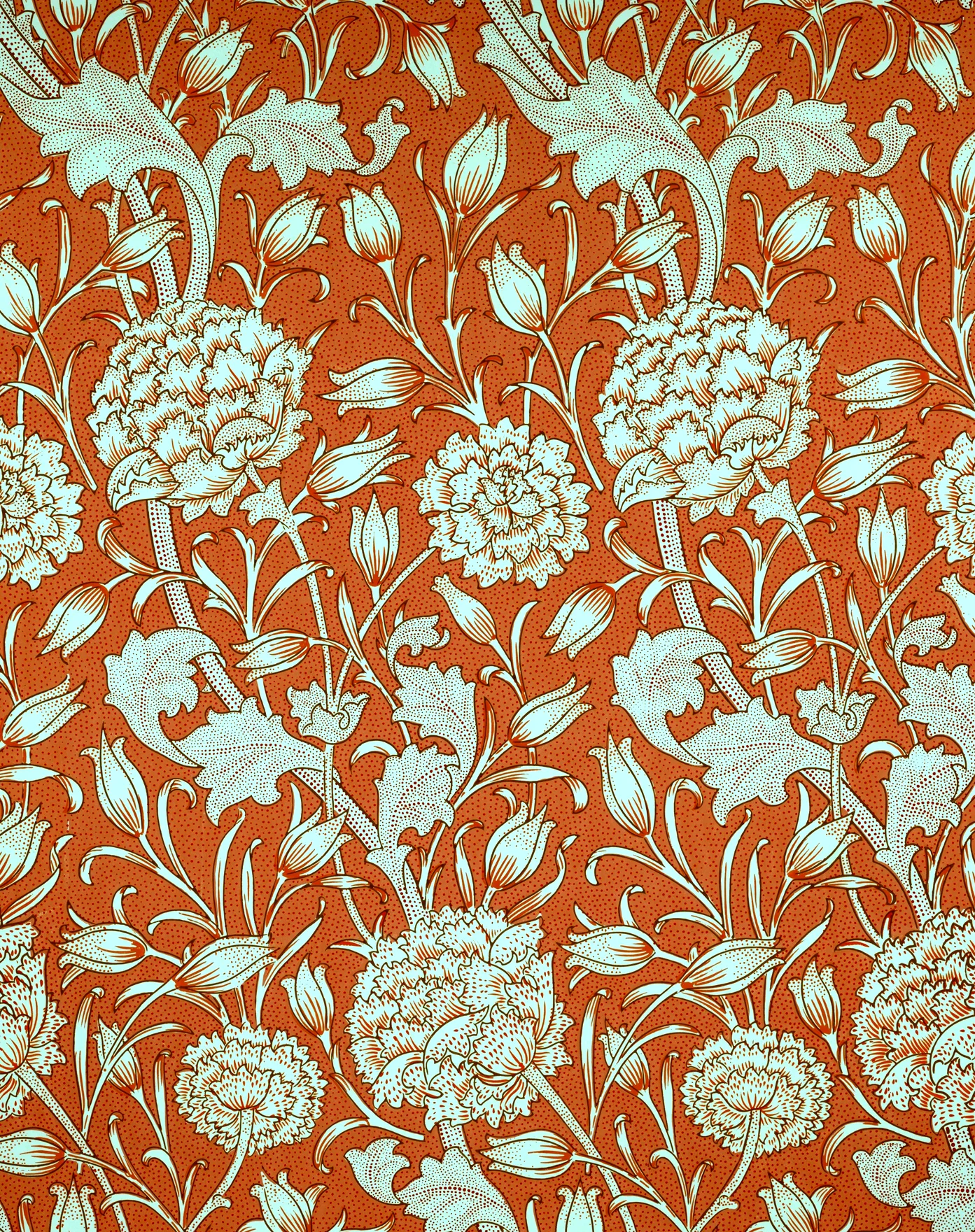
Wild Tulip by William Morris is an 1884 floral wallpaper pattern featuring dense blooms, scrolling leaves, and slender tulip buds set against a dotted terracotta ground.
| Designed | 1884 |
|---|---|
| Designer | William Morris |
| Type | wallpaper |
| Motifs | flowers |
| Colourway | Terracotta |
| Repeat | 5 × 24 in |
| Source | The Metropolitan Museum of Art. Licence: CC0. Museum record |
Order Wild Tulip as a print
Format
Size (inches)
$40
Made to order. Shipping included in the US.
Seamless pattern file
One repeat tile, ready to fill any size in design software.
What Wild Tulip shows
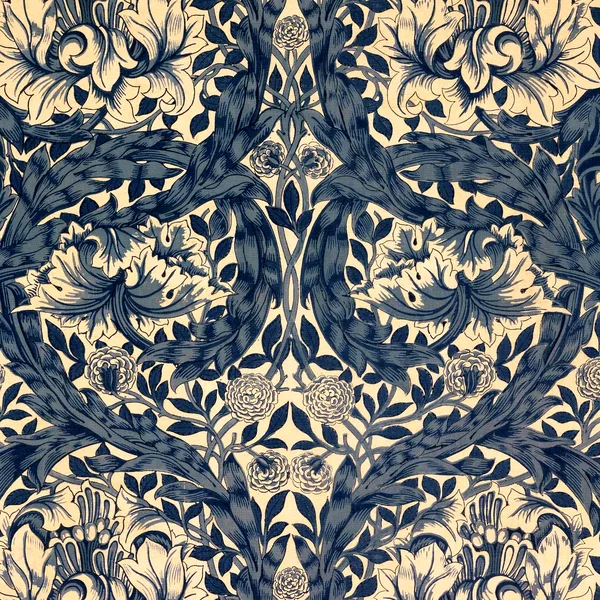
Wild Tulip by William Morris displays a dense, energetic field of garden flowers and foliage. Broad, circular ruffled blossoms anchor the composition. These large blooms look like double-petaled flowers with layered, feathered edges. Winding around them are slender stems carrying pointed tulip buds at various stages of opening. Some buds stand upright on delicate stalks, while others nod gently to the side.
Broad acanthus-style leaves curl and twist through the foreground and midground. The foliage features finely serrated edges and distinct vein details that give the plants a lively, organic rhythm. A thick, stippled stem arches upward through the pattern, reinforcing the vertical movement of the botanical network. In the background, a fine field of tiny dots covers the warm, earthy base. This stippled ground softens the space behind the pale floral motifs and gives the entire surface a rich, textured depth.
Who designed it and when
William Morris designed Wild Tulip in 1884. By this time, Morris was a master of repeating pattern construction, having spent decades studying historical textiles and natural flora. You can read more about his career and artistic philosophy in our guide to William Morris, life and work.
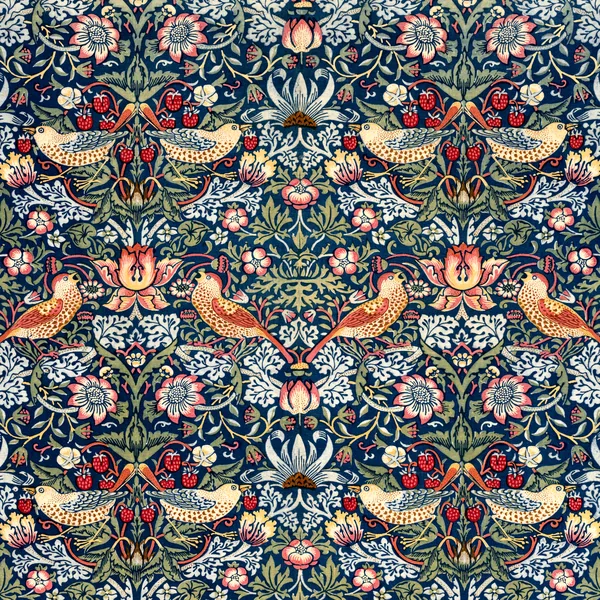
While some popular patterns sold under the Morris name were created by his apprentice John Henry Dearle or his daughter May Morris, museum records confirm that Wild Tulip is an authentic work by Morris himself. You can browse our complete collection of every William Morris design to see how his floral arrangements evolved over time alongside later patterns like Strawberry Thief.
How it was made and used
Morris created Wild Tulip as a wallpaper. Like his other wall coverings, it was originally block-printed using hand-carved woodblocks. The printer pressed each block onto long rolls of paper, applying the pigments by hand to ensure crisp line work and uniform coverage across the repeating rhythm.
In Victorian homes, wallpapers like Wild Tulip brought the beauty of English gardens indoors. Morris believed in covering living rooms, dining halls, and hallways with rhythmic natural patterns that provided interest without overwhelming the room. The upright growth of the tulips and scrolling leaves creates a vertical flow that naturally draws the eye upward along an interior wall.
Colourways
On this site, Wild Tulip is available in one colourway: Terracotta. This colourway is based on a public-domain museum scan of an original 1884 wallpaper printing held in the collection of the Metropolitan Museum of Art.
The Terracotta colourway pairs a warm, reddish-orange rust ground with cool, pale mint-tinted flowers and leaves. The stippled dots across the ground add warmth, while dark outlines define every leaf petal and stem. The balance between the warm background and the cool foliage makes the intricate linework stand out clearly across the surface.
Wild Tulip as a print
Wild Tulip works well as standalone wall art. All prints are printed and shipped by ArtsyWall in three formats: Archival Paper, Premium Canvas, and Framed Canvas.
Archival Paper is an unframed, heavyweight 340gsm cotton rag paper that highlights the fine stippling and delicate linework of the drawing. Premium Canvas is hand-stretched over solid wood bars with a clean gallery wrap. Framed Canvas places the canvas inside a wooden floating frame, available in black, white, gold, silver, walnut, and oak. When framed, the contrasting tones of the pale blossoms and terracotta ground create a strong, tailored focal point for any wall.
Want Wild Tulip on a whole wall? See Wild Tulip wallpaper, sized to your wall.
Questions and answers
Who designed Wild Tulip?
William Morris designed Wild Tulip in 1884 as a wallpaper pattern. The design features lush garden blooms and curving foliage. While several later patterns from Morris & Co. were designed by John Henry Dearle, museum records confirm that Wild Tulip is an original design by Morris himself.
When was Wild Tulip designed?
Wild Tulip was designed in 1884. William Morris created the pattern during an active period of wallpaper production. The design is now in the public domain, and high-resolution museum scans of the original 1884 printing are preserved in collections such as the Metropolitan Museum of Art.
What does the Wild Tulip pattern show?
The Wild Tulip pattern shows large, ruffled circular blooms surrounded by upright and nodding tulip buds on curving stems. Serrated, curled acanthus leaves wind through the composition, while a stippled dot texture fills the terracotta ground between the pale botanical forms.
Was Wild Tulip a wallpaper or a fabric?
Wild Tulip was produced as a wallpaper. William Morris designed it in 1884 specifically for interior wall coverings rather than as a woven textile or printed chintz. Today, you can also display the pattern as an individual wall art print on paper or canvas.