The Arts and Crafts Movement: William Morris and the Return to Handwork
The Arts and Crafts movement was an international decorative and fine arts trend that began in Britain during the 1880s. Championed by William Morris, it rejected factory production in favor of traditional handcraftsmanship and natural pattern design.
What the Arts and Crafts movement was
The Arts and Crafts movement was an international trend in the decorative and fine arts that began in the British Isles during the 1880s. It developed in reaction against the perceived impoverishment of the decorative arts and the factory conditions of industrial production. The movement flourished across Europe and North America between about 1880 and 1920, establishing a design philosophy centered on handwork, integrity of materials, and natural beauty.
The phrase itself was coined in 1887 by bookbinder T. J. Cobden-Sanderson during a meeting of the Arts and Crafts Exhibition Society in London. Even though the official name appeared in the late 1880s, the core ideas had developed across England for at least twenty years. Early reformers criticized the manufactured objects displayed at the Great Exhibition of 1851, which they considered excessively ornate, vulgar in detail, and ignorant of basic materials. The movement sought to replace those industrial goods with useful, well-made domestic furnishings.
By uniting design with social reform, the movement argued that healthy living required satisfying work and honest surroundings. Its adherents did not treat ornament as a superficial layer applied to an object. Instead, they demanded that decoration serve the object, respecting the structure and the surface.
Origins: Ruskin and Morris
The intellectual origins of the movement began with design reformers of the mid-19th century. Figures like Owen Jones, Richard Redgrave, Matthew Digby Wyatt, and Henry Cole deplored the items at the 1851 Great Exhibition. Jones argued that ornament must be secondary to the object decorated and that patterns on carpets and wallpapers should remain flat rather than mimic three-dimensional space. Architect Augustus Pugin also laid groundwork by praising medieval craftsmanship and demanding truth to material and structure.
Art critic John Ruskin gave these aesthetic complaints a moral foundation. Ruskin connected the social health of a nation to the conditions of its labor. He viewed the division of labor in modern factories as servile and dehumanizing, arguing that true dignity came when workers designed the objects they made by hand. Ruskin believed factory-made goods were dishonest because they hid human effort beneath machine polish.
Designer William Morris translated Ruskin’s ideas into commercial practice. In the 1850s at Oxford, Morris formed the Birmingham Set with Edward Burne-Jones, reading Ruskin and Thomas Carlyle while studying medieval art. In 1861, Morris founded the decorative arts firm Morris, Marshall, Faulkner & Co. alongside Burne-Jones, Philip Webb, Dante Gabriel Rossetti, and Charles Faulkner. The firm produced handcrafted furniture, stained glass, textiles, and wallpapers. Morris insisted on mastering techniques such as woodblock cutting, dyeing, and weaving before directing his workshops. He argued that without creative human occupation, people became disconnected from life.
Key ideas
The Arts and Crafts movement linked artistic standards directly to the welfare of the worker. Its philosophy rested on several shared principles:
- Joy in labor: Handcraftsmanship combined creative thought with physical work, replacing the repetitive division of labor found in modern factories.
- Truth to materials: Objects showcased the natural qualities of wood, wool, silk, stone, or clay, often leaving surfaces unfinished or hammered to reveal the maker’s technique.
- Simplified, flat ornament: Wallpapers and textiles featured stylized natural forms without artificial perspective or realistic shading.
- Unity of the arts: Architecture, furniture, textiles, and domestic utensils formed a single, harmonious living environment.
- Medieval inspiration: Designers looked to the Middle Ages as an era when independent craftspeople took pleasure in their daily production.
Attitudes toward machinery varied among practitioners. Morris attacked industrial factories and capitalism, but he was willing to use machines when they met his quality standards or reduced drudgery. His associate C. R. Ashbee welcomed the machine as long as workers mastered it rather than letting it control production. Some designers, like Walter Crane, argued that designer and maker must be the same person. Others, like Lewis Foreman Day, believed separating design from execution allowed each craftsperson to excel in their specialty.
The makers and the guilds
To promote handcrafts, practitioners formed guilds and cooperative associations across Britain. In 1882, architect A. H. Mackmurdo formed the Century Guild to bring together designers, metalworkers, and sculptors. In 1884, five young architects established the Art Workers Guild to raise the status of the applied arts alongside painting and sculpture. By 1890, the Art Workers Guild counted 150 members, and the organization still operates today.
The Arts and Crafts Exhibition Society formed in 1887 with Walter Crane as president. In November 1888, the society held its first major public exhibition at the New Gallery in London, displaying furniture, carpets, embroideries, and textiles from Morris & Co. The society credited individual craftspeople by name in its catalogues, highlighting the makers behind each design.
In 1888, C. R. Ashbee established the Guild and School of Handicraft in east London before relocating fifty craftsmen to Chipping Campden in the Cotswolds in 1902. The guild produced hammered silver tableware, jewelry with simple stone settings, and woodwork. Between 1895 and 1905, around 130 craft organizations emerged across Britain, including the Home Arts and Industries Association, which ran training classes in rural areas.
Architect C. F. A. Voysey achieved wide acclaim with simple, elegant furniture and flat pattern designs featuring birds and plants with clear outlines. Department stores like Liberty, founded in 1875, brought the style and artistic dress to an expanding middle-class public.
Arts and Crafts beyond Britain
The movement spread rapidly from England across the British Empire, Europe, and North America. In Scotland, the movement centered on the Glasgow School of Art and the work of Charles Rennie Mackintosh, who developed stylized motifs such as the Glasgow rose. In Wales, interest turned toward traditional salt-glazed ceramics at the Ewenny Pottery and ancient building techniques like rammed earth. Irish practitioners revived Celtic motifs in metalwork, stained glass, and hand-carved furnishings, seen in buildings like the Honan Chapel in Cork.
In continental Europe, designers adopted the movement’s principles to celebrate local vernacular traditions. Belgian architects Henry van de Velde and Gustave Serrurier-Bovy drew direct inspiration from English designs. In Austria, Josef Hoffmann and Koloman Moser founded the Wiener Werkstätte in 1903 on the ideal of handwork and unified interior design. In Germany, the Deutscher Werkbund formed in 1907 to link craftspeople with modern industry. In Hungary, architects like Károly Kós drew on Transylvanian peasant building traditions, while the Abramtsevo Colony in Russia revived medieval decorative arts.
In the United States, the movement flourished as the American Craftsman style between 1910 and 1925. Gustav Stickley popularized simple oak furniture and rustic interiors through his magazine, The Craftsman, while Elbert Hubbard built a craft community at the Roycroft campus in New York. In Japan during the 1920s, philosopher Yanagi Soetsu and potter Bernard Leach developed the related Mingei movement to honor traditional folk crafts.
How to recognise Arts and Crafts design
You can identify Arts and Crafts design by its clear relationship between ornament, material, and function. Unlike the ornate, heavily molded surfaces common in earlier Victorian homes, Arts and Crafts objects emphasize straightforward construction.
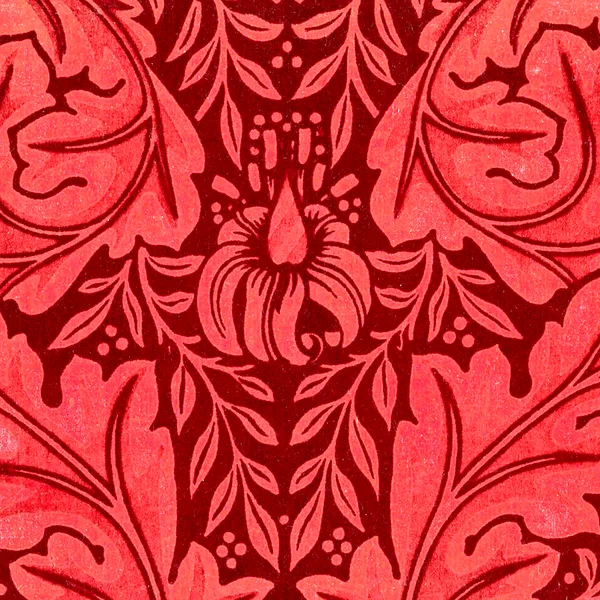
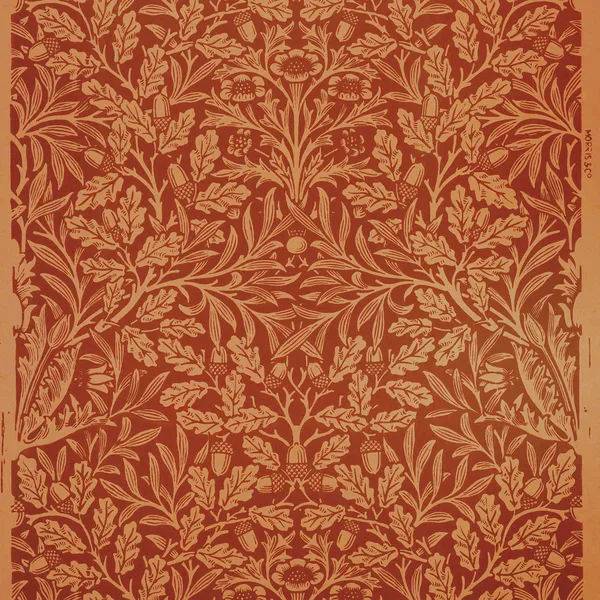
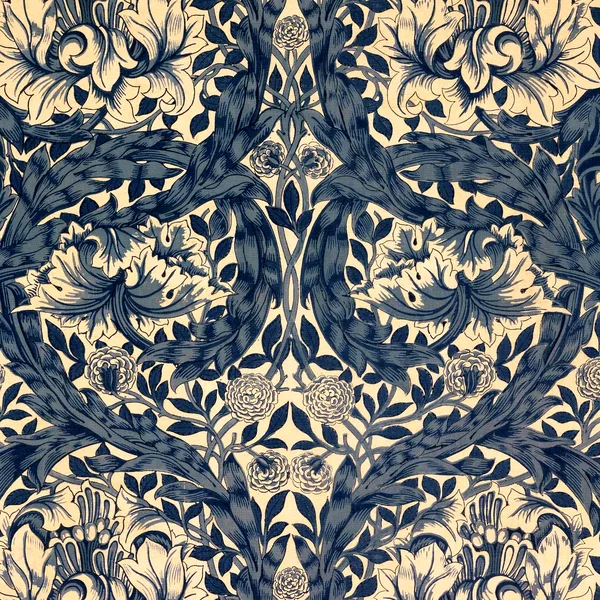
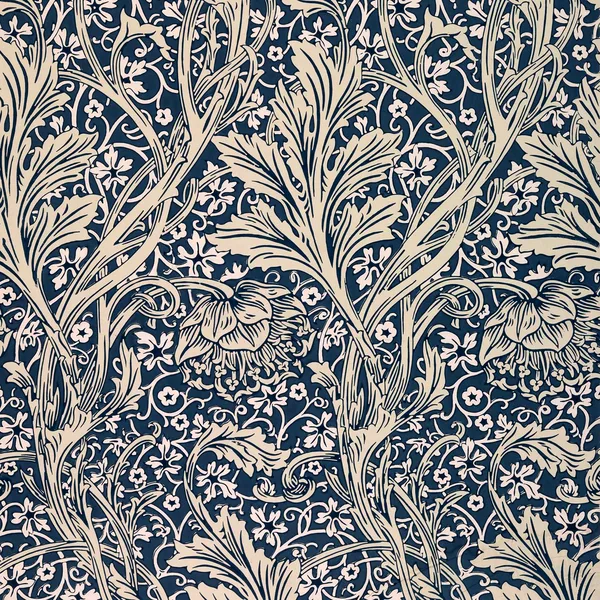
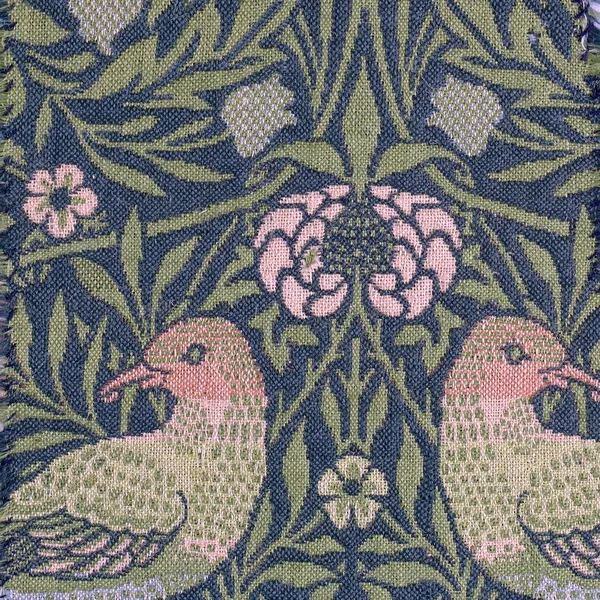
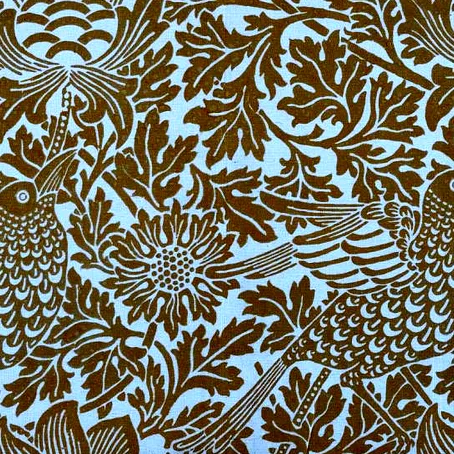
When examining a wallpaper or printed fabric in this style, look for these specific visual characteristics:
- Stylized natural motifs: Patterns feature recognizable garden flowers, native trees, birds, and river plants rather than exotic tropical species.
- Flat surface patterns: Stems and foliage flow across the surface without deep perspective, artificial shadows, or trompe l’oeil tricks.
- Rhythm and repeat: Stems meander or climb in organized diagonal, trellis, or vertical structures that repeat smoothly over large areas.
- Layered detail: Primary flowers and foliage often sit over an intricate background pattern of delicate willow twigs or small blossoms.
- Traditional color palettes: Colors reflect natural dye methods, using soft indigo blues, madder reds, sage greens, and warm terracottas.
Furniture pieces show exposed joinery, plain oak grain, rush seats, and hand-hammered metal hinges. Metalwork in silver, brass, or copper retains hammer marks, pairing clean outlines with enamel or unpolished gemstones.
Arts and Crafts patterns on your wall
Bringing Arts and Crafts patterns into your home connects your walls to this tradition of natural design and honest craftsmanship. You can explore individual patterns, original designers, and production dates in our complete index of designs.
Our collection of William Morris wall art lets you display these historic patterns as individual framed or unframed prints. Every print is printed and shipped by ArtsyWall in your choice of three formats: Archival Paper, Premium Canvas, or Framed Canvas. You can also download seamless vector and high-resolution raster pattern files to incorporate these balanced botanical repeats into your own custom interior decorating projects.
Designs in this guide
Questions and answers
What is the Arts and Crafts movement?
The Arts and Crafts movement was an international trend in decorative and fine arts that began in the British Isles during the 1880s and flourished until around 1920. Initiated as a reform movement against factory production, it emphasized traditional handcraftsmanship, the moral value of labor, and decorative motifs drawn directly from nature.
Who started the Arts and Crafts movement?
The movement grew from the social criticism of Thomas Carlyle and John Ruskin, but designer William Morris served as its primary practical leader. In 1887, bookbinder T. J. Cobden-Sanderson coined the actual name at a meeting of the newly formed Arts and Crafts Exhibition Society, which included artists such as Walter Crane.
When was the Arts and Crafts movement?
The Arts and Crafts movement flourished between roughly 1880 and 1920. The underlying design principles developed in England across the 1860s and 1870s, the official name appeared in 1887, and the style had largely ended in Britain by the close of the First World War.
What are the characteristics of Arts and Crafts design?
Arts and Crafts design is defined by flat, stylized patterns drawn from local flora and fauna, visible construction, and honest use of natural materials. Designers avoided the three-dimensional illusions of early Victorian machine manufacture, favoring balanced repeating structures, rustic simplicity, and traditional techniques such as hand-block printing and hand weaving.
What is the difference between Arts and Crafts and Art Nouveau?
Arts and Crafts emphasized medieval traditions, simple vernacular forms, and handwork while rejecting industrial materials. Art Nouveau favored fluid, asymmetrical whiplash curves and embraced modern industrial materials such as structural iron. Arts and Crafts practitioners openly criticized Art Nouveau for relying on these factory-made components in decorative schemes.