Bird and Anemone by William Morris
Bird and Anemone is an 1881 textile pattern designed by William Morris, featuring speckled birds set among large anemone flowers and deeply cut leaves.
Colourways
| Designed | 1881 |
|---|---|
| Designer | William Morris |
| Type | textile |
| Motifs | birds, flowers |
| Colourway | Blue |
| Repeat | not measured |
| Source | Cooper Hewitt, Smithsonian Design Museum. Licence: CC0. Museum record |
Order Bird and Anemone as a print
Format
Size (inches)
$40
Made to order. Shipping included in the US.
Seamless pattern file
A repeat tile of this design, ready to fill any size in design software.
What Bird and Anemone shows
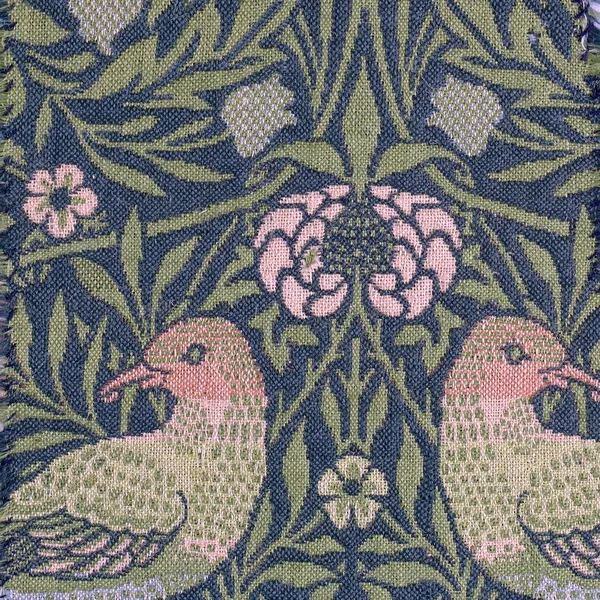
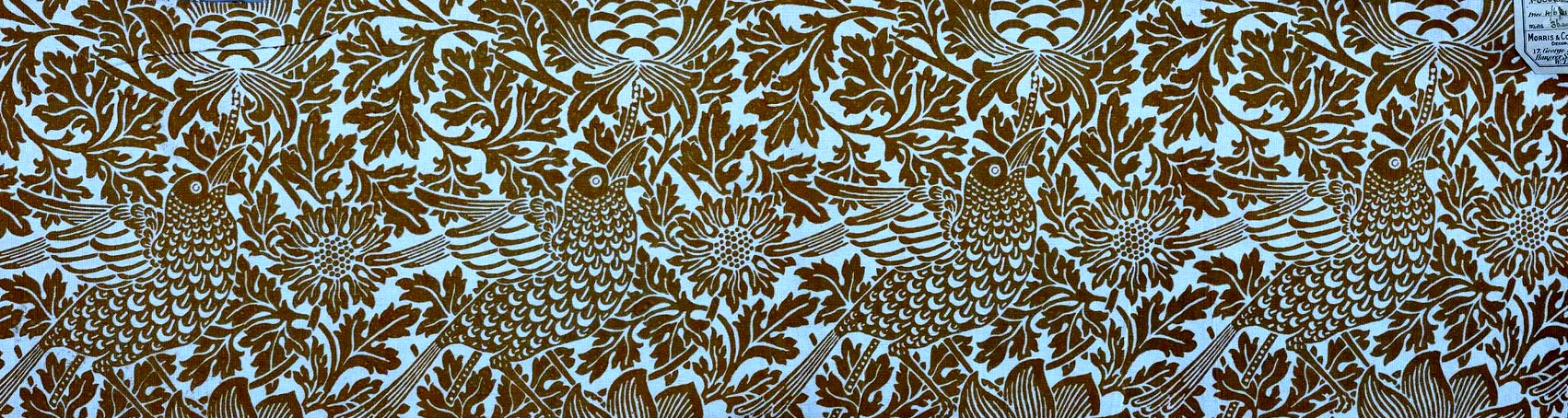
Bird and Anemone by William Morris presents a dense, two-tone pattern of wild birds and stylized botanical elements. The composition centers on small birds perched on slender branches or caught mid-flight among the foliage. The birds feature distinctive scalloped markings that resemble rounded scales across their breasts and backs, with long, banded wing and tail feathers that stretch across the ground.
Between the birds, large anemone flowers bloom in varying stages. Some blossoms appear head-on with radiating petals and round seed centers covered in dots. Other blooms are shown from the side, revealing cup-shaped forms with layered calyxes and curved petal tips. The remaining space is filled entirely with deeply lobed, serrated leaves and curling stems that weave in and out behind the primary figures, creating a rich visual rhythm with no large empty gaps.
Who designed it and when
William Morris designed the pattern. As a core piece in the broader collection of every William Morris design, it reflects the artist’s focus on British wildlife and garden flora. To learn more about his background and work across decorative arts, read our guide to William Morris.
The site design record dates Bird and Anemone to 1881. However, the Cooper Hewitt museum records for the physical textile specimens state “designed 1882.” When records disagree, the sources differ regarding the exact year of initial composition versus subsequent printing dates. While Cooper Hewitt records credit the firm Morris & Co., the design itself is credited by title to William Morris.
How it was made and used
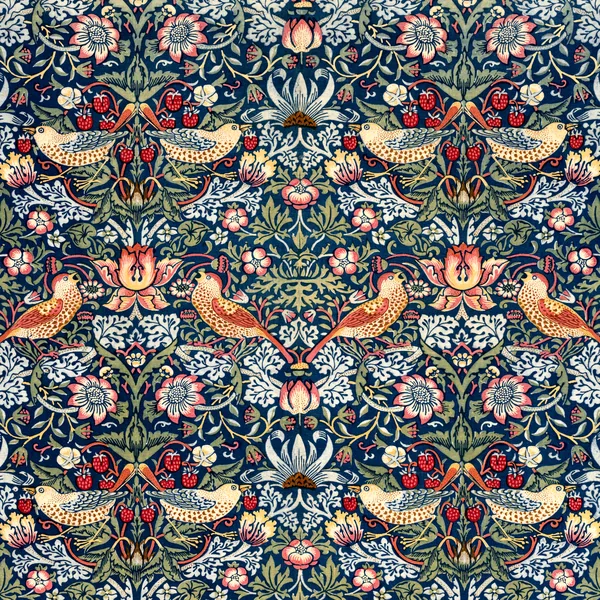
Bird and Anemone was designed and produced as a textile rather than a wallpaper. Like Morris’s later bird patterns, such as the famous Strawberry Thief, the layout relies on repeating floral and avian motifs that work across long expanses of cloth.
Morris used a two-tone scheme for this print, letting the contrast between the design and the ground define the entire structure. The flat tones of the leaves and birds rely entirely on carved line work and precise outlines rather than multi-layered color shading. In household interiors of the late nineteenth century, Morris & Co. used such textiles for upholstery, hangings, and curtain fabrics.
Colourways
This site presents Bird and Anemone in two distinct colourways sourced from high-resolution public-domain museum scans:
- Blue: A pale light-blue ground with dark brown lines and silhouettes. The pale ground creates a bright contrast that highlights the detailed feathers on each bird.
- Madder: A deep, earthy red-brown ground with lighter dusty-rose leaves, flowers, and birds. This dark ground offers a lower-contrast, tone-on-tone appearance where the shapes blend softly together.
Bird and Anemone as a print
Bird and Anemone prints are printed and shipped by ArtsyWall in three formats: Archival Paper, Premium Canvas, and Framed Canvas.
When hung on a wall, the dense branches, birds, and anemone blooms create an energetic focal point. The sharp contrasts of the Blue colourway draw attention to Morris’s graphic line work, while the deeper tones of Madder provide an understated, continuous backdrop. On Archival Paper, the line details across the wings and flower centers remain crisp and clean. Framed Canvas adds depth around the edge, separating the interlocking leaves from your wall with a neat border.
Want Bird and Anemone on a whole wall? See Bird and Anemone wallpaper, sized to your wall.
Questions and answers
Who designed Bird and Anemone?
William Morris designed the Bird and Anemone textile pattern. Cooper Hewitt museum records note the design as William Morris by title while crediting Morris & Co. as the maker. It is an original pattern created by Morris rather than later designers from his decorative firm.
When was Bird and Anemone designed?
The site design record dates the Bird and Anemone pattern to 1881. The Cooper Hewitt museum records for the textile scans note that it was designed in 1882. Because museum records and design archives can vary slightly, the sources differ between 1881 and 1882.
What does the Bird and Anemone pattern show?
Bird and Anemone shows small birds with patterned feathers perched and fluttering among large anemone blossoms and dense foliage. The birds have scale-like feather markings on their bodies and striped wings. Curling stems, layered petals, and deeply lobed leaves cover the entire surface without open space.
Was Bird and Anemone a wallpaper or a fabric?
Bird and Anemone was created as a textile. William Morris designed it as a fabric rather than a wallpaper. The historical museum examples held in collections such as the Cooper Hewitt were printed or woven on fabric grounds using two-tone colourways.