Rose by William Morris
Rose by William Morris is an 1883 block-printed textile featuring rounded cabbage roses, delicate perching birds, and scrolling foliage. Learn about its production history and order prints for your home.
| Designed | 1883 |
|---|---|
| Designer | William Morris |
| Type | textile |
| Motifs | flowers, birds, leaves |
| Colourway | Stone on Ivory |
| Repeat | 13 × 14.2 in (estimated) |
| Source | LACMA. Licence: Public domain (LACMA open access). Museum record |
Order Rose as a print
Format
Size (inches)
$40
Made to order. Shipping included in the US.
Seamless pattern file
One repeat tile, ready to fill any size in design software.
What Rose shows
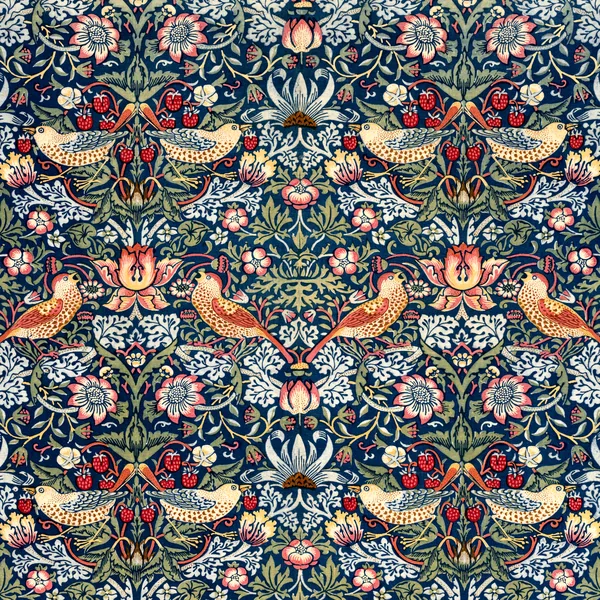
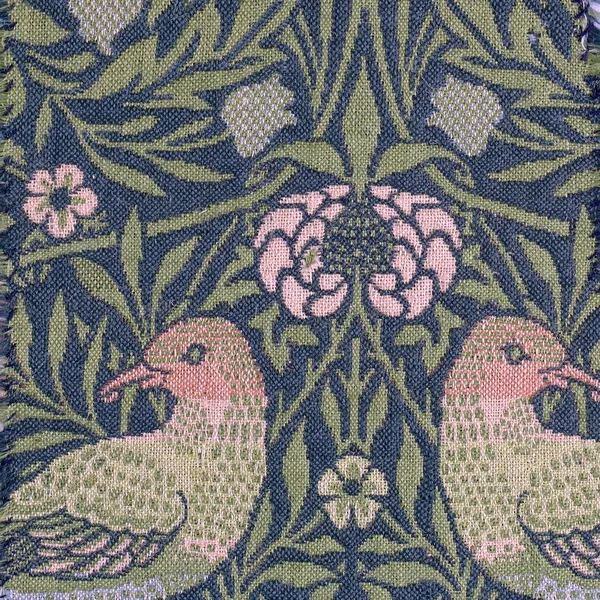
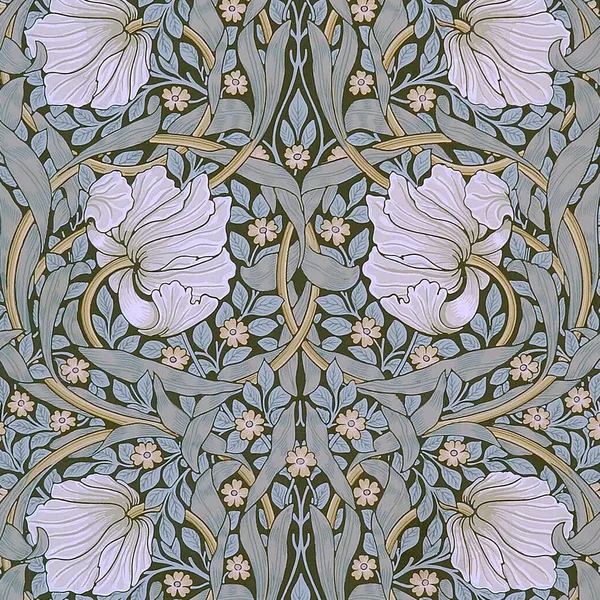
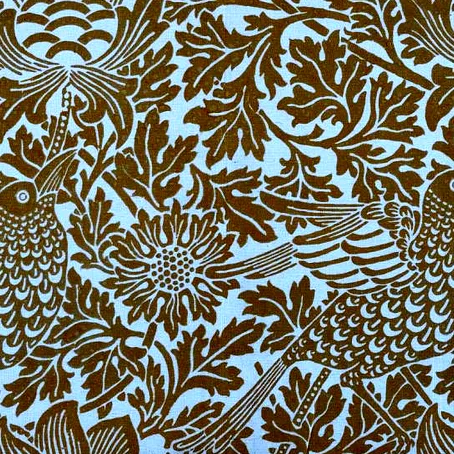
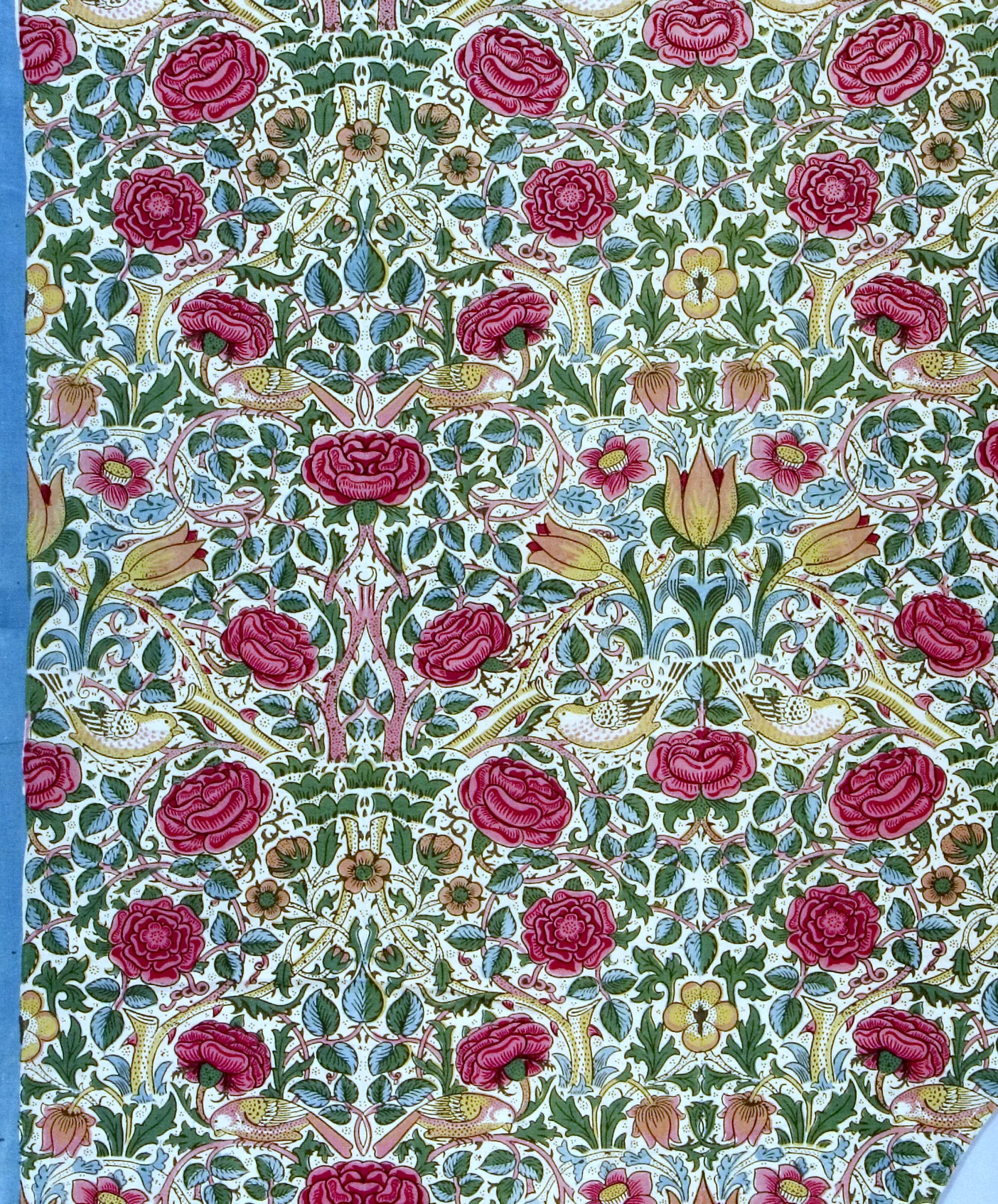
The Rose pattern by William Morris presents a dense, rhythmic arrangement of garden flora and bird life. At the center of the visual structure are full, rounded cabbage roses rendered in deep shades of rose and pink. These large flower heads feature heavy layers of petals with delicate outline work, giving them substance and weight. Alongside these primary blooms, smaller open flowers with yellow centers and slender, upward-pointing tulip-like blossoms branch across the composition.
Small songbirds perch among the twisting branches throughout the design. The birds feature pale plumage with soft dotting and fine line details along their wings and tails, turned in profile toward the floral stems. Thick, pale wooden branches split symmetrically upward, supporting a dense network of serrated green leaves, blue-green foliage, and curling thorned tendrils. The entire arrangement rests on a pale, warm ground filled with subtle background sprigs, giving the composition depth without leaving empty space.
The vertical repeat creates mirrored paths for the eye to follow. Morris balanced the broad rose heads with lighter elements such as budding flowers and perching birds. This careful distribution keeps the surface energetic while maintaining the structured order characteristic of his pattern work.
Who designed it and when
William Morris designed Rose in 1883. Produced by Morris & Co. in England, it was created during one of the most productive decades of the designer’s life. By the early 1880s, Morris had mastered the technical requirements of pattern construction, designing both flat papers and draping textiles.
That same year, Morris produced other celebrated patterns, such as the famous Strawberry Thief textile. Both patterns highlight his interest in British garden birds interacting with ripe fruit and flowers. You can read more about his life, training, and philosophy in our guide to William Morris, or browse every William Morris design in our library to see how his approach to natural ornament evolved.
How it was made and used
Morris & Co. produced Rose as a printed cotton textile rather than a wallpaper. The firm made the fabric on a plain weave cotton ground using traditional woodblock printing and indigo discharge dyeing methods. According to museum records from the Los Angeles County Museum of Art, which holds an original 1883 specimen, the fabric measures roughly 34 7/8 by 30 inches, with a pattern repeat of approximately 13 by 14.2 inches.
The discharge method was technically demanding. Workers dyed the cotton cloth in deep indigo vats before applying a bleaching agent with carved pearwood blocks to remove the blue dye in exact pattern shapes. Printers then built up the additional red, yellow, and green shades using separate woodblocks registered precisely by hand. The resulting fabric served as durable furnishing material, used for domestic upholstery, loose covers, and heavy window drapery in Victorian interiors.
Colourways
On this site, the design is presented in the Stone on Ivory colourway. This colourway reproduces the appearance of the original 1883 printed cotton held in museum archives. It features an ivory ground behind pale tan wood stems, rich pink cabbage blooms, soft yellow accent flowers, and muted green foliage.
Because original textile printings aged differently based on dye lots and light exposure, historical fabrics show slight tonal variations. The single scan preserved here captures the authentic warmth of the original mineral and vegetable dyes used in the 1880s production run.
Rose as a print
Rose adapts naturally to wall art, bringing a balanced Arts and Crafts character to any room. We offer this pattern printed and shipped by ArtsyWall in three formats: Archival Paper, Premium Canvas, and Framed Canvas.
On Archival Paper, the fine linework of the rose petals, bird feathers, and leafy tendrils stands out with crisp detail against the matte cotton paper. The Premium Canvas format gives the pattern the substantial feel of historical woven and printed cloth, stretched over solid wood bars. In Framed Canvas, available in finishes including oak, walnut, black, white, gold, and silver, the design gains a tailored border that highlights its structured symmetry.
Want Rose on a whole wall? See Rose wallpaper, sized to your wall.
Questions and answers
Who designed Rose?
William Morris designed the Rose pattern for Morris & Co. The pattern demonstrates his signature approach to British flora, combining natural forms with disciplined symmetry. You can compare it with other textiles he created during his prolific career, including famous designs like Strawberry Thief, to see how his botanical style developed over the decades.
When was Rose designed?
William Morris designed Rose in 1883 as a block-printed furnishing textile. Morris & Co. produced the fabric in England during a period of remarkable artistic output. Museum collections, including the Los Angeles County Museum of Art, preserve historical examples of this 1883 textile, which was created using complex indigo discharge printing techniques.
What does the Rose pattern show?
The Rose pattern shows deep pink cabbage roses, smaller open blossoms, upward-pointing tulip-like buds, and small songbirds perched among swirling green stems. These motifs are set against an ivory background filled with delicate leafy branches and tendrils, creating a dense, layered botanical composition with clear vertical symmetry.
Was Rose a wallpaper or a fabric?
Rose was originally produced as a fabric, specifically a plain weave cotton furnishing textile. Morris & Co. printed the design in England using woodblocks and indigo discharge dye. While many patterns by William Morris appeared as wallpaper, historical records and museum specimens catalog Rose specifically as a printed cotton textile.