Borage by William Morris
Borage by William Morris is an 1883 textile pattern filled with scrolling foliage, bell-shaped blossoms, and star flowers. This guide explores its history, structure, museum background, and art print options.
Colourways
| Designed | 1883 |
|---|---|
| Designer | William Morris |
| Type | textile |
| Motifs | flowers, leaves |
| Colourway | Gold on Ivory |
| Repeat | not measured |
| Source | Cooper Hewitt, Smithsonian Design Museum. Licence: CC0. Museum record |
Order Borage as a print
Format
Size (inches)
$40
Made to order. Shipping included in the US.
Seamless pattern file
A repeat tile of this design, ready to fill any size in design software.
What Borage shows
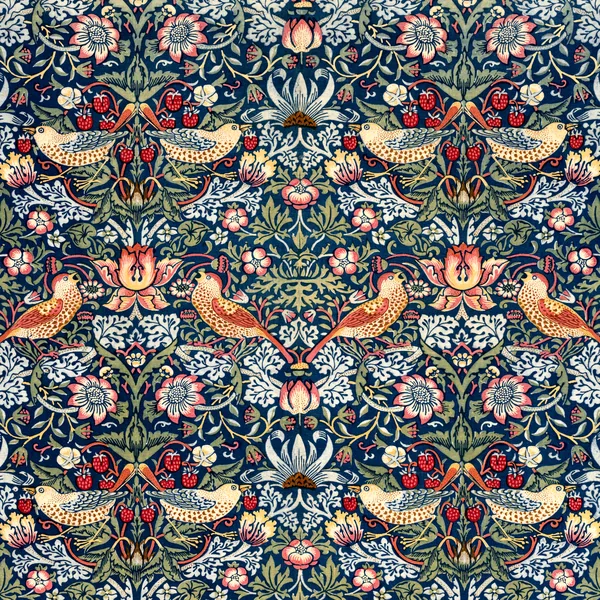
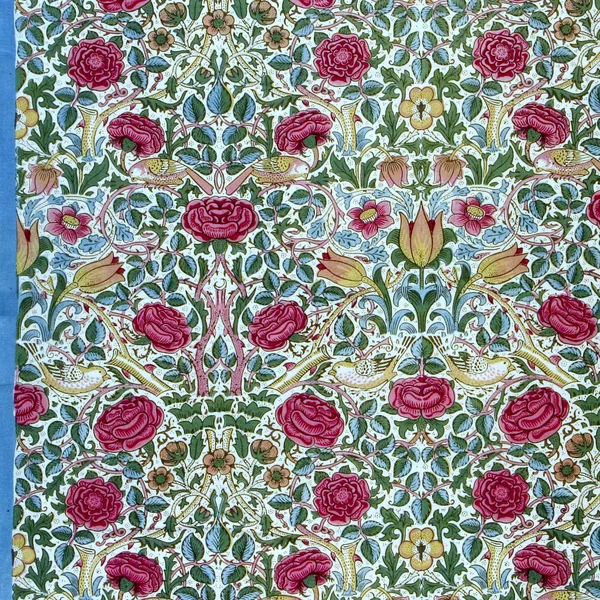
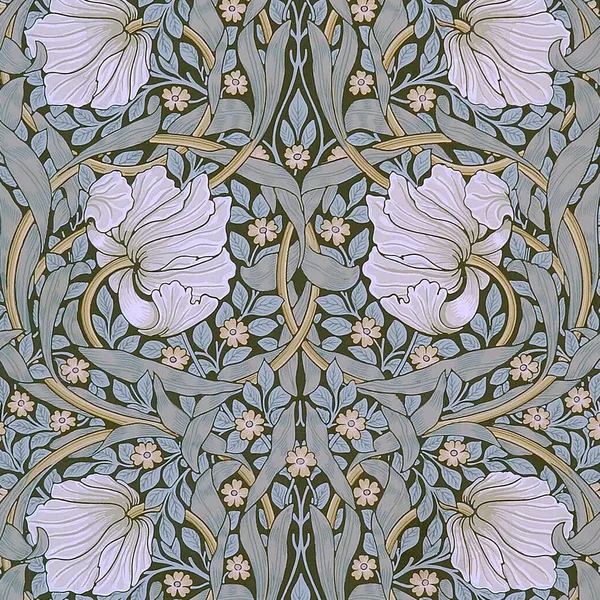
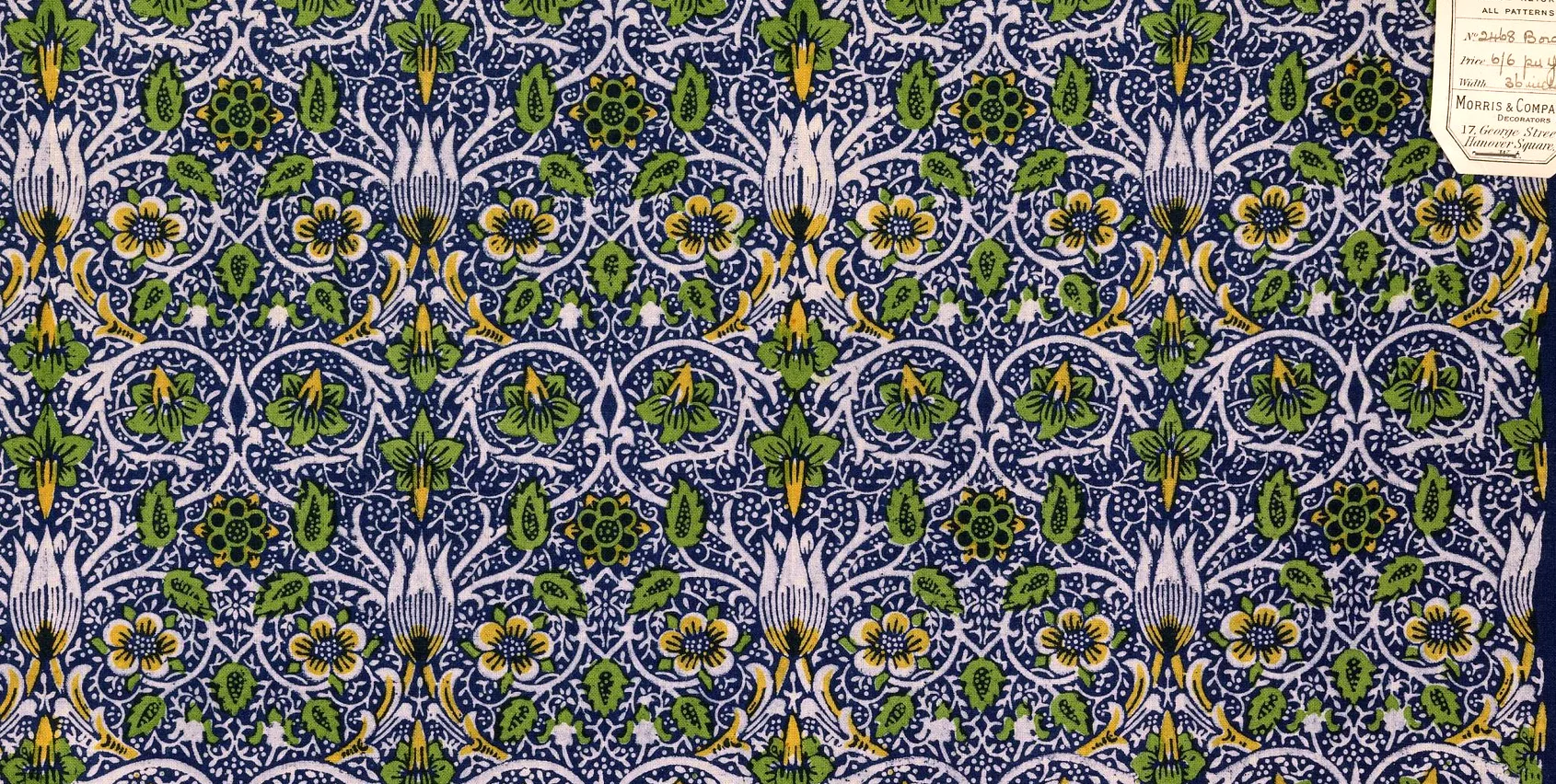
Borage by William Morris presents a dense, mirrored floral structure built on interlacing vines and leafy stems. Symmetrical scrollwork forms circular framing lines across the surface. Inside and around these roundels, you can see outward-facing star flowers with round, dotted centers alongside upright and nodding bell blossoms. Five-pointed calyxes and pointed leaflets sprout from the joints where the stems curve together.
Behind the prominent foreground stems, a dense web of fine white tendrils and delicate foliage fills the field. This background network breaks up the dark ground and gives the surface a rich, textured depth. In the lower and upper sections of the repeat, larger pointed flower heads open upward with striped petal details and yellow accents. Little oval leaves with serrated edges flank the central floral axes, balancing the rhythmic horizontal and vertical flow of the pattern. Small leaf clusters and stylized floral cups fill every corner of the repeat.
Who designed it and when
William Morris designed Borage in 1883 as a textile pattern. The design sits alongside other botanical textiles created during his productive period at Merton Abbey, including Strawberry Thief. Morris drew inspiration directly from English country gardens and traditional herbals, translating native plants into disciplined repeats for interior furnishings.
Museum sources differ slightly regarding its formal attribution. The Cooper Hewitt collection credits the firm Morris & Co. on its museum record, while noting William Morris by title. On our index of every William Morris design, Borage is listed under William Morris as designer for the year 1883. You can read more about his career, design philosophy, and pattern work in our guide to William Morris and his work.
How it was made and used
Morris created Borage as a printed textile. The pattern was intended for furnishing fabrics, such as curtains, drapery, and upholstery. Rather than using harsh synthetic dyes, Morris favored traditional block printing and natural dyestuffs like indigo and weld to achieve clear, resonant shades on cotton cloth.
The repeat structure uses a formal, mirrored balance that works across broad expanses of cloth. When the fabric hangs in folds, the interlocking stems and recurring blossoms create a continuous rhythm without awkward breaks. The design illustrates Morris’s principle that surface patterns should celebrate flat decoration rather than simulate artificial three-dimensional depth.
Colourways
This site offers Borage in two colourways sourced from high-resolution museum scans at Cooper Hewitt: Gold on Ivory and Black.
The Gold on Ivory colourway sets crisp ivory stems and vivid green leaves against a deep blue field. Rich golden-yellow touches highlight the flower petals and centers, giving the design high contrast and a bright, graphic presence. The white foliate background network stands out sharply against the dark blue ground.
The Black colourway features earthy, rose-tan stems across a very dark navy ground. Soft olive-green leaves and muted yellow florets provide warm accents that sit comfortably in low-lit rooms or alongside traditional wood finishes.
Borage as a print
You can display Borage in your home as a fine art print, printed and shipped by ArtsyWall in three formats: Archival Paper, Premium Canvas, and Framed Canvas.
Archival Paper reproduces the fine linework of the background scrollwork on heavyweight, textured cotton rag paper, shipping rolled in a sturdy tube. Premium Canvas stretches the pattern over solid wood bars with a sawtooth hanger attached. Framed Canvas places the canvas inside a wood floating frame available in six finishes: black, white, gold, silver, walnut, and oak. Framed on a wall, Borage reads as a structured botanical composition where the mirrored symmetry and winding floral stems draw the eye.
Want Borage on a whole wall? See Borage wallpaper, sized to your wall.
Questions and answers
Who designed Borage?
William Morris designed the Borage pattern in 1883 as a printed textile. While museum records at the Cooper Hewitt credit the historical firm Morris & Co., William Morris is credited as the designer by title. The design reflects his preference for balanced floral repeats based on familiar English plants.
When was Borage designed?
Borage was designed in 1883 by William Morris. He created the pattern during a major period of textile production at Merton Abbey, where his workshop produced block-printed cottons using natural dyes. The public-domain museum scans in our collection come from original textiles produced from that 1883 design.
What does the Borage pattern show?
The Borage pattern shows a dense arrangement of flowering stems, bell-shaped blossoms, and five-petaled star flowers. Mirrored vine scrolls create circular frames across the surface, supported by pointed leaves and upright buds. A fine web of white leafy scrollwork fills the background, giving the botanical motif depth and balance.
Was Borage a wallpaper or a fabric?
Borage was designed as a printed textile rather than a wallpaper. William Morris intended the cotton fabric for interior furnishings such as curtains, drapery, and upholstery. Its interlocking stems and mirrored repeats were structured specifically to hold their rhythmic appearance even when the printed fabric hung in gathered folds.