Strawberry Thief by William Morris: The Pattern, the Thrushes and the Indigo
Strawberry Thief is an 1883 printed cotton textile design by William Morris that shows garden thrushes stealing strawberries. Morris created the pattern using a multi-step indigo discharge printing process at his Merton Abbey workshop.
What Strawberry Thief shows
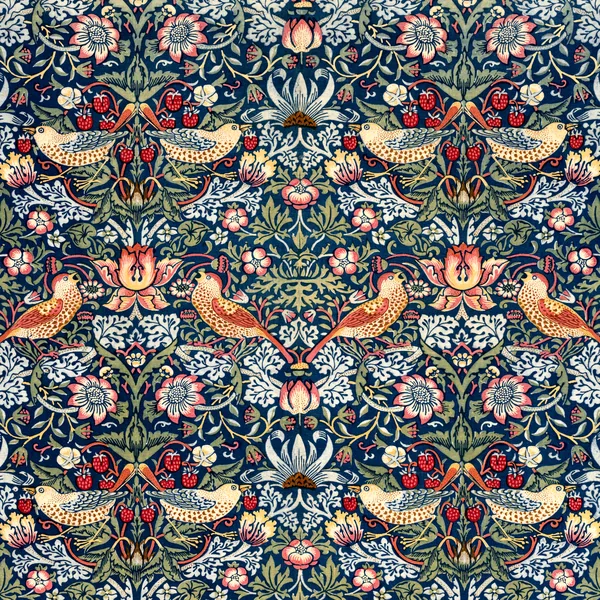
Strawberry Thief is a printed cotton textile design by William Morris, registered in 1883, showing thrushes stealing strawberries. Morris based the pattern on the thrushes he found stealing fruit in the kitchen garden of his countryside home, Kelmscott Manor, in Oxfordshire. The repeating pattern features birds feeding among strawberry plants and garden growth. It became one of the most popular repeating designs for textiles that William Morris ever produced.
Morris designed the pattern for hand woodblock printing rather than roller printing. The composition depicts the thrushes reaching for fruit across a repeating framework for home furnishings. Morris began producing repeating patterns for wallpaper in 1862, and six years later he designed his first pattern specifically for fabric printing. You can browse the wider catalog across every William Morris design in our library.
Strawberry Thief belongs to the long tradition of printed cotton furnishing fabrics known as chintz. Chintz originated in India as woodblock printed, painted, or stained calico featuring floral and animal patterns on a light ground. In modern textile history, the word came to describe industrially printed cottons. Morris rejected commercial machinery in favor of hand woodblocks, reviving traditional methods to create detailed decorative patterns.
The thrushes at Kelmscott Manor
Morris found the subject for Strawberry Thief at Kelmscott Manor, his countryside home in the Cotswolds village of Kelmscott, in West Oxfordshire, southern England. The limestone house sits close to the River Thames and dates from around 1570, with an additional wing built in the late 17th century. A local farmer named Thomas Turner built the house, which was originally called Lower House before James Turner purchased 53½ acres of manorial land and the lordship in 1864. Morris took a tenancy on the manor in 1871 and lived there as his country home until his death in 1896.
Morris drew great inspiration from the authentic craftsmanship of the building and its organic relationship with its garden. While at the manor, he observed thrushes stealing fruit in his kitchen garden, which gave him the subject for the pattern. The grounds also contained an orchard, surviving fruit trees, and an old black mulberry tree behind the house. A walled front garden contained standard roses and a stone summerhouse.
Kelmscott Manor remained central to the Morris family after his death. His widow, Jane Morris, purchased the property in 1913, and their daughters Jenny and May lived there in later years. Morris held such affection for the location that he named his London residence Kelmscott House and founded the Kelmscott Press in its honor. He was buried in the Kelmscott churchyard in a tomb designed by Philip Webb.
How it was printed: indigo discharge at Merton Abbey
To print Strawberry Thief, Morris used the painstaking indigo dye textile printing method he admired above all forms of printing. He first attempted to print using this method in 1875. Between 1875 and 1876, Morris spent long periods of incessant work at the Staffordshire dyeworks of Thomas Wardle. There he mastered dyeing processes and carried out experiments to revive vegetable dyes, such as madder and indigo, which had been driven out of use by chemical anilines.
Although Morris mastered dyeing wools, silks, and cottons, he could not print Strawberry Thief successfully until he secured larger manufacturing facilities. In June 1881, Morris relocated his dyeworks from Queen Square in London to the Merton Abbey Works in Merton, near Wimbledon. Merton Abbey was an historic calico-printing site on the River Wandle, where textile works had operated since 1667. The river supplied clean water suitable for dyeing, allowing Morris to establish dye vats, fabric printing, and weaving across the seven-acre site.
At Merton Abbey, Morris perfected the difficult discharge process. In May 1883, Morris wrote to his daughter: “I was a great deal at Merton last week … anxiously superintending the first printing of the Strawberry thief, which I think we shall manage this time.” Pleased with the successful run, he registered the design with the Patents Office.
Discharge printing was an intricate process that took days to complete. The cotton cloth was first dyed completely in an indigo vat to establish the blue ground. Workers then used carved woodblocks to print a discharge paste that bleached away the blue dye, leaving white ground in the required shapes. Further blocks then applied mordants and dyes directly onto the cleared sections. Because the entire process took days to complete, Strawberry Thief became one of Morris & Co.’s most expensive cottons.
The colours of the original
Strawberry Thief was the first design using the discharge technique in which red and yellow were added to the basic blue and white ground. The pattern began with a solid blue ground produced by the indigo vat. Discharge printing then removed the blue color in selected areas, leaving a clean white base for the additional colors.
Morris chose traditional vegetable dyes rather than synthetic colorants to complete the pattern. For the red details on the strawberries and thrushes, he used alizarin dye. For the yellow details, he applied weld, a traditional plant dye.
The combination of indigo blue, discharged white, alizarin red, and weld yellow formed the full palette of the original textile. By printing weld and alizarin onto the discharged cotton, Morris achieved precise registration across the design. The multi-step application of natural dyes gave the pattern a rich appearance that distinguished it from ordinary roller-printed fabrics.
How Strawberry Thief was used
Strawberry Thief was a printed cotton furnishing textile intended for several decorative uses in the home. Morris designed the cloth to be used for window curtains, loose covers on furniture, and fabric draped around walls. Draping textile hangings around walls was a method of interior decoration that Morris strongly advocated for domestic rooms.
Although the multi-day printing process made it one of Morris & Co.’s most expensive cottons, customers were not put off by the high price. Strawberry Thief proved to be one of Morris’s most commercially successful patterns, purchased by clients who valued hand-printed furnishings.
The pattern has also appeared in several modern cultural works. In 2014, video game designer Sophia George released a game based on the Strawberry Thief pattern while working as the first Game Designer in Residence at the Victoria and Albert Museum. The player controls a bird flying across the screen, gradually coloring in the pattern. Joanne Harris drew inspiration from the design for her 2019 novel The Strawberry Thief, and the design is discussed in Gabrielle Zevin’s 2022 novel Tomorrow, and Tomorrow, and Tomorrow.
Strawberry Thief as a print for your home
You can display Strawberry Thief in your home with reproductions from our pattern archive. You can order prints directly on the Strawberry Thief page, where you can select your preferred size and medium. Prints are printed and shipped by ArtsyWall in three formats: Archival Paper, Premium Canvas, and Framed Canvas. Archival Paper prints use heavyweight 100% cotton rag paper, while canvas options are hand-stretched over solid wood bars. If you want floating frames, Framed Canvas options include finishes in black, white, gold, silver, walnut, and oak. You can also buy the pattern as peel-and-stick wallpaper on williammorriswallpapers.com. Explore our complete range of William Morris wall art to find matching designs for your space.
Designs in this guide
Questions and answers
What is the story behind the Strawberry Thief?
William Morris based the Strawberry Thief pattern on thrushes he caught stealing fruit from the kitchen garden at Kelmscott Manor. Morris lived at the Oxfordshire country home from 1871 until 1896 and found creative inspiration in its natural surroundings. Instead of driving the birds away, he watched their behavior and sketched them feeding among the strawberry plants. He translated those observations into a repeating furnishing textile registered in 1883.
When did William Morris design Strawberry Thief?
William Morris registered the Strawberry Thief pattern with the British Patents Office in May 1883. He had attempted to master the necessary indigo printing technique as early as 1875 during dye trials in Staffordshire. Morris only achieved the technical success required for the pattern after moving his workshops to Merton Abbey in 1881. Following a successful printing run supervised by Morris in the spring of 1883, the firm offered the pattern to buyers.
What birds are in Strawberry Thief?
The birds depicted in Strawberry Thief are thrushes. William Morris observed these birds feeding in the kitchen garden of his countryside home at Kelmscott Manor in Oxfordshire. In the finished cotton textile, pairs of thrushes are shown among strawberry plants, bending toward the fruit. Morris used the birds to give life and narrative interest to the disciplined geometry of his repeating textile pattern.
How was Strawberry Thief printed?
Strawberry Thief was printed using the indigo discharge method, a demanding process carried out by hand at the Merton Abbey Works. Cotton fabric was first submerged in an indigo dye vat to color the entire piece dark blue. Carved woodblocks then applied a discharge paste that bleached the dye away to create white spaces. Additional hand woodblocks stamped natural dyes into those cleared areas, completing a labor-intensive sequence that required several days per run.
What colour is the original Strawberry Thief?
The original Strawberry Thief pattern features red and yellow dyes printed over a basic blue and white foundation. Morris used an indigo dye vat to establish the primary blue ground and discharged the dye to expose crisp white fabric underneath. He then applied red alizarin dye and yellow weld dye onto the discharged sections. This combination marked the first time Morris successfully united red and yellow with blue and white using discharge printing.