Strawberry Thief by William Morris
Strawberry Thief by William Morris is an 1883 printed cotton textile showing garden thrushes stealing strawberries among flowers and leaves. You can explore the design's history and buy it as fine art prints and seamless pattern files.
Colourways
| Designed | 1883 |
|---|---|
| Designer | William Morris |
| Type | textile |
| Motifs | birds, fruit, flowers, leaves |
| Colourway | Indigo |
| Repeat | 17.4 × 19.3 in |
| Source | Cleveland Museum of Art. Licence: CC0. Museum record |
Order Strawberry Thief as a print
Format
Size (inches)
$40
Made to order. Shipping included in the US.
Seamless pattern file
One repeat tile, ready to fill any size in design software.
What Strawberry Thief shows
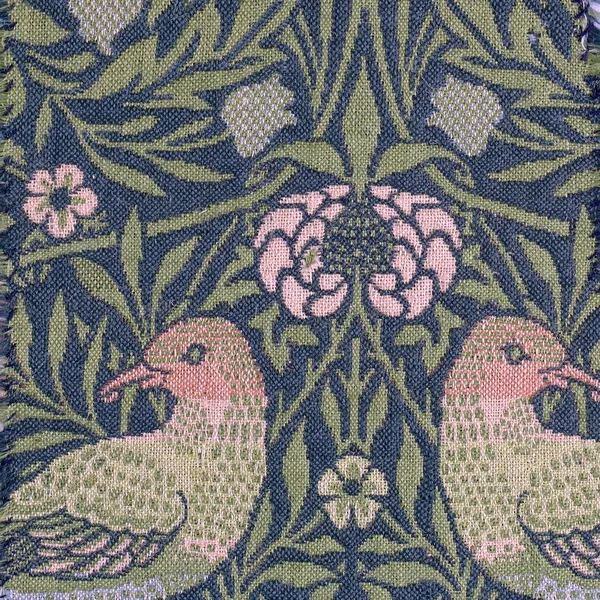
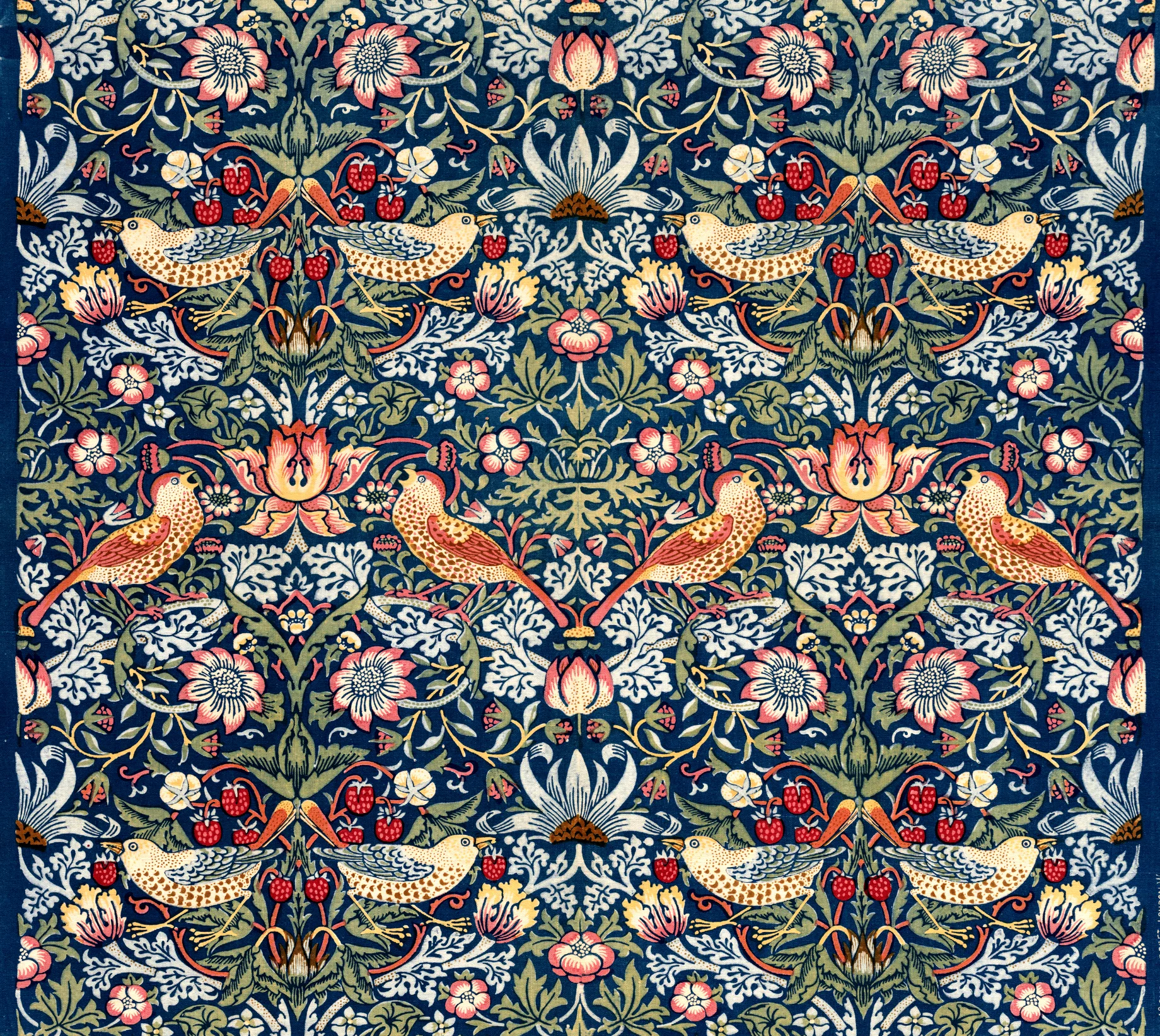
Strawberry Thief by William Morris is a repeating pattern of birds feeding on fruit amid a dense bed of foliage. Morris based the motif on garden thrushes that snatched fruit from the kitchen garden at Kelmscott Manor, his Oxfordshire country home. Paired songbirds perch along curving leafy stems, some facing inward with ripe strawberries caught in their beaks while others turn outward with heads tilted upward.
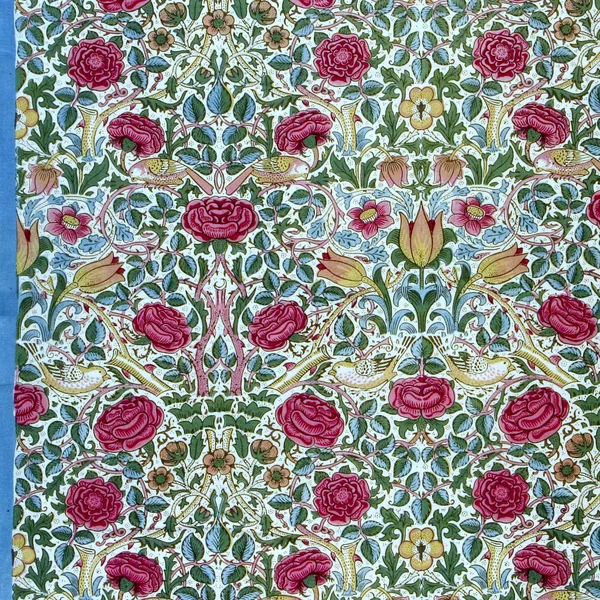
The layout forms a medium-scale symmetrical repeat of woodland plants. Around the birds, deep red strawberries hang from slender runners alongside five-petaled white and pale blossoms. Larger stylized flowers with rounded, cup-like petals anchor the vertical rhythm, balanced by sprawling leafy fronds in muted green and silvery blue-gray. The ground is a dark blue that sets off the bright red berries, cream highlights, and warm golden-buff plumage of the thrushes. If you enjoy Morris’s botanical studies, you can explore his other florals like Rose alongside every pattern in our catalog of every William Morris design.
Who designed it and when
William Morris designed Strawberry Thief in 1883. He registered the pattern with the British Patents Office in the same year, following months of experimental work. In May 1883, Morris wrote to his daughter that he was spending days at his workshop anxiously superintending the very first printing run.
Morris’s daughter May Morris recalled how her father observed the thrushes early in the morning in the kitchen garden at Kelmscott Manor. When the gardener complained and spoke of wringing the birds’ necks, Morris insisted that no bird in the garden be harmed. That affection for the countryside thieves inspired Morris & Co. to produce what became one of the firm’s most commercially successful printed patterns. You can read more about its background in our guide to Strawberry Thief.
How it was made and used
Morris produced Strawberry Thief using the discharge printing method combined with indigo vat dyeing. He had admired indigo dyeing for years and first attempted the process in 1875. He did not master it until after 1881, when he moved production to his textile works at Merton Abbey near Wimbledon.
The process required workers to dye the entire plain weave cotton cloth solid blue. Next, a bleaching agent discharged the blue dye from specific areas of the pattern, leaving white spaces. Woodblocks then printed the colors back onto the fabric: red from alizarin dye, yellow from weld, and green produced by overprinting yellow onto the original indigo. Because the steps took days to finish, Strawberry Thief was one of the firm’s most expensive cotton textiles. Morris intended the fabric for interior furnishings, including curtains, loose furniture covers, and lengths draped along walls.
Colourways
This site presents two scans under the Indigo colourway, drawn from museum holdings. The primary Indigo scan shows the historic dark blue ground filled with green leaves, soft blue-gray foliage, pale blooms, and deep red strawberries. A second museum scan preserves the same Indigo composition with slightly different lighting and tone across the cotton ground.
Sources differ on the date of surviving fabric specimens. While the design dates to 1883, the Cleveland Museum of Art object was printed around 1936 at Merton Abbey on plain weave cotton. The scan from the Cooper Hewitt, Smithsonian Design Museum records a specimen of the 1883 design measuring about 32 by 92 centimeters.
Strawberry Thief as a print
Our prints are printed and shipped by ArtsyWall in three formats: Archival Paper, Premium Canvas, and Framed Canvas. You can also explore peel-and-stick options via our sister site for Strawberry Thief wallpaper.
Framed on a wall, Strawberry Thief commands attention through its symmetrical geometry and energetic birds. The dark indigo background creates deep contrast, allowing the golden-feathered thrushes, creamy flowers, and scarlet strawberries to stand out across the room. In a floating frame, the dense leaf vines gain clean visual borders that highlight the balanced repeat of the branches.
Read the full story in our Strawberry Thief by William Morris guide.
Want Strawberry Thief on a whole wall? See Strawberry Thief wallpaper, sized to your wall.
Questions and answers
Who designed Strawberry Thief?
William Morris designed Strawberry Thief. He created the pattern based on the thrushes he watched stealing fruit from the kitchen garden at his country home, Kelmscott Manor, in Oxfordshire. His daughter May Morris later recorded his fondness for watching the birds feed on the fruit beds early in the morning.
When was Strawberry Thief designed?
William Morris designed Strawberry Thief in 1883. He registered the pattern with the British Patents Office that same year after perfecting the printing process at his Merton Abbey workshop near Wimbledon. He oversaw the first successful textile printings of the pattern in May 1883.
What does the Strawberry Thief pattern show?
Strawberry Thief shows paired songbirds perched among strawberries, woodland flowers, and curving leafy stems. Several of the thrushes hold red berries in their beaks against a dark blue ground. The composition forms a symmetrical repeat featuring blue, green, yellow, orange, red, and pink botanical elements.
Was Strawberry Thief a wallpaper or a fabric?
Strawberry Thief was designed as a printed cotton furnishing textile, not a wallpaper. William Morris produced it on plain weave cotton using an indigo-discharge printing method. Morris & Co. intended the expensive fabric to be used for window curtains, loose furniture covers, or lengths draped along interior walls.