Bird by William Morris
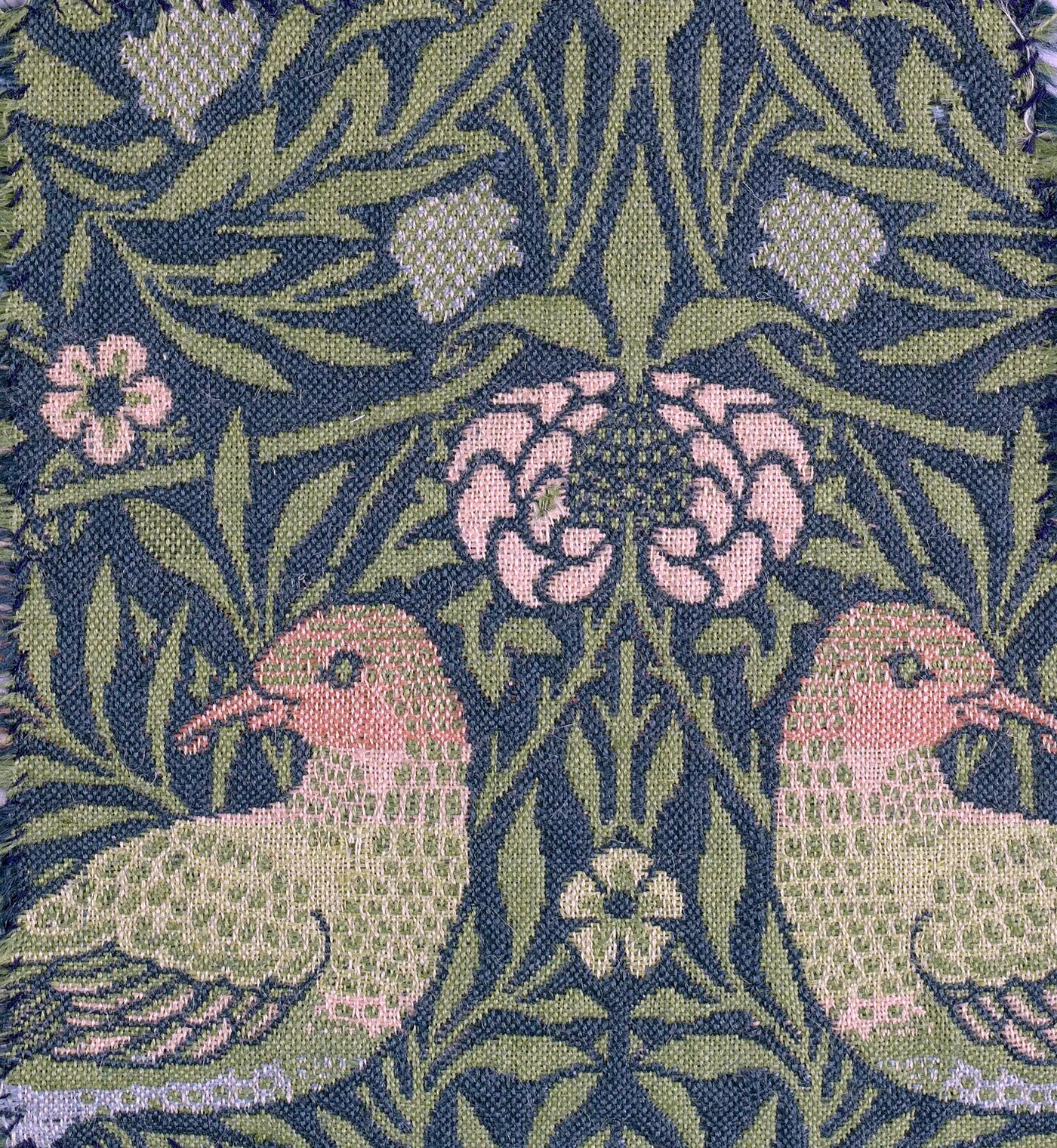
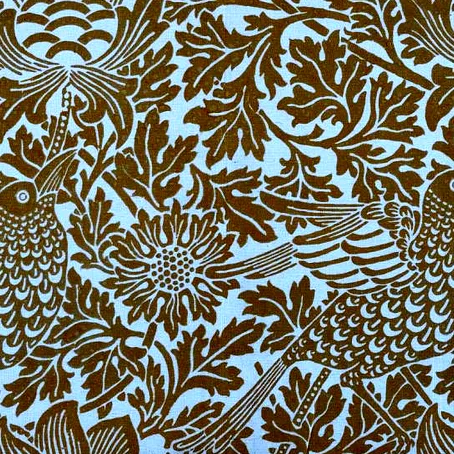
Bird is an 1878 woven wool textile designed by William Morris. The pattern features mirrored pairs of birds perched and in flight among scrolling foliage and round blossoms.
Colourways
| Designed | 1878 |
|---|---|
| Designer | William Morris |
| Type | textile |
| Motifs | birds, flowers, leaves |
| Colourway | Charcoal |
| Repeat | not measured |
| Source | Cooper Hewitt, Smithsonian Design Museum, via Wikimedia Commons. Licence: Public domain (Wikimedia Commons). Museum record |
Order Bird as a print
Format
Size (inches)
$40
Made to order. Shipping included in the US.
Seamless pattern file
One repeat tile, ready to fill any size in design software.
What Bird shows
Bird by William Morris presents a rhythmic composition of wildlife and flora set across a dark ground. The pattern features alternating horizontal bands of birds set within dense foliage. In one row, paired birds perch on winding branches, turning their heads inward or facing outward in mirrored symmetry. In the row above and below, pairs of birds are captured in flight with outstretched wings, swooping toward one another amid curving leaves.
Between the avian figures, Morris arranged detailed botanical motifs. Broad acanthus-style leaves scroll across the surface, framing round multi-petaled blossoms, smaller five-petaled florets, and textured thistle-like seed heads. Fine veining lines detail each leaf, while speckles and cross-hatching shade the bodies and wings of the birds. The interlocking vegetation leaves little open space, creating an intricate, balanced repeat across the surface.
Who designed it and when
William Morris designed Bird in 1878. To learn more about his background and creative career, read our guide to William Morris. Although a textile fragment record at the Cooper Hewitt lists the artist as unknown, records from the Metropolitan Museum of Art confirm Morris as the designer, noting that the sources differ on individual collection listings.
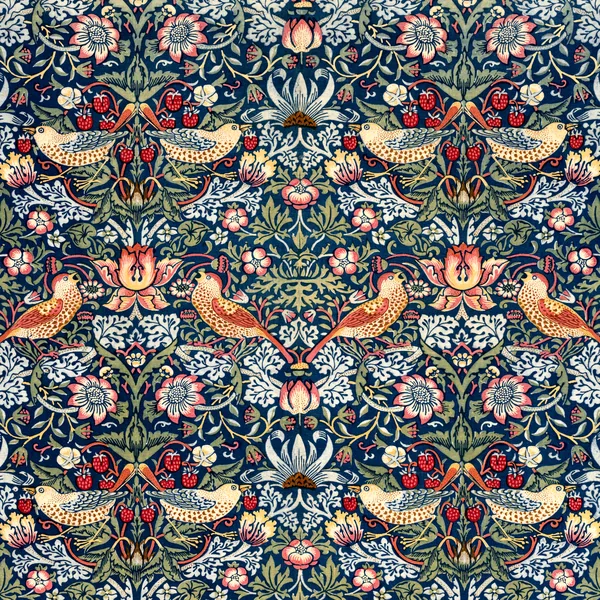
Morris created the pattern during a period of intense focus on woven furnishings. You can explore the full range of textiles and papers from this period across every William Morris design in our library. Unlike printed chintzes such as Strawberry Thief, which Morris designed later in 1883, Bird was planned specifically for the loom.
How it was made and used
Bird was produced as a woven wool textile. Historical lengths in museum collections, including a piece measuring over 88 inches long held by the Metropolitan Museum of Art, indicate that Morris & Co. manufactured the fabric at Merton Abbey in Surrey. Wool yarns provided both warmth and durability, making the heavy fabric suitable for interior furnishings, portieres, and wall hangings.
The repeat on historical woven examples measures roughly 6.9 by 10.4 inches. Weaving the pattern in wool allowed Morris to achieve subtle shifts in surface texture, with individual yarn colours building the forms of the feathers, petals, and twisting stems against the dark background.
Colourways
This site presents three colourways based on public-domain museum scans of surviving textile pieces:
- Charcoal: A deep, muted dark ground with leaves in olive green, blossoms in soft dusty pink, and birds detailed in pale pink and cream tones.
- Indigo: A rich dark blue ground filled with teal-green foliage, pale buff birds with terracotta-toned heads, and golden-ochre accents across the flowers and seed heads.
- Indigo (Variant): A secondary scan of the dark blue textile, capturing natural lighting variations across the woven wool surface.
Bird as a print
Prints of Bird are printed and shipped by ArtsyWall in three formats: Archival Paper, Premium Canvas and Framed Canvas. You can also buy peel-and-stick wallpaper of this design at williammorriswallpapers.com. The dense rows of perched and flying birds make a balanced, formal impression when displayed on a wall. Framed Canvas prints present the woven details in a clean wood floating frame with a slight perimeter gap, while Archival Paper highlights the graphic clarity of the drawing.
Want Bird on a whole wall? See Bird wallpaper, sized to your wall.
Questions and answers
Who designed Bird?
William Morris designed the Bird pattern for Morris & Co. While some museum records note an unknown artist for individual textile fragments, the primary Metropolitan Museum of Art record documents Morris as the designer. The pattern remains one of his most recognized woven wool designs, created alongside his broader decorative work.
When was Bird designed?
William Morris designed Bird in 1878. Museum records from both the Metropolitan Museum of Art and the Cooper Hewitt date the textile design to this year. Production of the woven fabric was later carried out by Morris & Co. at Merton Abbey in Surrey during the late nineteenth century.
What does the Bird pattern show?
The Bird pattern shows paired birds arranged in alternating horizontal bands among dense foliage and blossoms. In one row, pairs of birds perch facing inward or outward on leafy branches. In the alternate row, birds appear in flight facing each other with outstretched wings. Stylized flowers, leaves, and round seed heads fill the surrounding dark ground.
Was Bird a wallpaper or a fabric?
Bird was originally produced as a woven wool textile rather than a wallpaper. The historical lengths were manufactured by Morris & Co. at Merton Abbey in Surrey as heavy wool fabric. On this site, the pattern is reproduced as decorative wall prints and seamless digital files based on museum scans of surviving historical textiles.
.jpg)