William Morris: Designer, Poet and Maker
William Morris (1834–1896) was an English textile designer, poet, artist, writer, and socialist activist associated with the British Arts and Crafts movement. He revived traditional British textile arts, designed repeating patterns, and founded the decorative arts firm Morris & Co.
Who William Morris was
William Morris (1834–1896) was an English textile designer, poet, artist, writer, and socialist activist known for reviving traditional British textile arts. Associated closely with the [/arts-and-crafts-movement/](British Arts and Crafts movement), he led a profound shift toward handcrafted production, historic dyeing methods, and nature-inspired repeating ornament. He also made major contributions to modern fantasy literature and spent years campaigning for revolutionary socialism across Britain.
Morris spent his career fighting against industrial manufacturing methods. Influenced by medieval craftsmanship, he rejected commercial shortcuts in favor of hand techniques, plant dyes, and detailed observation of the natural world. He created hundreds of designs for decorative use, helped establish a successful decorative arts company, and produced limited-edition printed books. On this site, you can explore [/](William Morris prints and patterns) for your home. Prints are printed and shipped by ArtsyWall in three formats: Archival Paper, Premium Canvas, and Framed Canvas.
Early life and Oxford
Morris was born at Elm House in Walthamstow, Essex, to a wealthy middle-class family. His father was a partner in the bill-broking firm Sanderson & Co., and his mother was Emma Morris, née Shelton. In 1840, the family moved to Woodford Hall, an Italianate mansion with fifty acres of land near Epping Forest. Morris spent his youth fishing, gardening, and riding his pony to examine local architecture and earthworks.
Following his father’s sudden death in 1847, the family moved to Water House, supported by shares in the Devon Great Consols copper mines. Morris attended Marlborough College from 1848 until 1851, developing an interest in prehistoric monuments and the Anglo-Catholic movement. He went into residence at Exeter College, Oxford, in January 1853 to study classics.
Disliking classical tuition, Morris immersed himself in medieval history and Gothic architecture. At Oxford, he met Edward Burne-Jones, who became his lifelong collaborator. Together with other students from Pembroke College, they formed the Birmingham Set, known among themselves as the Brotherhood. Morris was deeply inspired by John Ruskin’s chapter “On the Nature of Gothic Architecture” in The Stones of Venice. Ruskin argued for raising artisans to the status of artists, eliminating hierarchies among artistic mediums, and rejecting tawdry factory manufacture in favor of hand-craftsmanship.
Red House and the firm
After earning his degree, Morris began an apprenticeship with Neo-Gothic architect George Edmund Street in January 1856. Working under Philip Webb in Oxford and London, Morris studied architectural drawing. He soon abandoned architecture when Dante Gabriel Rossetti persuaded him to take up painting. In 1857, Morris met Jane Burden, and they married in Oxford in April 1859.
To provide a home for his new family, Morris worked with Philip Webb to build Red House in Upton, Kent. Webb designed the L-shaped exterior in red brick and tile, while Morris and his Pre-Raphaelite friends decorated the interiors with Arthurian murals and hand-embroidered textiles. Morris described the building as “very mediaeval in spirit.” His two daughters, Jenny and May, were born during their years there. Commuting several hours daily to London proved exhausting, however, and Morris sold Red House in 1865 to live above his workshops in Queen Square, Bloomsbury.
In April 1861, Morris founded the decorative arts firm Morris, Marshall, Faulkner & Co. with Burne-Jones, Rossetti, Webb, Ford Madox Brown, Charles Faulkner, and Peter Paul Marshall. Calling themselves “the Firm,” they operated from Red Lion Square, producing furniture, metalwork, painted glass, and church decorations. Their display at the 1862 International Exhibition earned praise and medals, establishing the firm as an influential force in Victorian decorative art.
Wallpapers and textiles
Morris began designing repeating wallpaper patterns in 1862, starting with Trellis, which featured birds drawn by Philip Webb. The papers were printed for the firm by Jeffrey & Co. using hand-carved pearwood blocks. In March 1875, Morris bought out his partners to assume sole control of the business, renaming it Morris & Co.
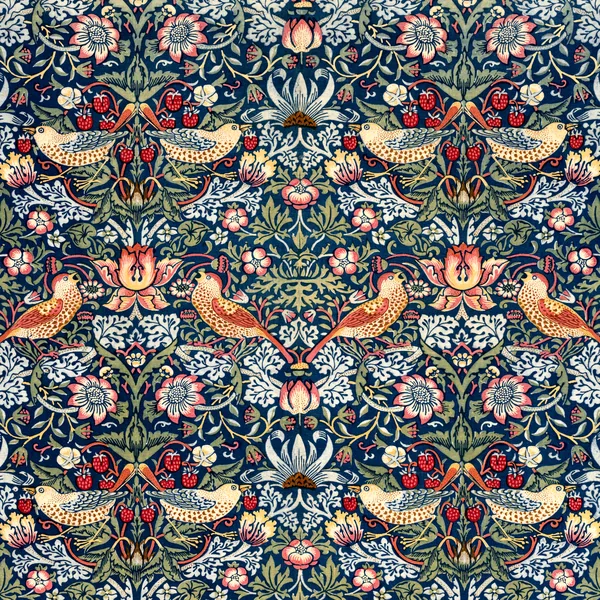
To improve the quality of his printed textiles, Morris studied dyeing under Thomas Wardle at Leek in Staffordshire between 1875 and 1878. He rejected harsh aniline chemicals, reviving organic dyes such as indigo for blues, madder for reds, and walnut shells for browns. Mastering indigo discharge printing allowed him to produce complex chintz patterns like [/strawberry-thief/](Strawberry Thief) in 1883.
In 1881, Morris moved his manufacturing workshops to the Merton Abbey Works beside the River Wandle. The site housed facilities for vegetable dyeing, block printing, carpet knotting, and stained glass. Morris also set up high-warp upright looms to produce hand-woven wall hangings. His apprentice, John Henry Dearle, trained the workshop weavers and partnered with Morris on intricate floral backgrounds.
Kelmscott Manor and the Kelmscott Press
In June 1871, Morris took a joint lease on Kelmscott Manor, a stone farmhouse built around 1570 in Oxfordshire. He sought a peaceful country retreat away from London’s industrial smoke for his family. The manor’s limestone gables, garden flora, and Thames riverside setting provided enduring inspiration for his creative work. Although he moved his London residence to Kelmscott House in Hammersmith in 1879, he kept Kelmscott Manor until the end of his life.
Morris launched the Kelmscott Press in Hammersmith in 1891 to publish limited-edition books in the style of early illuminated printing. He designed three proprietary typefaces, created woodcut borders and initials, and insisted on handmade linen paper and traditional relief printing. The press issued more than fifty titles, concluding with the Kelmscott Chaucer in 1896, which contained eighty-seven woodcut illustrations designed by Edward Burne-Jones.
Writing and politics
Morris built a substantial literary reputation alongside his craft work. His early poetry volume, The Defence of Guenevere, appeared in 1857. Broad acclaim followed with The Life and Death of Jason in 1867 and the four-part epic The Earthly Paradise between 1868 and 1870. Inspired by journeys to Iceland in 1871 and 1873, he collaborated with Eiríkur Magnússon to translate Icelandic sagas into English. In his later years, he wrote imaginative fantasy novels, including The Well at the World’s End, as well as the socialist utopian romance News from Nowhere.
Morris became deeply engaged in political campaigns during the late 1870s. In 1877, he organized the Society for the Protection of Ancient Buildings, known as “Anti-Scrape”, to stop damaging Victorian restorations of historic structures. Moving toward revolutionary socialism, he joined the Democratic Federation in 1883 and co-founded the Socialist League in 1884. He edited the socialist paper Commonweal, funded political work, and delivered lectures to working-class audiences across Britain.
Death and legacy
Morris died on 3 October 1896 at Kelmscott House at the age of sixty-two. His doctors attributed his death to his lifelong habit of intense, unceasing work across multiple disciplines. He was buried in the churchyard of St George’s Church in the village of Kelmscott.
During his lifetime, the British public viewed Morris primarily as a distinguished poet and author. After his death, his reputation as a decorative artist and pattern designer came to eclipse his literary renown. The William Morris Society was established in 1955 to promote his achievements, and several homes associated with him remain preserved for the public.
Morris patterns today
Morris & Co. continued operating until 1940, retaining workshops at Merton Abbey and showrooms in London. Many famous patterns traditionally attributed to William Morris were designed by other artists employed by the firm.
John Henry Dearle created numerous celebrated wallpapers and textiles while serving as head designer and art director. Morris’s daughter May Morris also directed the embroidery division from 1885 and produced distinctive patterns. You can explore the complete catalog of historical patterns and their creators in our [/designs/](guide to William Morris designs).
Designs in this guide
Questions and answers
Who was William Morris?
William Morris was a nineteenth-century English designer, poet, writer, and socialist activist born in 1834. He became a leading figure in the British Arts and Crafts movement, working to revive handcraftsmanship and historic production techniques. Morris founded the decorative arts firm later known as Morris & Co., wrote epic poetry and fantasy novels, ran the Kelmscott Press, and spent decades designing repeating patterns for wallpapers, fabrics, and carpets.
What is William Morris famous for?
William Morris is famous for his repeating patterns for wallpapers, printed chintzes, and woven fabrics, including designs such as Strawberry Thief. He is also remembered for co-founding the decorative arts firm Morris, Marshall, Faulkner & Co., championing traditional handcrafts during the industrial era, writing epic poetry like The Earthly Paradise, establishing the Kelmscott Press, and campaigning across Britain as a revolutionary socialist activist.
Was William Morris an architect?
William Morris trained briefly as an architect but did not practice as one. In 1856, after graduating from Oxford University, he began an apprenticeship in Oxford with the Neo-Gothic architect George Edmund Street, working under Philip Webb. Morris soon grew tired of architecture and abandoned his apprenticeship later that same year to pursue painting and decorative arts under the encouragement of Dante Gabriel Rossetti.
When did William Morris die?
William Morris died on 3 October 1896 at the age of sixty-two. By his final years, he had devoted his remaining energy to establishing and running the Kelmscott Press, producing limited-edition, illuminated-style printed books. After his death, his reputation shifted: during his life he was best known as a poet, but posthumously he became widely recognized for his decorative pattern designs.
Where did William Morris live?
William Morris lived in several notable homes in England throughout his life. After growing up in Essex at Elm House, Woodford Hall, and Water House, he shared flats in central London. In 1859, he built Red House in Kent with architect Philip Webb. Later, he lived above his London workshops in Queen Square, moved to Kelmscott House in Hammersmith, and leased Kelmscott Manor in Oxfordshire.