Pimpernel by William Morris
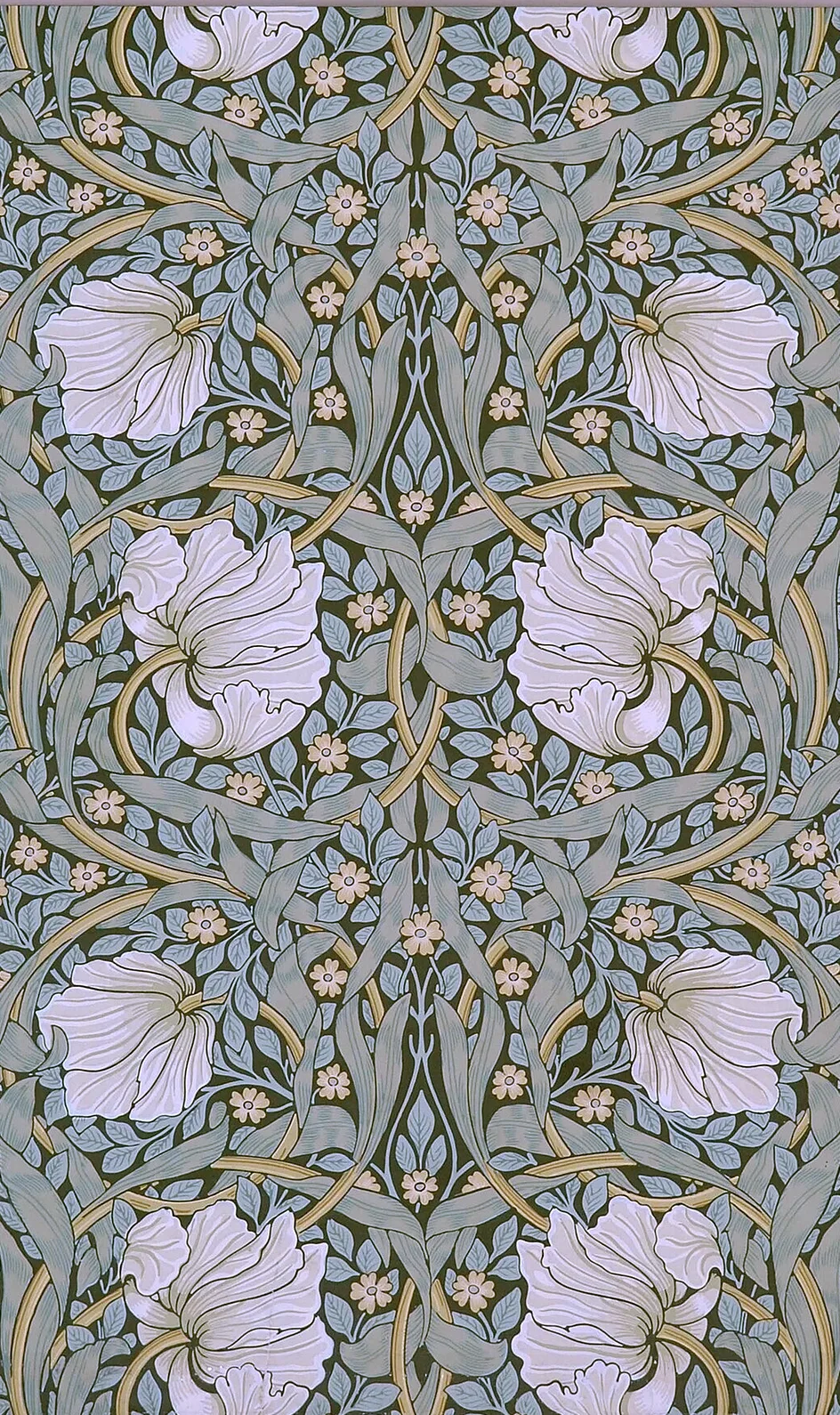
Pimpernel by William Morris is a complex wallpaper pattern designed in 1876. It pairs large, windswept flowers with curving stems, layered foliage, and small pimpernel blossoms.
| Designed | 1876 |
|---|---|
| Designer | William Morris |
| Type | wallpaper |
| Motifs | flowers, leaves |
| Colourway | Gold on Stone |
| Repeat | 10.6 × 15.6 in (estimated) |
| Source | Other, via Wikimedia Commons. Licence: Public domain (Wikimedia Commons). Museum record |
Order Pimpernel as a print
Format
Size (inches)
$40
Made to order. Shipping included in the US.
Seamless pattern file
One repeat tile, ready to fill any size in design software.
What Pimpernel shows
Pimpernel by William Morris is an intricate floral wallpaper pattern defined by large, pale blooms and swirling foliage. You can see large, ruffled flowers with layered, cupped petals dominating the field. Thick, golden-toned stems loop around each flower head, creating a strong circular framework that anchors the repeating pattern. The design relies on bilateral symmetry, with opposing pairs of large blossoms facing inward toward a central leafy axis.
Beneath and around the primary blooms, slender upward-reaching leaves interlock with broader, curving foliage in muted blue-gray tones. Scattered across the background are tiny, five-petaled pimpernel flowers with rounded centers, shown in pale cream and soft gold. These delicate filler blossoms balance the heavy forms of the central flowers. The deep, dark green ground provides high contrast, making the lighter petals and gray-green leaves stand out clearly across the full surface.
Who designed it and when
William Morris designed Pimpernel in 1876. It was developed during a productive decade in which Morris created many of his most enduring repeating patterns for domestic interiors. To learn more about his life, decorative principles, and career as a poet and designer, read our guide to William Morris.
While later designs produced by the decorative firm were created by associates such as John Henry Dearle, museum records attribute Pimpernel directly to Morris. Original specimens survive in international collections, including the National Museum of Decorative Arts in Madrid, which preserves a wallpaper roll measuring 57 centimeters wide. You can compare Pimpernel with other celebrated patterns in our archive, such as the famous Strawberry Thief, or browse every William Morris design to explore the range of his floral and botanical work.
How it was made and used
Morris produced Pimpernel as a repeating wallpaper for interior decoration. The pattern repeats seamlessly across widths of paper, allowing hanging panels to align cleanly along room walls. The composition uses intertwining vertical leaves and looping diagonal stems to guide the eye smoothly across pattern joins, avoiding harsh horizontal breaks.
Like other Morris wallpapers of the 1870s, the design was developed to bring structured, nature-inspired ornament into private residences. Morris used plant forms studied from English gardens and native hedgerows, transforming them into stylized, flat ornament suitable for surface pattern. The winding stems and contrasting floral scales made Pimpernel an effective pattern for dining rooms and hallways, where Morris often installed his complex wallpaper designs.
Colourways
On this site, Pimpernel is available in the Gold on Stone colourway, sourced directly from the 1876 museum wallpaper scan. This palette pairs creamy white and pale stone tones in the large flower petals with soft ochre-gold stems and small yellow pimpernel heads. The foliage displays calm shades of dusty sage and pale slate blue, all arranged over a dark olive-green background.
The light ground treatment in the flowers contrasts against the shadowed field, lending the pattern clear definition from a distance. The balance of muted leaf greens, warm golds, and soft stone whites gives this historical colourway a neutral, earthy balance that suits a wide range of wall spaces.
Pimpernel as a print
Pimpernel is offered as fine art prints printed and shipped by ArtsyWall in three formats: Archival Paper, Premium Canvas, and Framed Canvas. You can also view peel-and-stick versions at williammorriswallpapers.com.
When framed, Pimpernel functions as a bold botanical study. The large, twisting blooms draw focus, while the detailed network of stems and smaller pimpernel flowers rewards close viewing. Archival Paper prints provide crisp detail on matte cotton rag, while Premium Canvas offers a textured, gallery-wrapped presentation. A Framed Canvas adds a solid wood floating frame, available in black, white, gold, silver, walnut, or oak, that outlines the curving lines of Morris’s 1876 composition.
Want Pimpernel on a whole wall? See Pimpernel wallpaper, sized to your wall.
Questions and answers
Who designed Pimpernel?
William Morris designed the Pimpernel wallpaper pattern himself in 1876. While several later patterns sold under the Morris name were created by other artists such as John Henry Dearle, museum archives and historical records confirm that Pimpernel is an original design by Morris. The pattern reflects his signature method of using rhythmic curves, balanced symmetry, and layered botanical forms throughout the composition.
When was Pimpernel designed?
The Pimpernel pattern was designed in 1876 by William Morris as a printed wallpaper. Surviving historical rolls from that period, including a complete piece measuring fifty-seven centimeters wide held by the National Museum of Decorative Arts in Madrid, confirm that 1876 was the original production year. The pattern stands alongside Morris's other celebrated mid-1870s floral patterns created for interior decoration.
What does the Pimpernel pattern show?
The Pimpernel pattern shows large, ruffled blooms with folded white petals set against an intricate framework of curving stems. Intertwined among the central flowers are narrow upright leaves, pale blue-gray foliage, and small, five-petaled pimpernel blossoms scattered across a deep green ground. The composition creates a mirrored, symmetrical structure with continuous diagonal movement across the surface.
Was Pimpernel a wallpaper or a fabric?
Pimpernel was originally produced as a wallpaper pattern in 1876 rather than a woven textile or printed chintz fabric. William Morris created the design specifically for paper wall coverings. Today, the design survives in museum wallpaper collections and is offered through this site as fine art wall prints and seamless repeat tiles for personal decor projects.