Trellis by William Morris
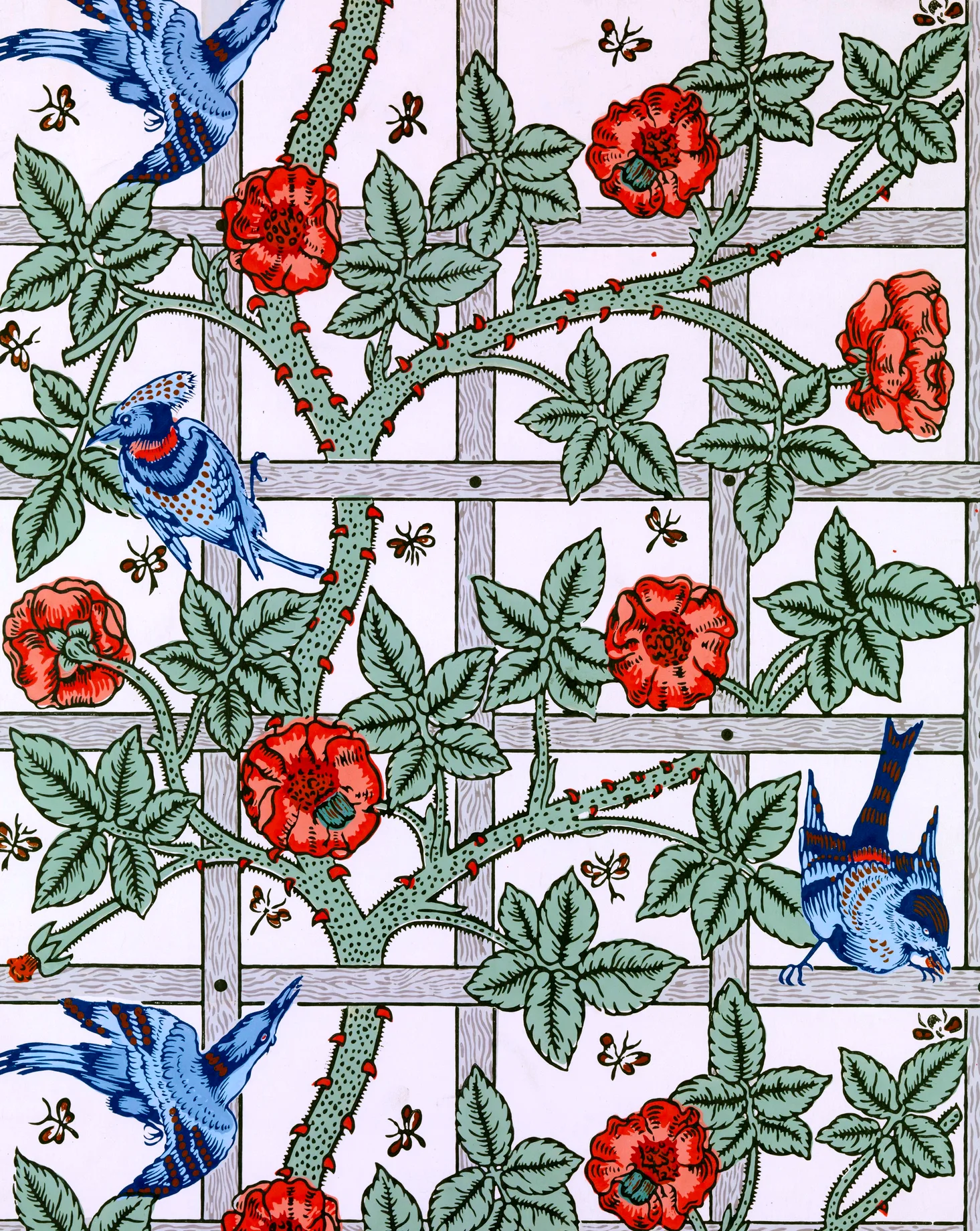
Trellis by William Morris is an 1862 wallpaper pattern combining thorny climbing roses on a wooden garden trellis with birds and small insects against a pale ground.
| Designed | 1862 |
|---|---|
| Designer | William Morris |
| Type | wallpaper |
| Motifs | birds, flowers, trellis |
| Colourway | Ivory |
| Repeat | not measured |
| Source | The Metropolitan Museum of Art. Licence: CC0. Museum record |
Order Trellis as a print
Format
Size (inches)
$40
Made to order. Shipping included in the US.
Seamless pattern file
A repeat tile of this design, ready to fill any size in design software.
What Trellis shows
Trellis by William Morris presents a structured outdoor garden scene centered on climbing roses and garden birds. A pale gray-brown wooden framework with visible wood grain and peg joints runs across the design in a regular grid. Stout, mossy-green rose canes covered in sharp red thorns wind their way through this structural lattice. Broad clusters of serrated green leaves branch out across the timber bars, accompanied by open red roses with dark centers and rounded rose hips.
Several birds with bright blue plumage, spotted breasts, and banded wing feathers populate the vine. Some perch alertly on the wooden crossbars, while others reach toward the stems or flutter downward with spread wings. Small winged insects with slender bodies hover in the open gaps of the framework. The composition balances the rigid geometry of the square garden lattice against the natural, curving growth of the rose branches. A clean, light ivory ground sits behind the timber frame, giving the birds and foliage a bright, readable outline.
Who designed it and when
William Morris designed Trellis in 1862. It stands as an important early milestone in the history of decorative design. To understand where this work fits within his career, you can read our guide to William Morris and his life and work.
The design record lists the original creation year as 1862. The museum object scanned for this site carries an object date of 1864, showing that sources record slightly different dates for the design drawing and the later physical printing. The pattern is cataloged alongside hundreds of historic patterns in our index of every William Morris design. It sits among his most recognized nature studies, alongside later favorites like Strawberry Thief.
How it was made and used
Morris conceived Trellis specifically as a wallpaper. In the Victorian home, wallpaper served as the primary method for introducing repeating natural patterns to parlors, drawing rooms, and hallways. The design relies on a vertical and horizontal lattice that naturally reinforces the architecture of an interior wall while bringing the appearance of a sunlit garden indoors.
Historically, wallpapers of this era were hand-printed from carved wooden blocks using opaque, water-based distemper pigments. Each color in the pattern required a separate block and an individual press. The light ground, the gray tones of the wood, the green leaves, the red rose petals, and the blue feathers of the birds were built up layer by layer to form the complete repeat.
Colourways
On this site, Trellis is offered in one colourway: Ivory. This colourway is derived from a high-resolution public-domain scan provided by the Metropolitan Museum of Art under a CC0 licence.
The Ivory colourway features a soft, pale off-white ground behind the wooden framework. The trellis itself is rendered in muted grayish-brown planks with subtle grain markings. The rose vines show warm olive and sage greens dotted with brick-red thorns, leading to open red blossoms. The blue birds offer a vibrant focal contrast across the pattern, their feathers rendered in clear sky-blue and deep indigo tones.
Trellis as a print
Trellis is available as a print, printed and shipped by ArtsyWall. You can order it in three formats: Archival Paper, Premium Canvas, and Framed Canvas. If you prefer covering an entire room rather than hanging art, you can also find this design as peel-and-stick wallpaper on williammorriswallpapers.com.
On Archival Paper, the fine linework of the wooden grain and the sharp details of the bird plumage read cleanly against the matte cotton paper. On Premium Canvas, the texture of the fabric lends a woven, painterly weight to the climbing vines. In a Framed Canvas format, the floating frame separates the outer edge of the print from the wall, allowing the architectural grid of the trellis to act as an open window overlooking an active garden scene.
Want Trellis on a whole wall? See Trellis wallpaper, sized to your wall.
Questions and answers
Who designed Trellis?
William Morris designed Trellis. It was his first wallpaper pattern, created in 1862. The design combines climbing rose canes woven through a garden trellis with blue birds and small flying insects. You can view Trellis alongside works by Morris and other designers in the pattern library.
When was Trellis designed?
Trellis was designed in 1862. The pattern design record dates it to 1862, while the museum printing scanned for the site bears the date 1864, reflecting when this specific object was produced. Both dates reflect the early decorative work created by William Morris during the 1860s.
What does the Trellis pattern show?
The Trellis pattern shows thick, thorny rose stems climbing across a square wooden garden framework. Clusters of serrated green leaves, open red blossoms, and rounded rosebuds weave through the laths. Several blue birds perch on the canes and bars, accompanied by small brown insects hovering in the open spaces.
Was Trellis a wallpaper or a fabric?
Trellis was originally designed as a wallpaper. The historical design record classifies it as wallpaper rather than a woven or printed textile. William Morris developed it in 1862 as an architectural pattern for interior walls, and it remains available today as wall prints and peel-and-stick wallpaper.