African Marigold by William Morris
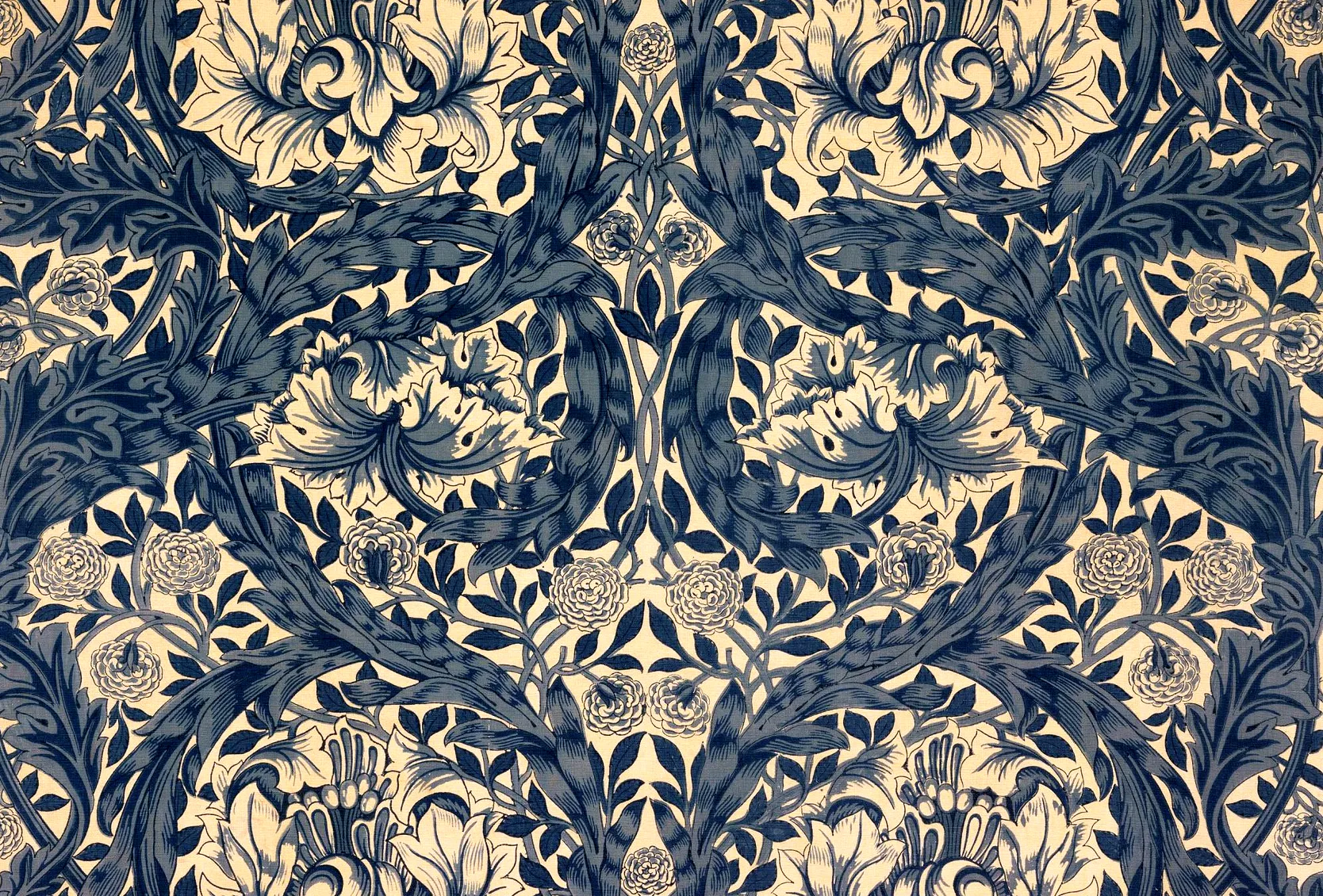
African Marigold by William Morris is an 1876 textile pattern featuring symmetrical scrolling foliage, large ruffled flowers, and round marigold blossoms across a balanced vertical repeat.
Colourways
| Designed | 1876 |
|---|---|
| Designer | William Morris |
| Type | textile |
| Motifs | flowers |
| Colourway | Indigo |
| Repeat | not measured |
| Source | Cooper Hewitt, Smithsonian Design Museum. Licence: CC0. Museum record |
Order African Marigold as a print
Format
Size (inches)
$40
Made to order. Shipping included in the US.
Seamless pattern file
A repeat tile of this design, ready to fill any size in design software.
What African Marigold shows
African Marigold by William Morris is an 1876 textile pattern defined by large scrolling foliage, jagged flower petals, and small rosette blooms. The design runs in a symmetrical vertical structure. Thick, curving leaves sweep upward and outward, curling into prominent crests before turning downward. Intertwined stems weave through the center, balancing the weight of the broad foliage with delicate linework.
Large open flowerheads emerge along the main vines, displaying ruffled, scalloped petals with detailed line shading. Beneath and around these focal flowers, tight, round marigold heads sit on slender branchlets. Pointed leaflets cluster closely around each small bloom, filling the background spaces between the heavy foliage. The composition alternates between broad, shaded ribbons of acanthus-style leaves and tight clusters of blossoms, creating rhythm across the repeating surface.
Who designed it and when
William Morris designed African Marigold in 1876. The design record dates the pattern to 1876 as a textile design, though museum records note that the museum page credits Morris & Co. while listing Morris by title. The sources differ slightly on attribution wording, reflecting how the firm produced and cataloged work created by its founder.
In our guide to William Morris, you can trace how his work evolved during the 1870s as he experimented with complex repeats. African Marigold arrived during a prolific decade of textile production for Morris & Co. It preceded later printed textile works in our directory of every William Morris design, sharing the energetic growth and organic foliage seen in patterns like Strawberry Thief.
How it was made and used
African Marigold was designed and produced as a textile. The museum objects scanned for this collection, preserved at the Cooper Hewitt, Smithsonian Design Museum under CC0 public domain licenses, represent textile printings dated to 1876. Morris developed patterns like this for home interiors, where printed cotton fabrics served as curtains, loose covers, and upholstery.
The repeat structure uses mirrored vertical symmetry. When multiple panels hang side by side, the intertwined stems meet at the boundaries to form continuous arches and diamond-shaped spaces. This balanced structure allows the eye to follow the vertical flow of the vines without losing the individual floral details. Morris relied on careful hand-drawn curves so the continuous repeats would avoid stiff or mechanical lines across wide expanses of fabric.
Colourways
This site presents African Marigold in two colourways sourced from historical museum scans. Both versions preserve the delicate line work and textural shading of the original 1876 textile specimens.
The Indigo colourway presents a tonal blue scheme. Deep indigo and slate blue inks define the leaves, stems, and flower petals over a warm, pale ground. The dark blue shading on the large scrolling leaves creates strong depth against the lighter blue petals and cream background.
The Black on Ivory colourway introduces a richer, multi-colored palette. It features muted slate-blue tones on the large twisting foliage and outer flower petals, paired with earthy green leaves along the climbing stems. Small marigold blossoms appear in warm ochre and mustard yellow, giving the composition distinct points of warm contrast across an ivory ground.
African Marigold as a print
You can order African Marigold in three print formats printed and shipped by ArtsyWall: Archival Paper, Premium Canvas, and Framed Canvas. The Archival Paper option suits traditional glazing in standard picture frames, highlighting the fine etched shading of the petals. If you prefer a clean look without glass, Premium Canvas wraps the pattern over solid wood stretcher bars.
Framed Canvas encases the design in a wooden floating frame, available in black, white, gold, silver, walnut, or oak. When framed, the mirrored curves of African Marigold draw the eye straight into the center of the wall. The bold scrolling foliage provides immediate presence across the room, while the tight clusters of marigolds reward closer viewing.
Want African Marigold on a whole wall? See African Marigold wallpaper, sized to your wall.
Questions and answers
Who designed African Marigold?
William Morris designed African Marigold. Historical design records attribute the pattern directly to Morris, while the museum catalog at the Cooper Hewitt lists William Morris by title and credits the firm Morris & Co. This dual attribution is common for Morris & Co. patterns, as Morris served as both the primary pattern designer and the head of the decorative arts manufacturing workshop.
When was African Marigold designed?
African Marigold was designed in 1876. Both the core design records and the textile specimens preserved at the Cooper Hewitt museum date this pattern to 1876. The mid-1870s represented a highly productive era for William Morris, during which he focused heavily on creating complex floral repeat patterns for interior textiles and furnishing fabrics.
What does the African Marigold pattern show?
The African Marigold pattern shows a vertically symmetrical arrangement of intertwined stems, large ruffled flower blossoms, and small rounded marigolds. Broad, curving leaves arc outwards with fine parallel line shading, while slender vines weave through the center. Small marigold blossoms with dense petals cluster alongside pointed green leaflets, filling the intervals between the bold scrolling foliage.
Was African Marigold a wallpaper or a fabric?
African Marigold was designed and produced as a fabric rather than a wallpaper. The historical pattern belongs to the textile category in the Morris catalog, and the original 1876 specimens in museum archives are printed textiles. Morris & Co. printed designs of this scale on cotton fabrics intended for decorative furnishings, drapery panels, and domestic upholstery.