Arcadia by May Morris
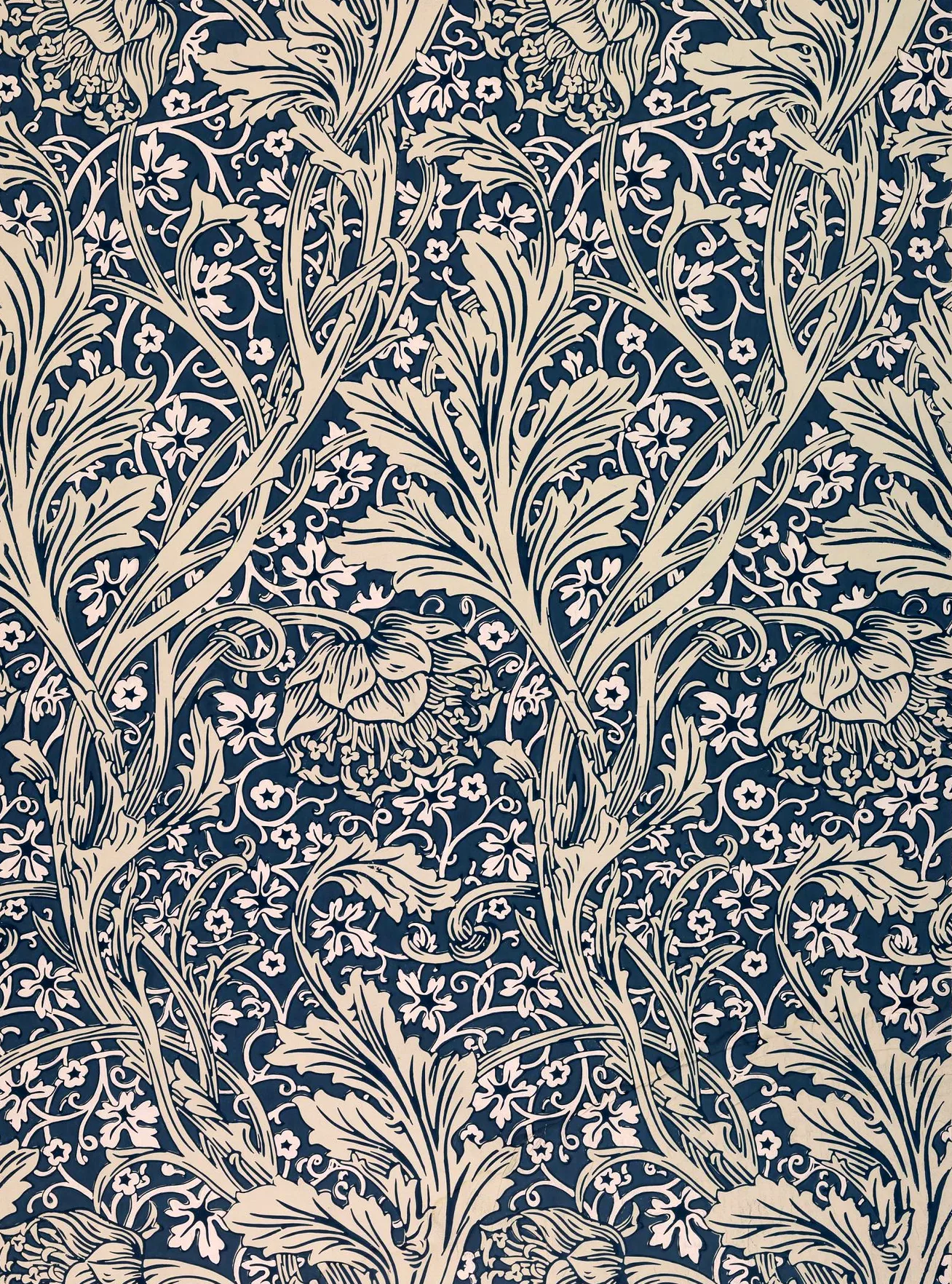
Arcadia is an 1886 wallpaper pattern designed by May Morris for Morris & Co. It features large acanthus-like leaves, nodding flower heads, and scrolling stems across a delicate floral ground.
| Designed | 1886 |
|---|---|
| Designer | May Morris |
| Type | wallpaper |
| Motifs | flowers, leaves |
| Colourway | Indigo on Ivory |
| Repeat | not measured |
| Source | Cooper Hewitt, Smithsonian Design Museum. Licence: CC0. Museum record |
Order Arcadia as a print
Format
Size (inches)
$40
Made to order. Shipping included in the US.
Seamless pattern file
A repeat tile of this design, ready to fill any size in design software.
What Arcadia shows
Arcadia features bold, arching plant stems that curve across the surface, bearing deeply lobed, feathered leaves and heavy downward-facing blossoms. The primary foliage resembles classical acanthus, twisting in graceful arcs that interlock across the composition. Beneath and between these large curving branches, a dense secondary layer of small star-like flowers and thin sprigs fills every open space, giving the design substantial textural depth.
In the Indigo on Ivory colourway shown on this site, the entire composition is rendered in two contrasting tones. The deep indigo blue field forms the background, while the light ivory shade defines the foreground branches, leaves, and underlying sprigs. The lighter tone also outlines the serrated edges and interior ribs of each leaf, creating a crisp, graphic read across the wall.
Who designed it and when
Arcadia was designed in 1886 by May Morris. May was the younger daughter of William Morris and Jane Morris, and an accomplished artisan who took charge of the Morris & Co. embroidery department in 1885 at age twenty-three. Although many patterns from the workshop were often misattributed to her father, museum records document May Morris as the designer of this pattern.
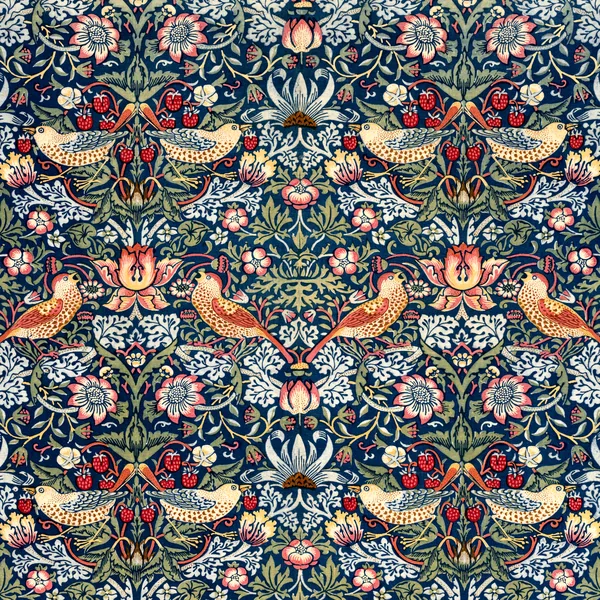
Her work on Arcadia arrived during an active decade for Morris & Co., only three years after her father’s famous Strawberry Thief printed textile. You can browse every William Morris design in our library to see how May’s botanical work sits alongside designs by her father and fellow Morris & Co. designer John Henry Dearle.
How it was made and used
Arcadia was manufactured as a wallpaper for domestic interiors. While May Morris built a substantial reputation leading embroidery work and founding the Women’s Guild of Arts in 1907, she also produced flat patterns intended for paper printing.
Like other Morris & Co. papers of the 1880s, the design relied on carefully planned repeats to allow the curving stems to connect seamlessly from roll to roll. The complex background tracery helped disguise the seams between paper drops, creating an unbroken decorative surface when hung across a room.
Colourways
This site currently offers Arcadia in one historical colourway:
- Indigo on Ivory: A dark navy blue ground paired with pale ivory stems, leaves, and meadow flowers, based on an original 1886 wallpaper specimen in the Cooper Hewitt collection.
The high-contrast two-tone palette emphasizes the structure of May Morris’s drawing without competing multi-colour fills, allowing the rhythmic movement of the stems to take center stage.
Arcadia as a print
Arcadia is available as an art print printed and shipped by ArtsyWall in three formats: Archival Paper, Premium Canvas, and Framed Canvas.
Because Arcadia relies on a balanced two-color scheme, it works exceptionally well as a standalone framed picture. On Archival Paper, the textured 100% cotton rag surface highlights the crisp botanical line work. On Premium Canvas or Framed Canvas, the deep indigo ground provides rich, graphic depth against lighter wall surfaces. The Framed Canvas option surrounds the design with a floating wood frame in your choice of black, white, gold, silver, walnut, or oak.
Want Arcadia on a whole wall? See Arcadia wallpaper, sized to your wall.
Questions and answers
Who designed Arcadia?
Arcadia was designed by May Morris, the younger daughter of William Morris. She became head of the embroidery department at Morris & Co. in 1885. While many patterns produced by the firm are credited to William Morris, museum records name May Morris as the designer of Arcadia.
When was Arcadia designed?
Arcadia was designed in 1886. That was the year after May Morris took charge of the embroidery department at Morris & Co. The pattern was produced as a commercial wallpaper during a period when she created numerous designs for her father's decorative arts enterprise.
What does the Arcadia pattern show?
Arcadia shows sweeping botanical stems with deeply serrated, feathered acanthus leaves and large nodding flower blossoms. Behind these primary curving branches lies a dense background field filled with miniature five-petaled blossoms and fine leafy sprigs, creating a rich two-layered floral rhythm.
Was Arcadia a wallpaper or a fabric?
Arcadia was produced as a wallpaper. Although May Morris was best known for directing the Morris & Co. embroidery workshop and producing needlework patterns, historical records and museum collections categorize Arcadia specifically as a machine-printed or block-printed wallpaper design for interiors.