Acanthus by William Morris
Acanthus by William Morris is an 1876 textile design defined by large, sweeping acanthus leaves and dense foliage layers. It presents bold, scrolling greenery that creates deep visual rhythm across walls and fabrics.
Colourways
| Designed | 1876 |
|---|---|
| Designer | William Morris |
| Type | textile |
| Motifs | leaves |
| Colourway | Red |
| Repeat | not measured |
| Source | Art Institute Chicago. Licence: CC0. Museum record |
Order Acanthus as a print
Format
Size (inches)
$40
Made to order. Shipping included in the US.
Seamless pattern file
One repeat tile, ready to fill any size in design software.
What Acanthus shows
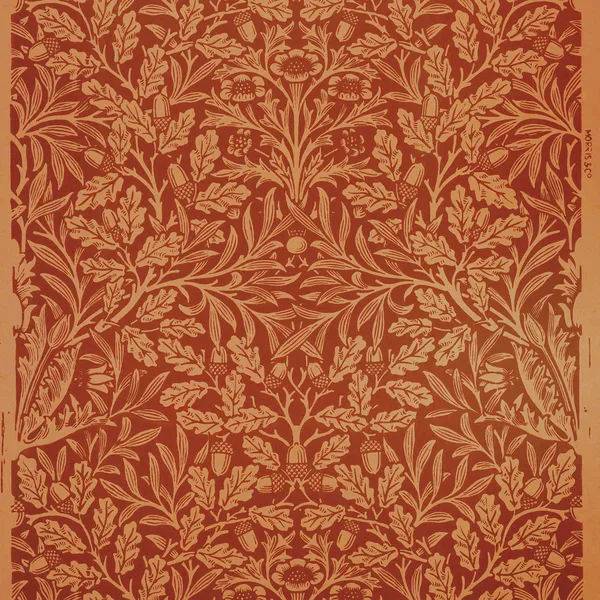
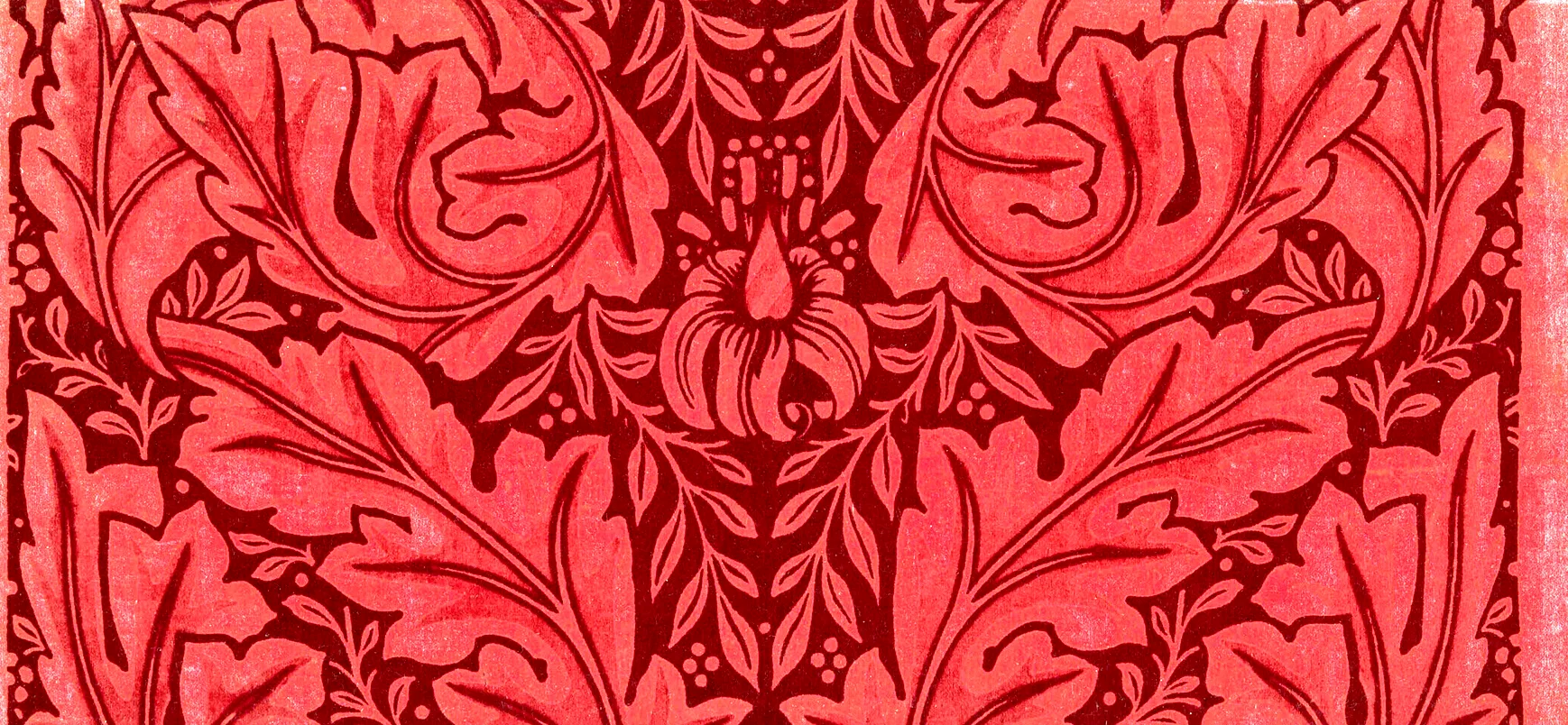
Acanthus by William Morris presents large, scrolling foliage that fills the entire surface with fluid movement. Broad, deeply lobed acanthus leaves curve upward and inward, their serrated edges turning over to show layered contours. The stems arch and intertwine, establishing a strong vertical rhythm that guides your eye through the composition.
Beneath and around the heavy main leaves lies a dense secondary ground of foliage. Pointed sprigs, slender fronds, and clustered berries pack the negative spaces. Fine dots and hatched accents line the stems and leaf bases, adding subtle texture without distracting from the primary scrollwork. You can see how the repeat mirrors and locks together, forming an unbroken screen of woodland growth.
Who designed it and when
William Morris designed Acanthus in 1876. He developed the pattern for Morris & Co. as part of his extensive exploration of botanical forms. To see more work from this period or read about his design principles, explore our William Morris guide covering his life and work.
Museum collections document the continued manufacture of the design over several decades. Surviving printed and woven examples from the Art Institute of Chicago show production dates ranging from 1877 to 1917. A silk embroidery on linen version, worked as a portière and held by the Art Gallery of South Australia, dates from the 1890s. You can compare Acanthus with later Morris favourites like Strawberry Thief in our complete index of William Morris patterns.
How it was made and used
Design records classify Acanthus as a textile. Morris used natural leaf motifs to construct repeating patterns that hung comfortably across domestic interiors, serving as drapery, wall hangings, and upholstery. The design achieved prominence as both yard goods and dedicated architectural furnishings.
One preserved specimen from the Art Gallery of South Australia demonstrates how the pattern was adapted as a portière, or door curtain, using silk embroidery on a linen ground. The embroidery stitches follow the curved ribs of the foliage, giving the flat textile raised physical texture and catching light across the leaves. In other versions, block-printed pigments transfer the dense lines of the background fronds directly onto woven cloth.
Colourways
This site presents three colourways based on public-domain museum scans. Two scans come from the Art Institute of Chicago, and one comes from Wikimedia Commons.
- Red (light ground): Features bright orange and golden-yellow foliage outlined in deep crimson over a warm, lighter red ground.
- Red (dark ground): Presents deep crimson and scarlet leaves set against a darker, near-black red background, emphasizing dramatic contrast in the central flower and leaf clusters.
- Brown on Ivory: Derived from the 1890s embroidered portière, pairing warm brown and sepia needlework tones with a soft, neutral ivory base.
Acanthus as a print
When displayed on a wall, Acanthus commands attention through its bold botanical curves and intricate foliage layers. The large acanthus leaves anchor a room, while the background stems reward close inspection. If you prefer to cover an entire wall rather than hang individual art, you can also view Acanthus peel-and-stick wallpaper through our sister site.
Prints are printed and shipped by ArtsyWall in three formats: Archival Paper, Premium Canvas, and Framed Canvas. Archival Paper highlights the delicate drawn line work of the background leaves. Premium Canvas emphasizes the rich, saturated ground tones across an unframed edge. Framed Canvas places the pattern within a clean wood float frame, giving the scrolling vegetation a sharp boundary that works well in both classic and contemporary rooms.
Want Acanthus on a whole wall? See Acanthus wallpaper, sized to your wall.
Questions and answers
Who designed Acanthus?
William Morris designed Acanthus in 1876. He created the pattern for Morris & Co., featuring dynamic, curling foliage and layered foliage sprays. While many historical patterns sold today came from other workshop artists like John Henry Dearle, museum and workshop records attribute the original Acanthus design directly to William Morris.
When was Acanthus designed?
William Morris designed Acanthus in 1876. The design was produced as a textile, with surviving museum examples manufactured between 1877 and 1917, as well as an embroidered portière dating from the 1890s. The design remains one of Morris's most recognized botanical compositions from the mid-1870s.
What does the Acanthus pattern show?
Acanthus shows large, curling acanthus leaves that curve in deep vertical sweeps across the surface. Behind and between the primary foliage, delicate sprays of pointed leaves, small buds, and dotted berry clusters fill every gap. The interlacing vegetation forms a layered ground that repeats seamlessly from top to bottom.
Was Acanthus a wallpaper or a fabric?
Acanthus was designed and produced as a textile according to historical design records. Surviving museum pieces include woven and printed textiles, as well as a silk embroidery on linen made as a portière in the 1890s. Today, the design is also adapted and sold as decorative wallpaper.