Willow Bough by William Morris
Willow Bough by William Morris is an 1887 wallpaper pattern featuring curving willow branches and dense leaves. You can explore its original design history and order prints in three archival formats.
Colourways
| Designed | 1887 |
|---|---|
| Designer | William Morris |
| Type | wallpaper |
| Motifs | leaves, trees |
| Colourway | Charcoal |
| Repeat | not measured |
| Source | Cooper Hewitt, Smithsonian Design Museum, via Wikimedia Commons. Licence: Public domain (Wikimedia Commons). Museum record |
Order Willow Bough as a print
Format
Size (inches)
$40
Made to order. Shipping included in the US.
Seamless pattern file
One repeat tile, ready to fill any size in design software.
What Willow Bough shows
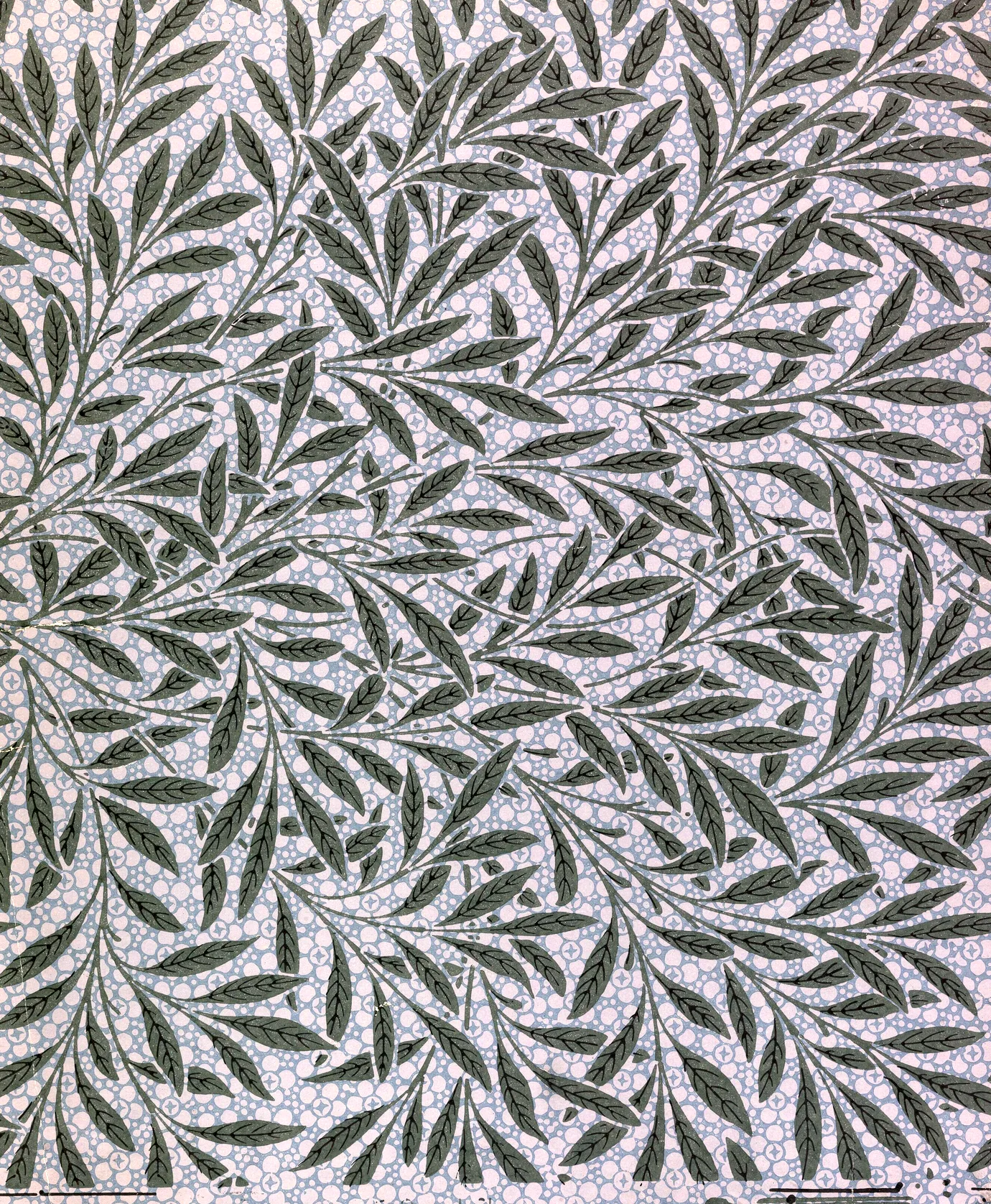
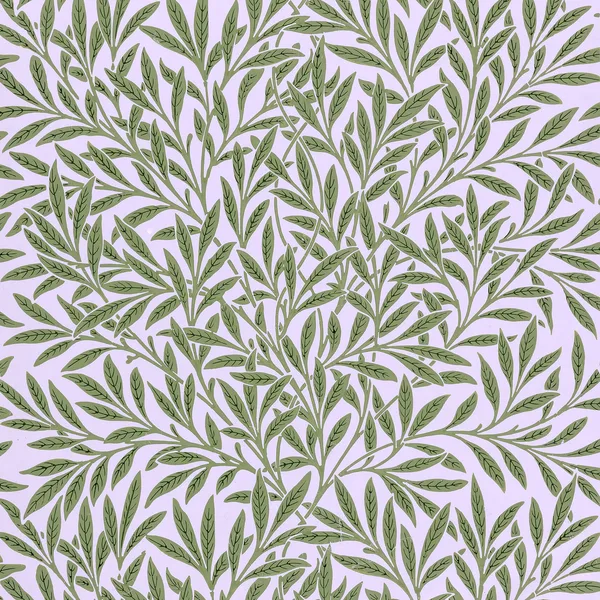
Willow Bough by William Morris displays a dense, rhythmic pattern of curling willow branches laden with long, pointed leaves. The stems curve across the surface in sweeping diagonals, splitting into smaller shoots that intertwine with neighboring boughs. Each lance-shaped leaf is rendered with a dark center vein and an organic curve, giving the whole composition the feeling of a living tree canopy seen from below.
The arrangement fills the visual field without leaving large blank voids. Depending on the colourway, you see either a clean, solid background or an intricate secondary ground powdered with delicate dots and tiny four-petaled florets. The layered branches create a rich sense of depth through overlapping forms rather than artificial perspective or shading.
Who designed it and when
William Morris designed Willow Bough in 1887. You can trace Morris’s career and development across our guide to William Morris. Although the pattern is firmly credited to Morris, museum catalog records show slight variations: some Cooper Hewitt entries list the designer line as unknown artist, whereas the museum category attributes it to William Morris, and The Metropolitan Museum of Art explicitly names Morris as the designer.
Morris had explored willow foliage earlier in his career, notably in his 1874 pattern Willow. While the 1874 work relied on simpler, diagonal branches against a lighter ground, Willow Bough expanded that botanical theme with more complex intertwining stems and dense foliage. It became one of the most enduring designs cataloged among every William Morris design produced by Morris & Co. during the late nineteenth century.
How it was made and used
Morris & Co. produced Willow Bough as a block-printed wallpaper sidewall. Craftsmen carved the design across multiple relief woodblocks, with separate blocks used to stamp each distinct pigment onto long rolls of paper. Block printing allowed the inks to lie opaque and slightly textured on the paper, giving the foliage clean edges and deep tone.
The design was intended for interior walls in domestic settings. The pattern repeat measures about 10.4 by 17.7 inches according to museum measurements, allowing the branching stems to join seamlessly when hung as sidewall panels. In Victorian homes, decorators often installed Willow Bough across entire rooms to bring the natural structure of English riverbanks indoors.
Colourways
This site presents Willow Bough in three distinct colourways derived from public-domain museum scans:
- Charcoal: Dark grey-green willow leaves and branching stems set over a soft off-white ground powdered with muted blue-grey dots and delicate petal shapes.
- Gold: Warm olive-yellow leaves and branches set against a clean, unadorned light ground.
- Dark Green on Ivory: Deep olive-green foliage arranged over an ivory backdrop, showcasing the crisp silhouette of the woodblock printing.
Each colourway reveals a different aspect of the botanical structure. The powdered ground in Charcoal adds subtle texture between the leaves, while Gold and Dark Green on Ivory emphasize the fluid line of the willow branches against open space.
Willow Bough as a print
You can bring Willow Bough into your home as an art print, printed and shipped by ArtsyWall in three formats: Archival Paper, Premium Canvas, and Framed Canvas. Archival Paper delivers the design on heavy 340gsm cotton rag paper with a textured watercolor feel. Premium Canvas features acid-free canvas hand-stretched over solid wood bars with a sawtooth hanger ready for the wall. Framed Canvas places the stretched canvas inside a wood floating frame, available in black, white, gold, silver, walnut, or oak finishes with an attached hanging wire.
Framed on a wall, Willow Bough creates an earthy focal point where the sweeping branches read clearly from across a room. If you are decorating an entire wall surface instead of hanging a single artwork, you can also find Willow Bough peel-and-stick wallpaper through our sister site.
Want Willow Bough on a whole wall? See Willow Bough wallpaper, sized to your wall.
Questions and answers
Who designed Willow Bough?
William Morris designed Willow Bough. While museum catalog records at the Cooper Hewitt list the artist as unknown on certain file entries, the museum category and historical records attribute the wallpaper design directly to William Morris. It remains one of his most recognized pattern works, featuring curving willow branches and slender leaves.
When was Willow Bough designed?
Willow Bough was designed in 1887. Museum records and historical documentation date the original block-printed wallpaper sidewall to that year. Morris had earlier created a simpler pattern called Willow in 1874, but he returned to the motif in 1887 to develop this more layered, curving version with overlapping branches and delicate leaf clusters.
What does the Willow Bough pattern show?
The Willow Bough pattern shows a dense arrangement of curving willow branches covered in long, slender leaves. The stems sweep across the surface in natural, overlapping curves, creating a layered botanical rhythm. Depending on the colourway, the foliage sits against a plain light background or a decorative ground powdered with delicate dots and tiny floral shapes.
Was Willow Bough a wallpaper or a fabric?
Willow Bough was originally designed and produced as a block-printed wallpaper sidewall. The design records and museum collections, including the Cooper Hewitt and The Metropolitan Museum of Art, classify the 1887 work specifically as wallpaper. Its popularity later inspired various decorative uses, but historical printings began on paper for Victorian interior walls.
.jpg)