Oak by William Morris
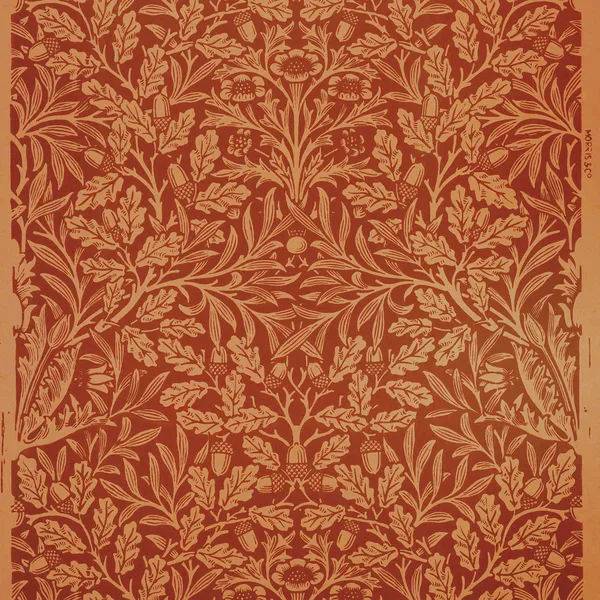
Oak is an 1881 textile pattern designed by William Morris, featuring scrolling oak leaves and stylized botanical motifs set in a symmetrical repeat.
| Designed | 1881 |
|---|---|
| Designer | William Morris |
| Type | textile |
| Motifs | leaves, trees |
| Colourway | Blue |
| Repeat | not measured |
| Source | Art Institute Chicago. Licence: CC0. Museum record |
Order Oak as a print
Format
Size (inches)
$40
Made to order. Shipping included in the US.
Seamless pattern file
A repeat tile of this design, ready to fill any size in design software.
What Oak shows
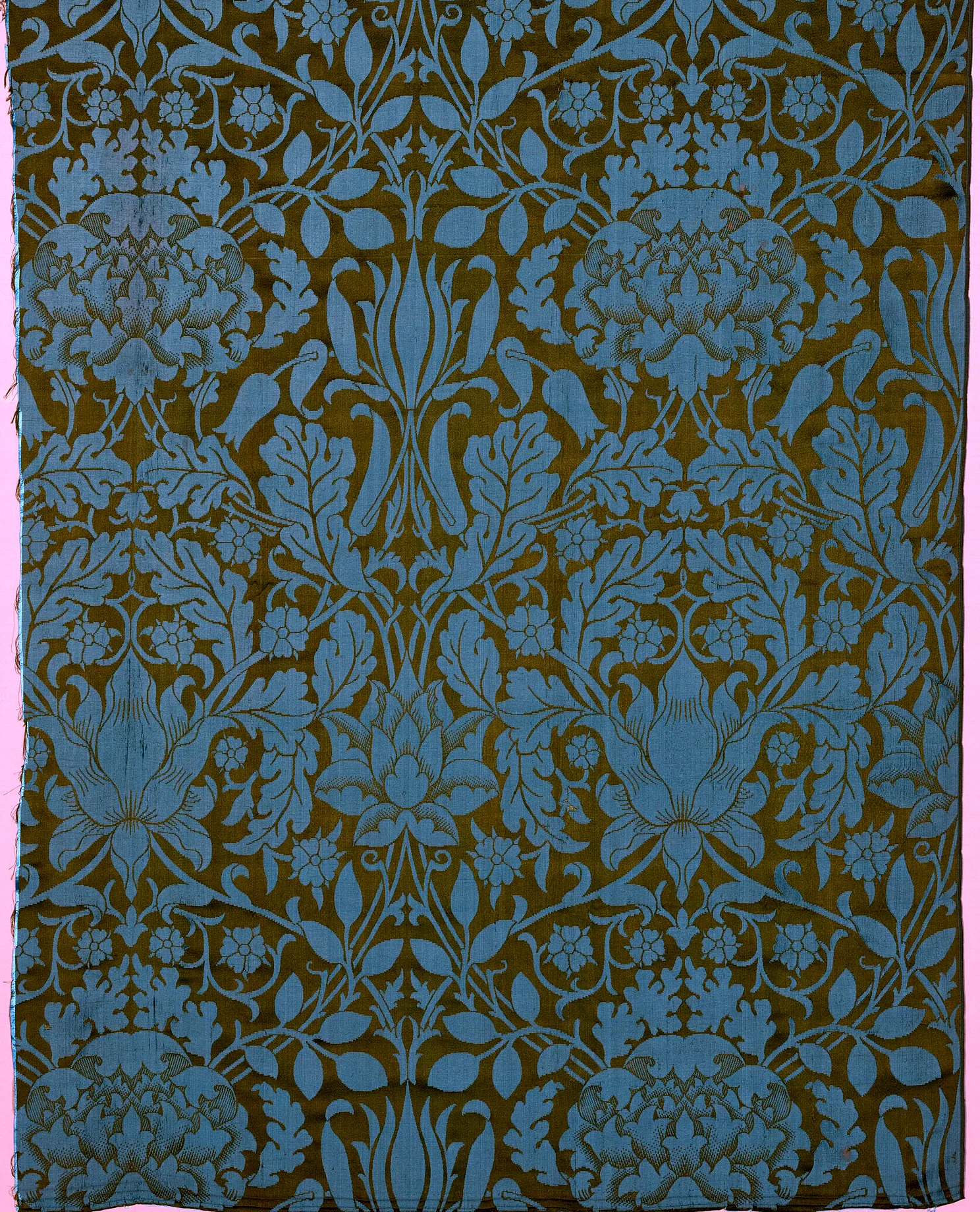
Oak by William Morris is a formal textile design built around the foliage of English woodland trees. You can see pairs of broad, lobed oak leaves branching off central stems, curving outward to fill the field. Stylized floral crowns and large multi-petaled blossoms anchor the vertical axes, while smaller rosettes with rounded petals fill the spaces between the thick branches.
The layout follows a symmetrical, mirrored structure. Two heavy stems rise, divide, and bend back toward each other to create ogee-like compartments. Inside each frame, Morris placed upright leafy palmettes and drooping bud forms. The leaves carry fine linear details along their ribs, giving the pattern clear visual structure against the dark background.
Every part of the surface stays active. Morris balanced large massed leaves with delicate sprigs, small five-petaled flowers, and turning tendrils. Because the motifs mirror each other across the vertical centerline, the pattern creates a steady, formal rhythm when viewed across a wide area.
Who designed it and when
William Morris designed Oak in 1881. By that year, Morris had developed an extensive library of patterns based on native British trees, plants, and garden vines. You can explore every William Morris design in our library to see how his approach evolved across different mediums.
Morris drew his foliage directly from nature while imposing a strict geometric discipline. Rather than drawing a photographic scene of an oak bough, he adapted the tree into a repeating pattern. You can read more about his life, methods, and career in our guide to William Morris.
During the early 1880s, Morris designed both dense floral patterns and lighter leaf arrangements. While foliage patterns such as Willow Bough offer a delicate, overlapping canopy, Oak presents a heavier, more architectural presence built on symmetry and weight.
How it was made and used
Oak was manufactured as a textile rather than a printed wallpaper. The original design was made to be woven, allowing the pattern to emerge through the contrast of warp and weft threads. The museum scan in our collection comes from a woven textile preserved at the Art Institute of Chicago.
In Victorian interiors, heavy textiles of this type served practical needs. Woven fabrics hung as portieres across drafty doorways, covered parlor chairs, or dressed tall windows. The dense layout and strong structure helped the design read clearly even when hung in deep, gathered folds.
Because the design repeats evenly in vertical and horizontal lines, the fabric could be cut and joined cleanly across wide walls or window bays. The woven structure gave the pattern physical weight and durability suitable for daily home use.
Colourways
Our library presents Oak in one colourway: Blue. This colourway is taken directly from the historical textile scan held by the Art Institute of Chicago under a CC0 public-domain licence.
The Blue colourway pairs a light slate-blue motif against a deep, dark olive-brown ground. The cool blue tones highlight the edges of the oak leaves, stems, and petals, while the dark ground recedes behind them. The contrast gives the foliage a sharp outline and brings out the fine detailing inside each blossom.
Oak as a print
Oak works well as wall art due to its strong symmetry and rhythmic foliage. You can order the pattern through ArtsyWall in three formats: Archival Paper, Premium Canvas, and Framed Canvas. Archival Paper prints offer a fine art finish printed on 340gsm textured cotton rag paper, shipped rolled in a sturdy tube.
Canvas prints are hand-stretched on solid wood bars and feature archival giclée inks. Framed Canvas options include floating frames in black, white, gold, silver, walnut, and oak finishes, leaving a clean gap around the canvas edge. Framed on a wall, Oak functions as a focused botanical study with balanced, quiet geometry.
Want Oak on a whole wall? See Oak wallpaper, sized to your wall.
Questions and answers
Who designed Oak?
William Morris designed the Oak pattern in 1881. Morris created it as a woven textile pattern featuring pairs of lobed leaves, scrolling stems, and formal floral forms arranged in a vertical symmetry. The design is preserved in museum collections, including the Art Institute of Chicago, and rests in the public domain.
When was Oak designed?
The Oak pattern was designed in 1881 by William Morris. Morris produced several nature-inspired textile and wallpaper designs during this period, focusing on British woodland trees and garden flora. The museum specimen at the Art Institute of Chicago records the design date as 1881.
What does the Oak pattern show?
The Oak pattern shows bold, lobed oak leaves that turn outward along climbing stems, framing central floral palmettes and large blossoms. Small five-petaled rosettes sit among the larger foliage. The composition forms a mirrored, balanced vertical repeat typical of late nineteenth-century damask textiles.
Was Oak a wallpaper or a fabric?
Oak was produced as a textile rather than a wallpaper. The historical museum record catalogs the object as a woven fabric design. Its large repeat and mirrored vertical structure were planned specifically to suit hanging fabrics, draperies, and domestic furnishings.