Willow by William Morris
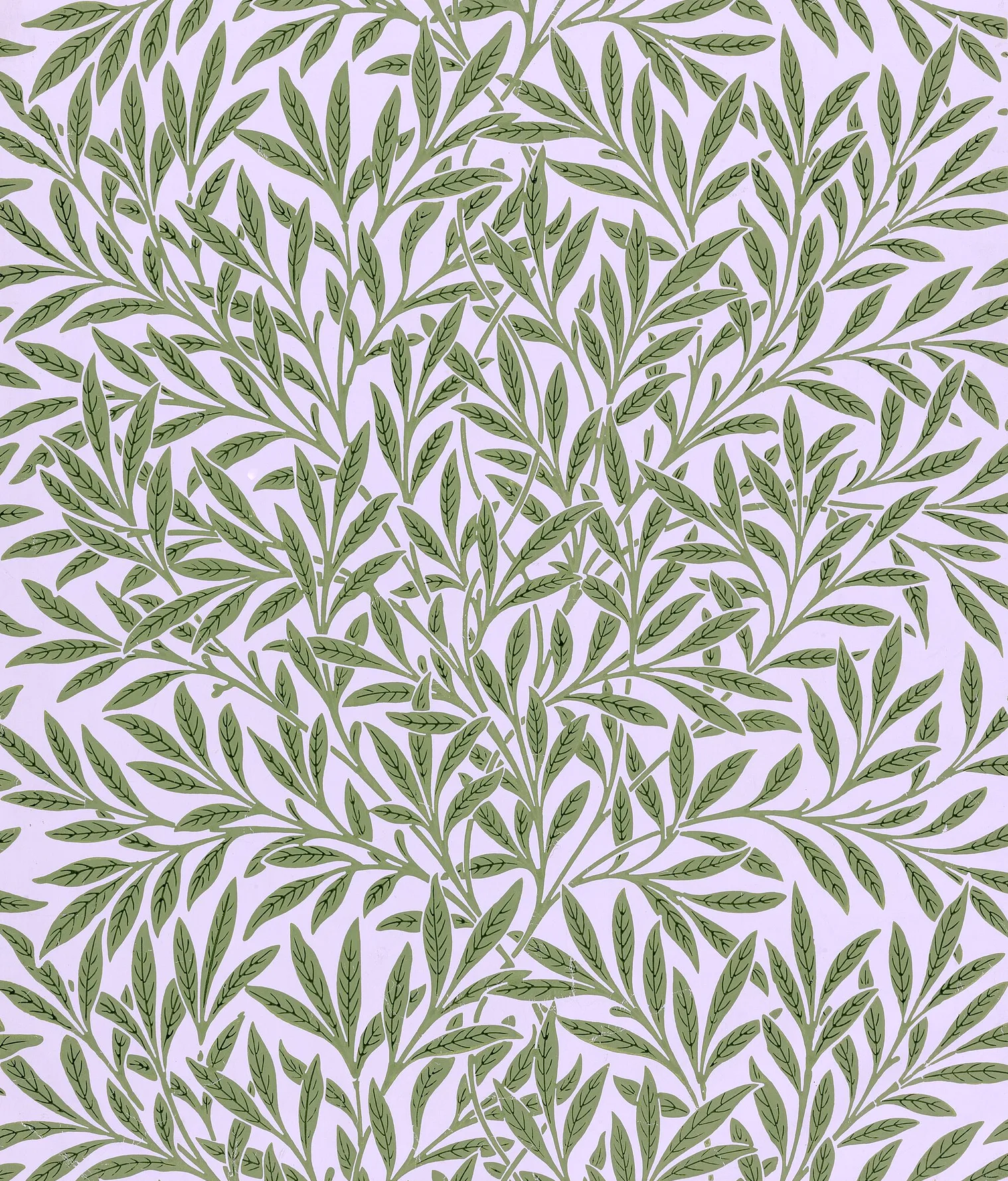
Willow by William Morris is an 1874 wallpaper pattern formed by curving willow branches and pointed leaves. It creates an all-over foliate pattern across your wall.
Colourways
| Designed | 1874 |
|---|---|
| Designer | William Morris |
| Type | wallpaper |
| Motifs | leaves, trees |
| Colourway | Green on Ivory |
| Repeat | not measured |
| Source | Cooper Hewitt, Smithsonian Design Museum, via Wikimedia Commons. Licence: Public domain (Wikimedia Commons). Museum record |
Order Willow as a print
Format
Size (inches)
$40
Made to order. Shipping included in the US.
Seamless pattern file
One repeat tile, ready to fill any size in design software.
What Willow shows
The Willow pattern by William Morris presents a continuous network of curving willow branches and slender leaves. Stems branch outward and sweep upward in gentle arcs, filling the field with botanical detail. The composition contains no flowers, birds, or fruit, focusing entirely on foliage and growth lines.
Each willow leaf features a simple lance-like shape with a defined outline and a central vein running down its middle. Leaves sprout in pairs and clusters, overlapping one another to create visual depth across a light background. The stems weave together into a dense lattice that prevents any single area from dominating the eye. This balanced arrangement gives the pattern an even texture that works well on broad surfaces.
Who designed it and when
William Morris designed Willow in 1874 for his decorative arts firm. You can learn more about his background and design philosophy in our guide to William Morris and his work. Morris loved the natural forms of British riverbanks, and willow foliage remained a recurring subject in his work. He later returned to this plant in 1887 to design Willow Bough, which features longer, trailing branches.
Museum records show slight variations in how the design is cataloged. Design records and most catalog entries identify William Morris as the designer, but one Cooper Hewitt museum record lists the designer as an unknown artist while naming Jeffrey & Company as the manufacturer. Another museum scan specifically attributes the sidewall design to Morris. These differences reflect how archival collections registered acquired samples from different historical donors over the years.
How it was made and used
Jeffrey & Company manufactured Willow in London as a sidewall wallpaper using hand-carved relief woodblocks. Printers applied water-based distemper pigments to the woodblocks and pressed them onto continuous paper rolls by hand. Surviving historical specimens at the Cooper Hewitt museum measure between 68.5 by 56 centimeters and 75 by 51.5 centimeters.
As a sidewall paper, Willow was intended to hang across the primary vertical surfaces of domestic living rooms, dining rooms, and hallways. The repeating pattern joins seamlessly along the roll edges to create an unbroken field of leaves. Its modest scale and muted rhythms allowed it to furnish a room without overpowering woodwork or furnishings. To see how Willow compares to other historical wallcoverings, you can browse every William Morris design across our complete catalog.
Colourways
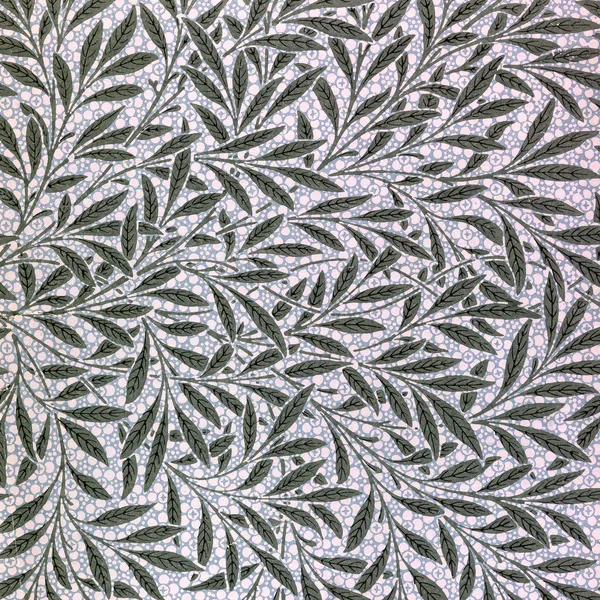
Our library offers five colourways based on public-domain museum scans of original printings. These include Green on Ivory, Green, Ivory on Stone, a second Green on Ivory variant, and Blue. Each option uses a pale, neutral ground to maintain clarity and lightness across the composition.
The Green and Green on Ivory colourways use natural olive tones on cream paper, matching the classic palette associated with Morris’s leafy wallpapers. Ivory on Stone captures an original subtle printing described in museum records as white on white, creating a tonal effect where the leaves appear as soft silhouettes. The Blue colourway delivers a crisp, cool interpretation that sharpens the contrast between the slender willow foliage and the pale ground.
Willow as a print
ArtsyWall prints and ships Willow in three distinct formats: Archival Paper, Premium Canvas, and Framed Canvas. Archival Paper prints provide an unframed fine art poster on textured cotton rag paper. Premium Canvas prints come stretched over solid wood bars with a sawtooth hanger attached. Framed Canvas options include wood floating frames in oak, walnut, black, white, gold, and silver finishes. Framed on a wall, the curving willow leaves sit inside clean borders that balance the busy, natural repeat of the boughs. If you are decorating an entire room rather than hanging standalone artwork, you can also purchase peel-and-stick Willow wallpaper from our sister site.
Want Willow on a whole wall? See Willow wallpaper, sized to your wall.
Questions and answers
Who designed Willow?
William Morris designed the Willow wallpaper pattern in 1874. Historical museum records from the Cooper Hewitt attribute the printing to Jeffrey & Company in England. While some museum archive sheets leave the artist field as unknown, design records and partner institution scans confirm William Morris as the original creator of this foliate pattern.
When was Willow designed?
William Morris designed Willow in 1874. The design was produced as a block-printed sidewall wallpaper during the height of his work with Jeffrey & Company. It predates Morris's later, related foliage design, Willow Bough, which he created thirteen years later in 1887 using longer, looser branches.
What does the Willow pattern show?
The Willow pattern shows dense, curving branches covered in slender willow leaves across a light background. There are no flowers, birds, or fruit in this design. Instead, the composition focuses entirely on overlapping stems and pointed leaves, which feature delicate vein outlines and create an organic, rhythmic movement across the surface.
Was Willow a wallpaper or a fabric?
Willow was originally created as a block-printed wallpaper rather than a woven or printed textile. Jeffrey & Company manufactured the design in the United Kingdom as a sidewall paper, printing pigment onto paper rolls with hand-carved woodblocks. Today, the design is also reproduced as fine art prints and canvas wall art.
.jpg)