Acorn by William Morris
Acorn by William Morris is an 1880 wallpaper pattern built around stylized oak foliage, clustered acorns, and trailing vines.
Colourways
| Designed | 1880 |
|---|---|
| Designer | William Morris |
| Type | wallpaper |
| Motifs | leaves, trees |
| Colourway | Red |
| Repeat | not measured |
| Source | Cooper Hewitt, Smithsonian Design Museum. Licence: CC0. Museum record |
Order Acorn as a print
Format
Size (inches)
$40
Made to order. Shipping included in the US.
Seamless pattern file
A repeat tile of this design, ready to fill any size in design software.
What Acorn shows
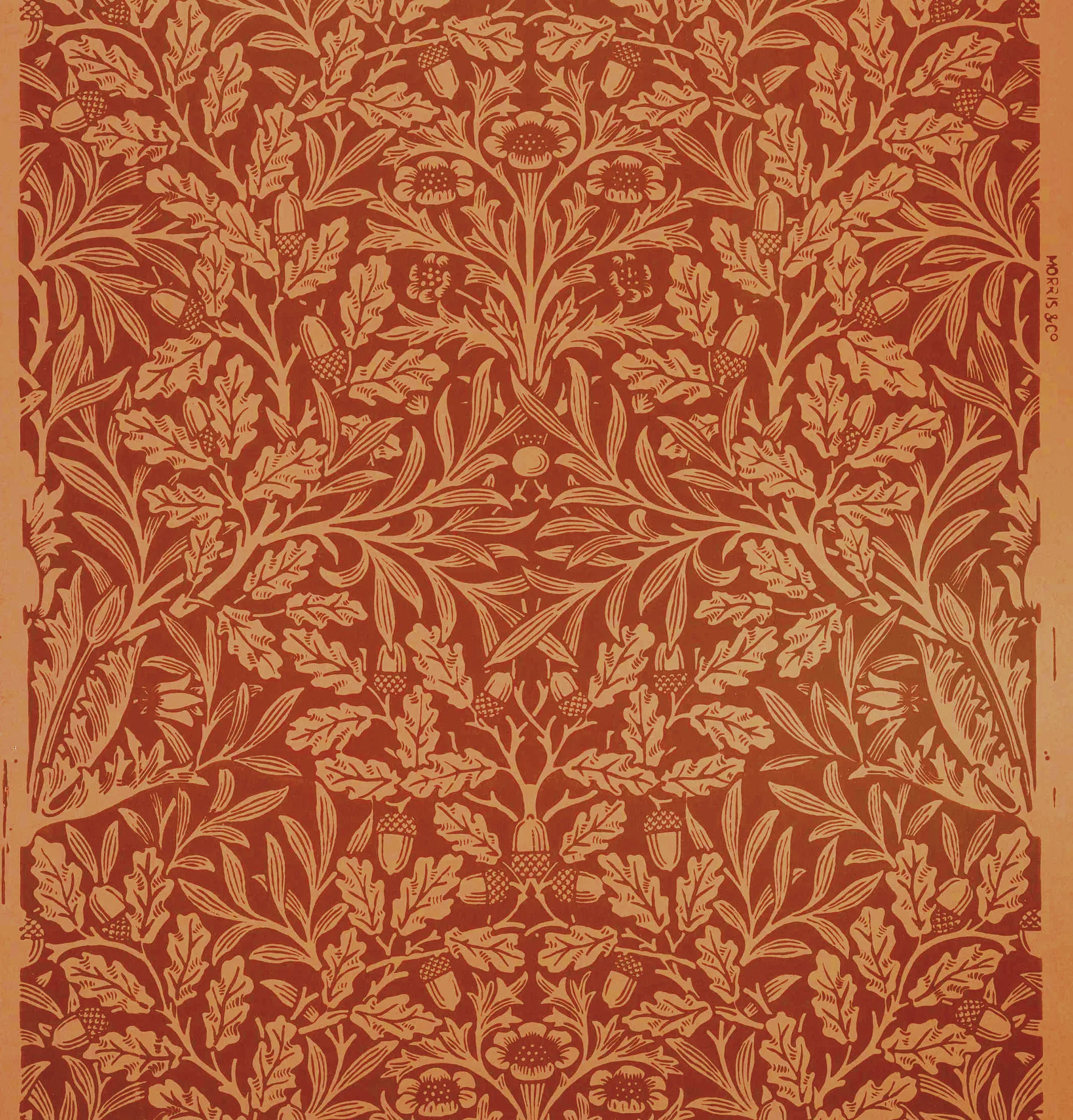
Acorn by William Morris presents a dense, rhythmic arrangement of British woodland flora. The pattern centers on the English oak, featuring sturdy lobed oak leaves, clusters of capped acorns, and branching stems. Morris intersperses these oak elements with slender curving vines, rounded wild flower blossoms, and pointed foliage. The elements intertwine across the surface, leaving minimal unprinted space.
Symmetry anchors the composition. A central floral motif rises vertically along the axis, sending branches outward in mirrored arcs. Beneath these primary boughs, secondary stems twist down and outward, where cups of acorns sit among clusters of serrated oak foliage. Thin internal hatching lines define each leaf blade and give texture to the acorn shells. The background fills with delicate sprigs, which softens the contrast between the primary plant forms and the base paper.
Who designed it and when
William Morris designed Acorn in 1880. It entered production during a prolific period for his decorative arts firm, which had been reorganized as Morris & Co. in 1875. The design captures the mature phase of Morris’s surface design, where complex natural forms align strictly with flat decorative pattern rules.
Museum catalog entries show slight variations in attribution. Records at the Cooper Hewitt, Smithsonian Design Museum, which preserves original 1880 printed sheets, credit Morris & Co. as the maker, with some archive sheets listing the designer line as unknown artist. Standard decorative arts records, however, confirm William Morris as the designer of the pattern. You can browse our directory of every William Morris design to see how Acorn compares with other botanical studies produced by the firm.
How it was made and used
Acorn was manufactured as a wallpaper sidewall, designed to cover primary interior walls. Like most wallpapers sold by Morris & Co., it was hand block-printed using carved pearwood blocks and distemper pigments. The printing was contracted to Jeffrey & Company, an established London wallpaper printing firm located in Islington.
Block printing required precision registration. Printers laid carved wooden blocks coated with water-based pigments directly onto long rolls of paper, applying pressure with a foot-operated lever. Each color pass had to align precisely with the next. Surviving samples at the Cooper Hewitt measure roughly 66 by 55 centimeters for full pattern repeats, alongside smaller preserved paper fragments mounted on muslin. As with his famous foliage studies like Willow Bough, Morris balanced strict geometry with natural movement, a core principle detailed in our overview of William Morris’s life and work.
Colourways
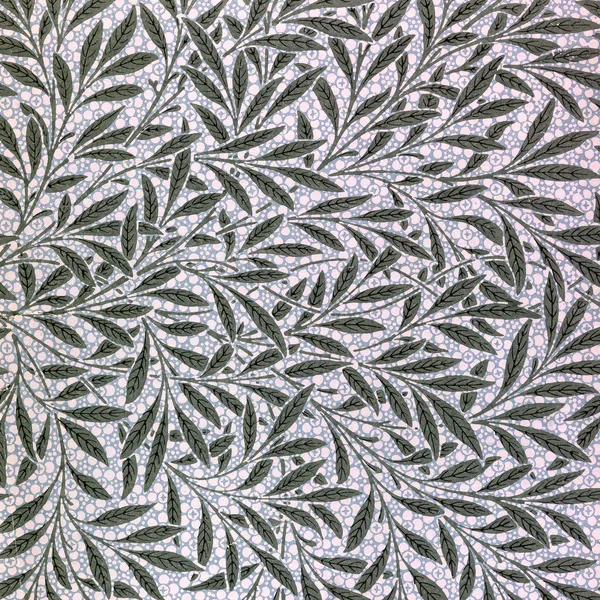
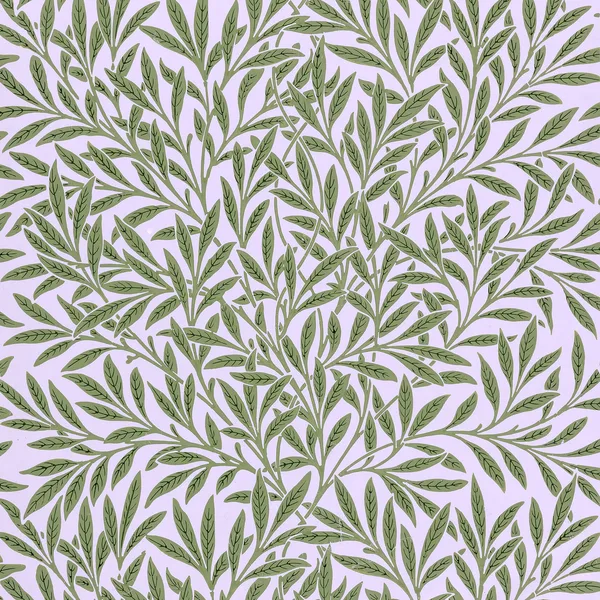
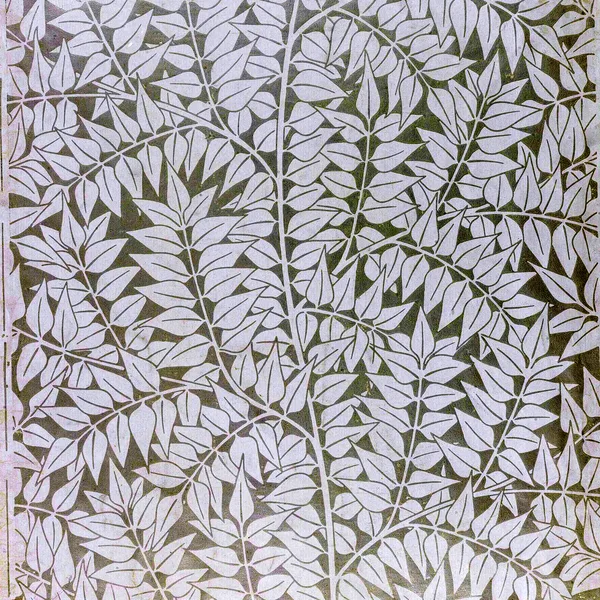
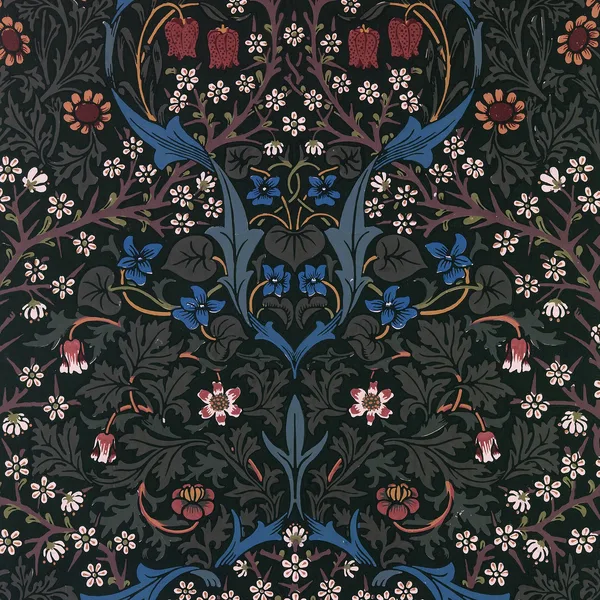
This site presents four scans of Acorn derived from original museum specimens:
- Red (dark ground): Features vibrant warm cream and golden-orange stems against a deep crimson red background.
- Red (bright ground): A high-contrast variant setting crisp orange-yellow foliage against an intense, saturated scarlet ground.
- Gold: A light-ground variant that renders the oak stems, leaves, and acorns in soft warm ochre on a pale field.
- Teal on Ivory: Displays cool blue-green and teal linework set over an ivory background, matching early two-color production sheets.
Acorn as a print
Acorn works well as standalone wall art because its balanced symmetry holds together within a frame. The dense intertwining leaves and acorn cups fill the picture plane cleanly without losing their central structure. You can also view Acorn wallpaper options through our sister site.
Prints are printed and shipped by ArtsyWall in three formats: Archival Paper, Premium Canvas, and Framed Canvas. Archival Paper delivers clean, matte graphic lines suited for standard glazed frames. Premium Canvas presents the design stretched over wood bars without glass. Framed Canvas encases the pattern within a wooden floating frame, creating a slim border that highlights the disciplined symmetry of the original block-printed repeat.
Want Acorn on a whole wall? See Acorn wallpaper, sized to your wall.
Questions and answers
Who designed Acorn?
William Morris designed the Acorn pattern for Morris & Co. Historical museum records at the Cooper Hewitt, Smithsonian Design Museum credit Morris & Co. and note manufacturer Jeffrey & Company as the block printer for the wallpaper. While some archival entries list the designer as unknown or credit the firm as a whole, standard design records attribute the original 1880 pattern directly to William Morris.
When was Acorn designed?
Acorn was designed in 1880 as a block-printed wallpaper. Surviving museum specimens at the Cooper Hewitt date to 1880, produced in the United Kingdom during the height of the English Arts and Crafts movement. The design reflects the formal botanical patterns Morris developed during this productive decade of wallpaper production.
What does the Acorn pattern show?
The Acorn pattern shows lobed oak leaves, stems, and clusters of acorns mixed with scrolling vines and small stylized flowers. A central vertical stem branches out into curving side boughs, creating a symmetrical rhythm. The dense field balances heavy oak foliage with fine linework across the background, giving the surface a rich botanical texture.
Was Acorn a wallpaper or a fabric?
Acorn was originally designed and produced as a block-printed wallpaper, cataloged in historical collections as a sidewall paper. Specialist firm Jeffrey & Company printed the pattern on paper rolls in England using carved woodblocks. The pattern was intended for interior wall decoration rather than woven or printed upholstery textiles.