Violet and Columbine by William Morris
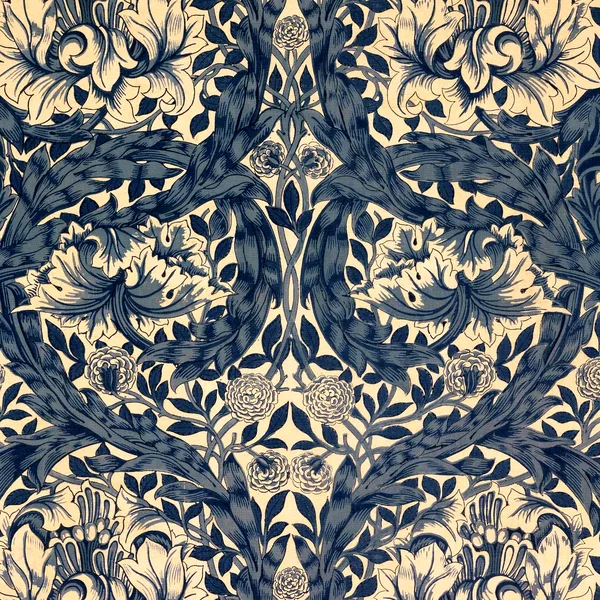
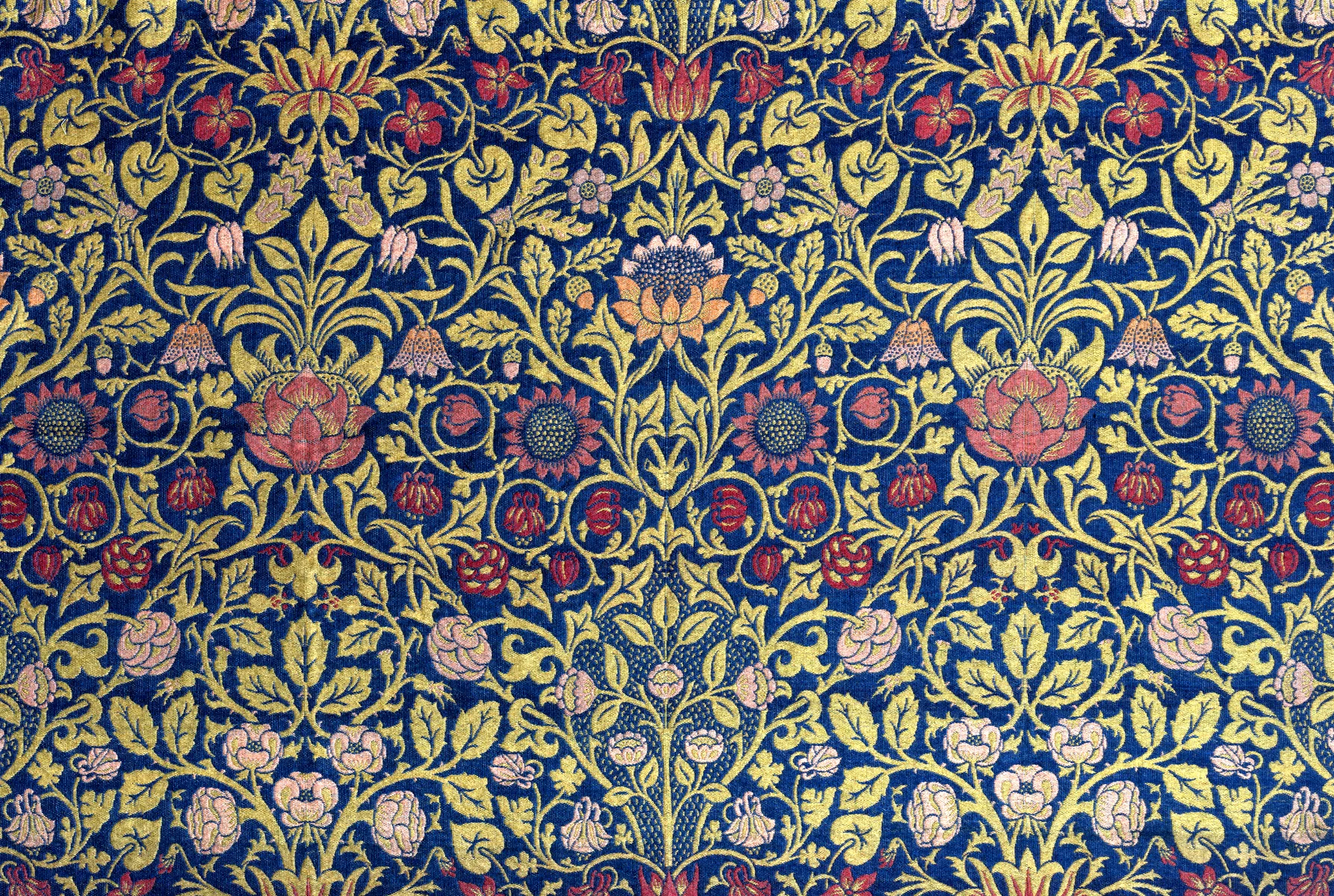
Violet and Columbine by William Morris is an 1883 woven textile design featuring formal floral blooms, twining leaves, and delicate nodding blossoms on a rich, patterned ground.
Colourways
| Designed | 1883 |
|---|---|
| Designer | William Morris |
| Type | textile |
| Motifs | flowers |
| Colourway | Indigo |
| Repeat | not measured |
| Source | Cleveland Museum of Art. Licence: CC0. Museum record |
Order Violet and Columbine as a print
Format
Size (inches)
$40
Made to order. Shipping included in the US.
Seamless pattern file
A repeat tile of this design, ready to fill any size in design software.
What Violet and Columbine shows
Violet and Columbine by William Morris presents a dense, mirrored arrangement of garden flowers, branching stems, and foliate ornament. In the center, large radiating blossoms anchor the pattern, crowned by outward-curving acanthus leaves and upright petal buds. Around these central forms, bell-shaped columbine blossoms hang downward, interspersed with small rosettes, rounded violet-like blooms, and tiny seed pods. The composition balances strong bilateral symmetry with organic curves that carry the eye up and across the surface.
The background remains closely packed with curling foliage, giving the fabric a rich texture where ground and foreground weave together. In the woven original, the weave creates a fine crosshatched surface that softens line edges and blends adjacent tones. The pattern repeats across a grid of roughly 10.4 by 12.8 inches, producing a continuous floral rhythm across larger wall expanses.
Who designed it and when
William Morris designed Violet and Columbine in 1883. The design was registered that same year by his manufacturing firm, Morris & Co., during an ambitious period of textile production at Merton Abbey in Surrey, England. To explore other textiles and wallpapers created during this era, you can view the complete index of patterns in our catalogue of William Morris patterns.
While museum records at the Metropolitan Museum of Art and the Cleveland Museum of Art credit the design directly to William Morris, a fragment record at the Cooper Hewitt lists the designer as unknown. Such differences occasionally arise in historical collections, but standard registers and contemporary records attribute the pattern firmly to Morris. To understand how this work fits into his broader creative career, read about William Morris and his decorative work. That same year, Morris also produced his famous discharge-printed cotton textile, the Strawberry Thief pattern.
How it was made and used
Unlike printed chintzes, Violet and Columbine was constructed as a heavy woven textile. It was woven at Merton Abbey on a jacquard loom as a weft-faced twill double cloth, using a mixture of wool and mohair. Morris favored natural organic dyes over contemporary synthetic chemicals, seeking softer tonal shifts and improved resistance to light and washing. Surviving museum lengths reveal warp threads in blue and green, with multi-colored weft yarns in red, pink, yellow, and blue crossing behind the face.
Morris intended textiles like Violet and Columbine to hang in heavy, structural folds. In domestic interiors, the substantial weight of the wool and mohair helped insulate rooms, while the layered floral pattern suggested the lush growth of an enclosed garden wall. Pieces were woven in continuous lengths that could be trimmed for portieres, curtains, or loose hangings.
Colourways
This site presents four distinct colourways based on public-domain museum scans:
- Indigo: Features warm peach, coral, and golden-yellow flowers set over twining foliage against a dark indigo ground.
- Indigo on Cream: Highlights soft tones of green, salmon, orange, and pale pink with delicate details across a deep blue background.
- Black: Presents an earthy palette of olive greens, russet flowers, and cream accents set over a deep, dark ground.
- Dark Green: Displays rich forest-green foliage with mustard-gold stems and dusty-rose blossoms across a shadowed ground.
Violet and Columbine as a print
Prints of Violet and Columbine are printed and shipped by ArtsyWall in three formats: Archival Paper, Premium Canvas, and Framed Canvas. The Archival Paper option uses 100% cotton rag fine art paper, capturing the fine thread lines of the original weave. The Premium Canvas and Framed Canvas formats wrap the pattern across textured canvas stretched on solid wood bars.
Framed Canvas choices include floating wood frames in black, white, gold, silver, walnut, and oak. When framed, the dense floral structure serves as a commanding focal point on any wall. The architectural symmetry draws the eye inward, while the subtle weave texture provides visual depth in a living room, hallway, or study.
Want Violet and Columbine on a whole wall? See Violet and Columbine wallpaper, sized to your wall.
Questions and answers
Who designed Violet and Columbine?
William Morris designed Violet and Columbine in 1883 for his firm, Morris & Co. The textile was manufactured at the Merton Abbey workshop in Surrey, England. A museum fragment record from the Cooper Hewitt lists the designer as unknown, though standard design records and museum collections attribute the work directly to Morris.
When was Violet and Columbine designed?
Violet and Columbine was designed and registered in 1883. It belongs to an active period of textile production at Morris & Co.'s Merton Abbey workshop in Surrey, England. Surviving woven samples and museum collection pieces in major institutions document the pattern registration date as 1883.
What does the Violet and Columbine pattern show?
The Violet and Columbine pattern shows an intricate composition of stylized floral motifs. Symmetrical central blooms with rayed centres sit flanked by scrolling acanthus leaves, while nodding columbine flowers and bell-shaped blossoms branch outward across the ground. Small berries, rounded flowers, and dense foliage fill the spaces between the curving stems.
Was Violet and Columbine a wallpaper or a fabric?
Violet and Columbine was originally produced as a woven fabric rather than a printed wallpaper. Morris designed it as a heavy double-cloth textile woven on a jacquard loom using wool and mohair. The firm intended the durable woven cloth to hang in deep folds as decorative wall hangings and domestic furnishings.