Vine by William Morris
Vine by William Morris is an 1873 wallpaper pattern featuring bunches of grapes and broad vine leaves set against willow foliage.
Colourways
| Designed | 1873 |
|---|---|
| Designer | William Morris |
| Type | wallpaper |
| Motifs | fruit, leaves |
| Colourway | Charcoal |
| Repeat | not measured |
| Source | Cooper Hewitt, Smithsonian Design Museum. Licence: CC0. Museum record |
Order Vine as a print
Format
Size (inches)
$40
Made to order. Shipping included in the US.
Seamless pattern file
A repeat tile of this design, ready to fill any size in design software.
What Vine shows
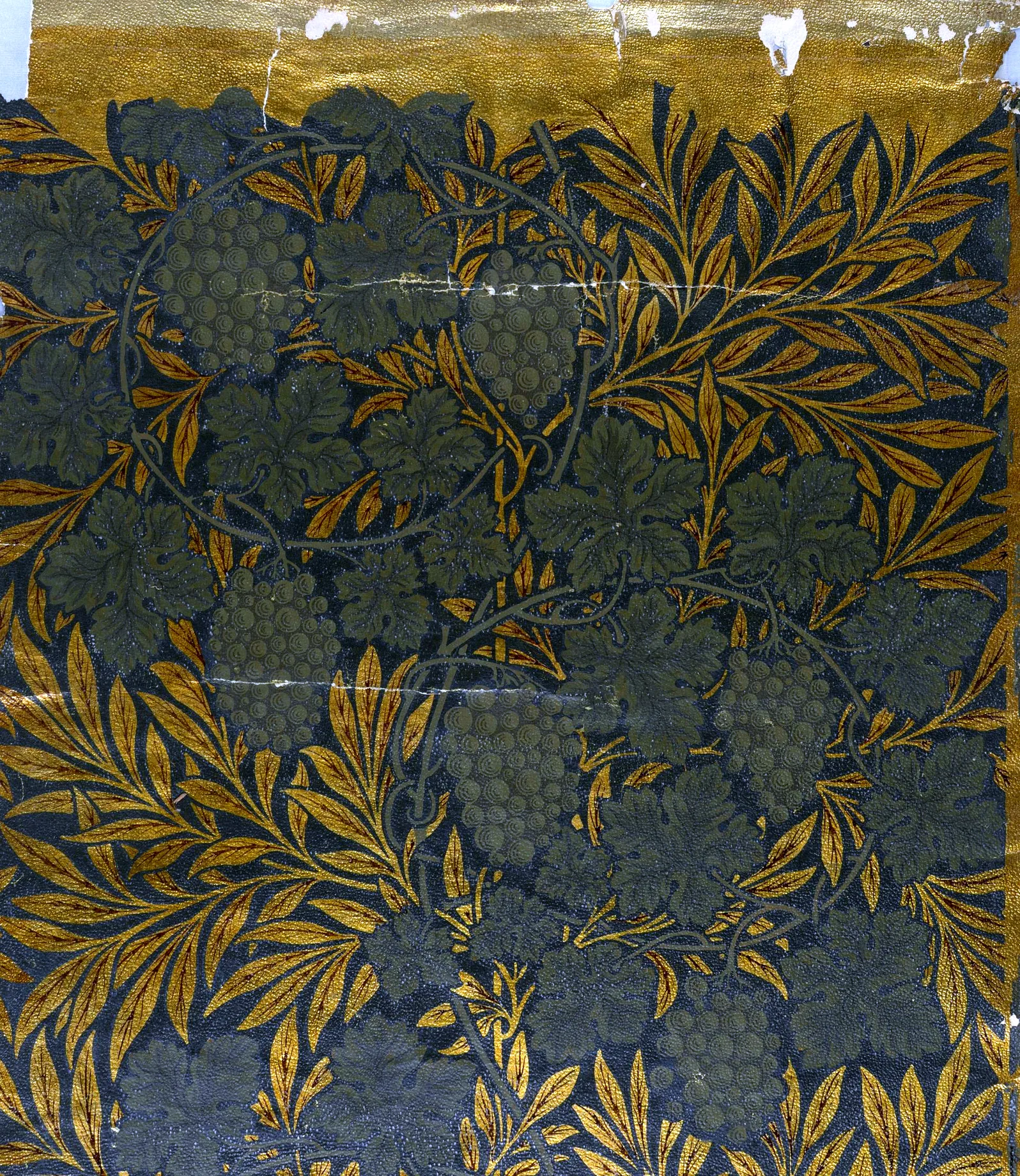
Vine by William Morris layers heavy bunches of grapes over a dense screen of foliage. Deep clusters of rounded fruit hang from curving, serpentine woody stems that wander across the surface. Broad, lobed grape leaves branch out beside the fruit, detailed with clear internal veins that give them a flat, graphic presence.
Behind the grapevines lies a continuous field of long, pointed willow leaves. These background leaves sweep upward and outward in rhythmic sprays, filling nearly every open space on the paper. The interaction between the fine willow foliage and the broader vine leaves creates two distinct visual layers, giving the wallpaper depth without using modern perspective tricks.
Who designed it and when
William Morris designed Vine in 1873. The pattern joined an expanding collection of botanical papers created during an active decade of work for Morris & Co. You can read about his life and decorative work in our guide to William Morris.
Surviving museum sheets show minor differences in attribution. While primary design records assign the pattern directly to Morris, some museum catalog records list the designer as an unknown artist or attribute production to Morris & Co. and Arthur Sanderson & Sons, Ltd. Surviving wallpaper samples in the Cooper Hewitt collection carry dates of 1873 and 1874. You can compare Vine with other historical patterns in our directory of every William Morris design.
How it was made and used
Vine was manufactured as a wallpaper sidewall for interior rooms. Craftsmen produced the pattern by hand using relief woodblocks stamped on long rolls of paper. Museum records note that one 1873 printing required nine separate woodblocks to apply the various ink layers and build up the complete image.
Surviving examples in museum archives show a vertical repeat measuring 21 inches (53.3 cm) with a straight side join. The dense botanical repeat made it suitable for covering broad, uninterrupted wall surfaces. While later patterns such as the printed cotton Strawberry Thief focused on narrative scenes with wildlife, Vine relies purely on natural garden growth, looping stems, and fruit clusters.
Colourways
This site presents Vine in three distinct colourways derived from historical scans:
- Charcoal: Dark ground colourway featuring warm golden-brown willow leaves paired with muted grey-green vine leaves and dark grape clusters.
- Black: Deep dark ground colourway contrasting bright golden-yellow willow foliage against dark olive leaves and grape bunches.
- Ivory on Stone: Light ground colourway showing rich lavender grapes and pale cream leaves set against light slate-blue willow foliage.
Vine as a print
Vine is available as an individual wall art print, printed and shipped by ArtsyWall. You can order the design in three physical formats: Archival Paper, Premium Canvas, and Framed Canvas. The Archival Paper print ships rolled in a tube, ready for custom matting and framing. The Premium Canvas print is stretched over solid wood bars with an attached sawtooth hanger. The Framed Canvas option sets the stretched canvas into a wood floating frame, leaving a slight gap around the edges, and arrives with hanging wire installed. Framed on a wall, the curving stems and dense layers of willow leaves create a strong focal point suited to living rooms, studies, or dining spaces.
Want Vine on a whole wall? See Vine wallpaper, sized to your wall.
Questions and answers
Who designed Vine?
William Morris designed Vine as a wallpaper pattern for Morris & Co. While some museum catalog entries describe the designer as unknown or simply attribute the manufacturing to Morris & Co. or Arthur Sanderson & Sons, Ltd., design records credit William Morris directly as the original creator of the pattern.
When was Vine designed?
Vine was designed in 1873. Museum specimens and catalog records in collections like the Cooper Hewitt date surviving wallpaper prints between 1873 and 1874. Printing blocks and samples continued in production through later decades as the pattern remained in the firm's active decorating catalog.
What does the Vine pattern show?
The Vine pattern shows large clusters of grapes hanging from winding, serpentine woody stems among broad grape leaves. These fruiting vines are layered directly over an intricate background pattern of narrow, pointed willow leaves that fill the ground, creating a dense two-layer botanical effect.
Was Vine a wallpaper or a fabric?
Vine was designed originally as a block-printed wallpaper rather than a woven or printed furnishing fabric. Historical examples preserved in museum collections were produced as paper sidewall hangings using hand-carved woodblocks, including historic printings recorded with nine separate woodblocks by manufacturers such as Arthur Sanderson & Sons, Ltd.