Fruit by William Morris
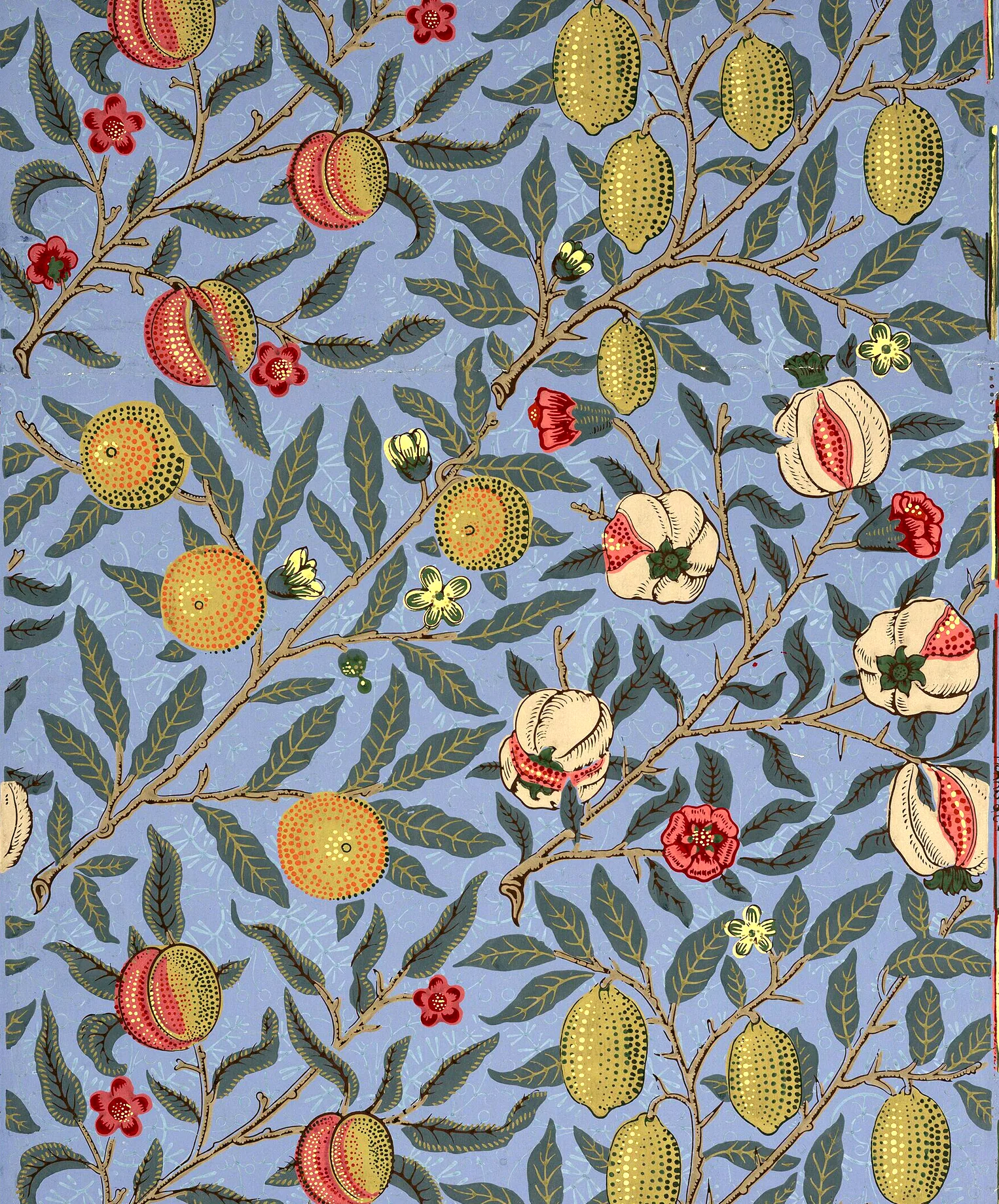
Fruit by William Morris is an 1862 wallpaper pattern that weaves ripe pomegranates, lemons, and citrus blossoms across diagonal branches. You can order it as an art print or seamless pattern file.
Colourways
| Designed | 1862 |
|---|---|
| Designer | William Morris |
| Type | wallpaper |
| Motifs | fruit, leaves |
| Colourway | Blue |
| Repeat | not measured |
| Source | Cooper Hewitt, Smithsonian Design Museum, via Wikimedia Commons. Licence: Public domain (Wikimedia Commons). Museum record |
Order Fruit as a print
Format
Size (inches)
$40
Made to order. Shipping included in the US.
Seamless pattern file
A repeat tile of this design, ready to fill any size in design software.
What Fruit shows
The Fruit pattern by William Morris displays an orchard bough pattern filled with branches, fruit, foliage, and scattered flowers. Diagonal branches cross the field, bearing large pomegranates that split open to show clusters of rounded seeds. Alongside the pomegranates hang round citrus fruits covered in fine dotted stippling, oval lemons, and smooth peaches.
Leaves cluster along every branch in dense groupings. Each leaf is long and pointed, shaded with darker green tones along the edges and veins. Between the larger branches, small flowers appear with five rounded petals, alongside compact flower buds and small blossom sprigs. In the open areas between the leaves and fruit, faint scrolling lines wander across the ground, adding a delicate layer of tracery behind the solid branch structure. The repeat carries your eye diagonally across the wall, creating continuous movement across the entire surface.
Who designed it and when
William Morris designed Fruit in 1862. It is one of his earliest repeating wallpaper patterns, created during the early 1860s when he began producing decorative wallcoverings. You can learn more about his background, career, and design principles in our guide to William Morris.
Museum records also list this pattern under the alternative titles Pomegranate and Four Fruits. The design stands at the beginning of Morris’s career as a pattern designer, long before he produced later textile works such as Strawberry Thief. In our index of William Morris designs, you can compare Fruit with other wallpapers and textiles from across his working life. While some popular designs from the firm were created later by John Henry Dearle, museum collections document that Morris designed Fruit himself.
How it was made and used
Fruit was manufactured as a wallpaper rather than a printed or woven textile. The English printing firm Jeffrey & Company produced the wallpaper for Morris & Co. using carved woodblocks. Craftsmen carved individual blocks for each separate ink layer, then printed the rolls on paper by hand. In museum archives, such as the Cooper Hewitt, Smithsonian Design Museum, surviving specimens measure around 69.5 by 58.5 centimeters and bear the inscription MORRIS & CO printed along the selvedge.
The museum records classify Fruit as a sidewall paper. In interior decoration, a sidewall pattern covers the primary wall space of a room. Because the diagonal boughs repeat seamlessly across adjacent drops of wallpaper, the design masks seams and creates an expansive, unbroken pattern across a room.
Colourways
The site features Fruit in three distinct colourways taken from historical museum scans. Each option presents a different background tone and room mood:
- Blue: A light-ground colourway presenting soft olive leaves, warm yellow fruit, and deep pink pomegranates over a pale blue background filled with white scrollwork. The museum record describes this historical sample as printed in reds, greens, and brown on a deep blue ground, though the scan reflects a lighter blue field.
- Ivory on Stone: A subtle, light colourway showing pale fruit, soft grey-green foliage, and muted blossom accents over an off-white stone ground.
- Charcoal: A dark-ground colourway setting pale lemons, golden citrus, and pink split pomegranates against a deep navy or black field decorated with white linework.
Fruit as a print
You can buy Fruit as an art print in three formats, printed and shipped by ArtsyWall: Archival Paper, Premium Canvas, and Framed Canvas. Archival Paper is an unframed, heavyweight 340gsm cotton rag paper with a textured watercolor finish. Premium Canvas is an acid-free archival canvas stretched over solid wood bars and supplied with a sawtooth hanger. Framed Canvas places the canvas in a wooden floating frame with an attached hanging wire, available in black, white, gold, silver, walnut, and oak finishes.
Framed on a wall, Fruit functions as a bold botanical artwork. The diagonal boughs, dotted fruit, and open pomegranates give the print depth and structural clarity in any room setting. If you want peel-and-stick wallcoverings instead of framed art, find Fruit wallpaper on our sister site.
Want Fruit on a whole wall? See Fruit wallpaper, sized to your wall.
Questions and answers
Who designed Fruit?
William Morris designed Fruit in 1862 for his decorative arts firm. Although many later Morris & Co. patterns were produced by John Henry Dearle, historical records confirm Morris drew this pattern himself. It stands as one of his first repeating patterns for domestic interiors, celebrating orchard boughs, leaves, and ripening fruits.
When was Fruit designed?
Fruit was designed in 1862 at the start of William Morris's design career. It is among the earliest repeating wallpapers he created for Morris & Co. Surviving nineteenth-century block-printed rolls in museum collections such as the Cooper Hewitt document that the design was produced and sold in the early 1860s.
What does the Fruit pattern show?
The Fruit pattern features diagonal orchard boughs bearing ripe pomegranates, round citrus, lemons, and peaches. Several pomegranates are shown split open with their internal seeds exposed. Dense green leaves and small five-petaled blossoms surround the branches, while a secondary background pattern of fine scrolling foliage fills the spaces between the limbs.
Was Fruit a wallpaper or a fabric?
Fruit was originally designed and produced as a block-printed wallpaper, not a fabric. The firm Morris & Co. contracted the printing out to Jeffrey & Company, who hand-stamped the design onto paper rolls using carved wooden blocks. Museum records designate it as a sidewall paper meant to decorate room walls.
.jpg)