Utrecht Velvet by William Morris
Utrecht Velvet by William Morris is a historical textile pattern designed around 1871. It features ornate foliate forms and stylized leaf motifs organized along a vertical axis.
Colourways
| Designed | 1871 |
|---|---|
| Designer | William Morris |
| Type | textile |
| Motifs | leaves |
| Colourway | Charcoal |
| Repeat | not measured |
| Source | Art Institute Chicago. Licence: CC0. Museum record |
Order Utrecht Velvet as a print
Format
Size (inches)
$40
Made to order. Shipping included in the US.
Seamless pattern file
A repeat tile of this design, ready to fill any size in design software.
What Utrecht Velvet shows
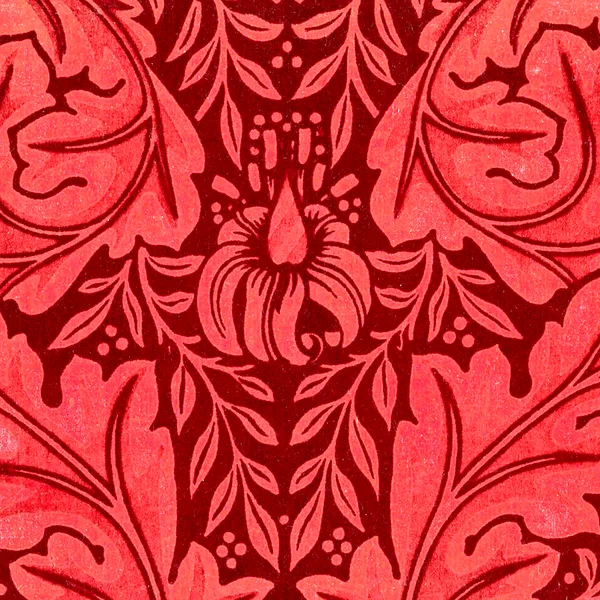
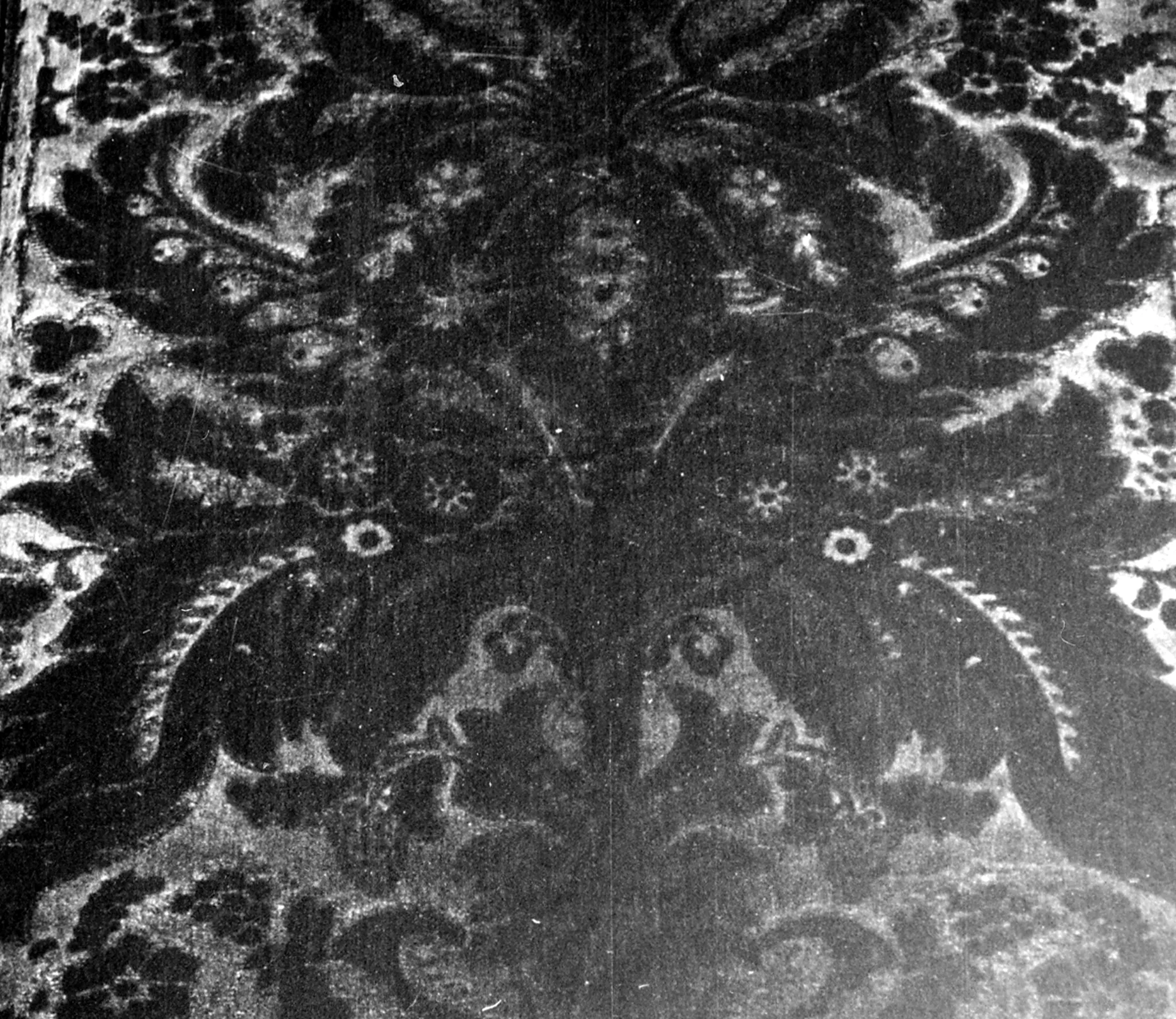
Utrecht Velvet by William Morris presents a formal, mirrored foliate arrangement built around a strong vertical stem. Unlike pictorial Morris patterns such as Strawberry Thief, which feature birds and fruit, Utrecht Velvet focuses entirely on dense leaf forms and floral motifs. The composition relies on bilateral symmetry, where curving acanthus-like leaves sweep upward and outward from a central spine.
Looking closely at the pattern, you can see layers of stylized foliage branching across the surface. Serrated leafy plumes arch over smaller rounded rosettes and delicate blossom sprigs. Small dot details accent the curving ribs of the larger leaves, creating textural contrast against the darker ground. The overall repeat feels weighty and structured, reminiscent of historical European cut velvets and woven damasks.
Who designed it and when
William Morris designed Utrecht Velvet in 1871. Museum records at the Art Institute of Chicago list the design date as circa 1871 and credit William Morris directly as the designer.
The year 1871 was an active period in the career of William Morris. During the early 1870s, Morris developed numerous repeating patterns that balanced natural observation with historic formal ornament. You can explore how this piece fits alongside his other patterns in our index of every William Morris design, which spans wallpapers, printed cottons, and woven textiles produced across several decades.
How it was made and used
Utrecht Velvet is classified in museum collections as a textile. Traditional Utrecht velvet was historically a plush, patterned pile fabric often made from mohair or wool, known for durability and deep texture in upholstery and wall hangings. Morris adapted the broad, sculptural weight of historical velvets into this pattern, designing broad leaves and bold silhouettes that could hold their shape in heavy woven materials.
The repeat is structured so that the mirrored sprays interlock cleanly when pieces are joined edge to edge. In interior decoration, heavy patterned textiles of this kind were typically used for domestic furnishings, heavy drapery, portières, and upholstery. The design uses broad forms that remain readable even when draped or folded.
Colourways
This site presents Utrecht Velvet in two colourways sourced from high-resolution museum scans:
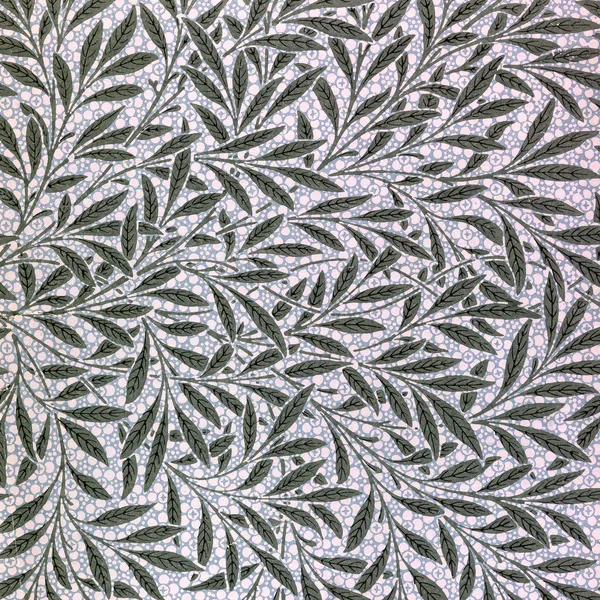
- Charcoal: A monochrome presentation where light gray and silvery leaf forms emerge from a deep, near-black ground. The high tonal contrast emphasizes the serrated edges, floral accents, and mirrored curves of the foliage.
- Red: A rich monochromatic red variation. Deep crimson and magenta shades define both the background and the foliage, relying on subtle shifts in tone to reveal the intricate leaf sprays.
Both colourways share a dark ground structure, staying close to the tactile, shadowy feel of historical pile textiles.
Utrecht Velvet as a print
Utrecht Velvet is available as a fine art wall print, printed and shipped by ArtsyWall in three formats: Archival Paper, Premium Canvas, and Framed Canvas.
On Archival Paper, the velvety tonal gradations and fine leaf borders appear crisp and matte. Framed Canvas options give the pattern an architectural presence, framed in solid wood floating frames in finishes such as black, walnut, gold, oak, silver, or white. Because the design is symmetrical and bold, it reads well as a standalone focal piece on a wall or paired alongside other Victorian pattern studies.
Want Utrecht Velvet on a whole wall? See Utrecht Velvet wallpaper, sized to your wall.
Questions and answers
Who designed Utrecht Velvet?
Utrecht Velvet was designed by William Morris. Museum records at the Art Institute of Chicago confirm William Morris as the designer of the textile pattern. It stands as an example of his early 1870s pattern work, created well before later Morris firm collaborations with designers such as John Henry Dearle.
When was Utrecht Velvet designed?
Utrecht Velvet was designed in 1871. Records from the Art Institute of Chicago date the design to circa 1871. During this period in the early 1870s, William Morris created several of his foundational repeating patterns, exploring complex symmetrical structures and stylized plant forms for decorative home furnishings.
What does the Utrecht Velvet pattern show?
The Utrecht Velvet pattern shows a dense, symmetrical arrangement of stylized foliage and leaves. Curved stems branch out from a central vertical line, supporting layered leaf sprays, serrated edges, and round florets. The design balances dark ground areas against textured foreground motifs to create a rich damask-like rhythm.
Was Utrecht Velvet a wallpaper or a fabric?
Utrecht Velvet was produced as a textile rather than a wallpaper. The historical museum objects scanned for this design are cataloged as textiles by the Art Institute of Chicago. The pattern uses mirrored decorative forms suited to woven fabrics, contrasting with the lighter, sprawling plant rhythms found in Morris wallpapers.