Tulip by William Morris
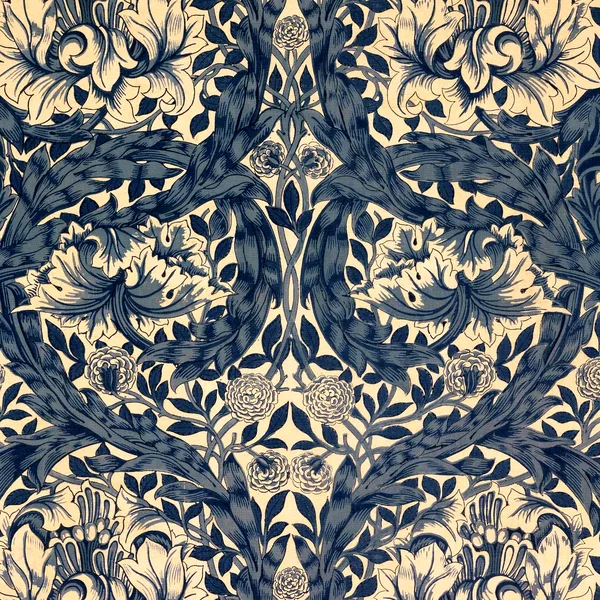
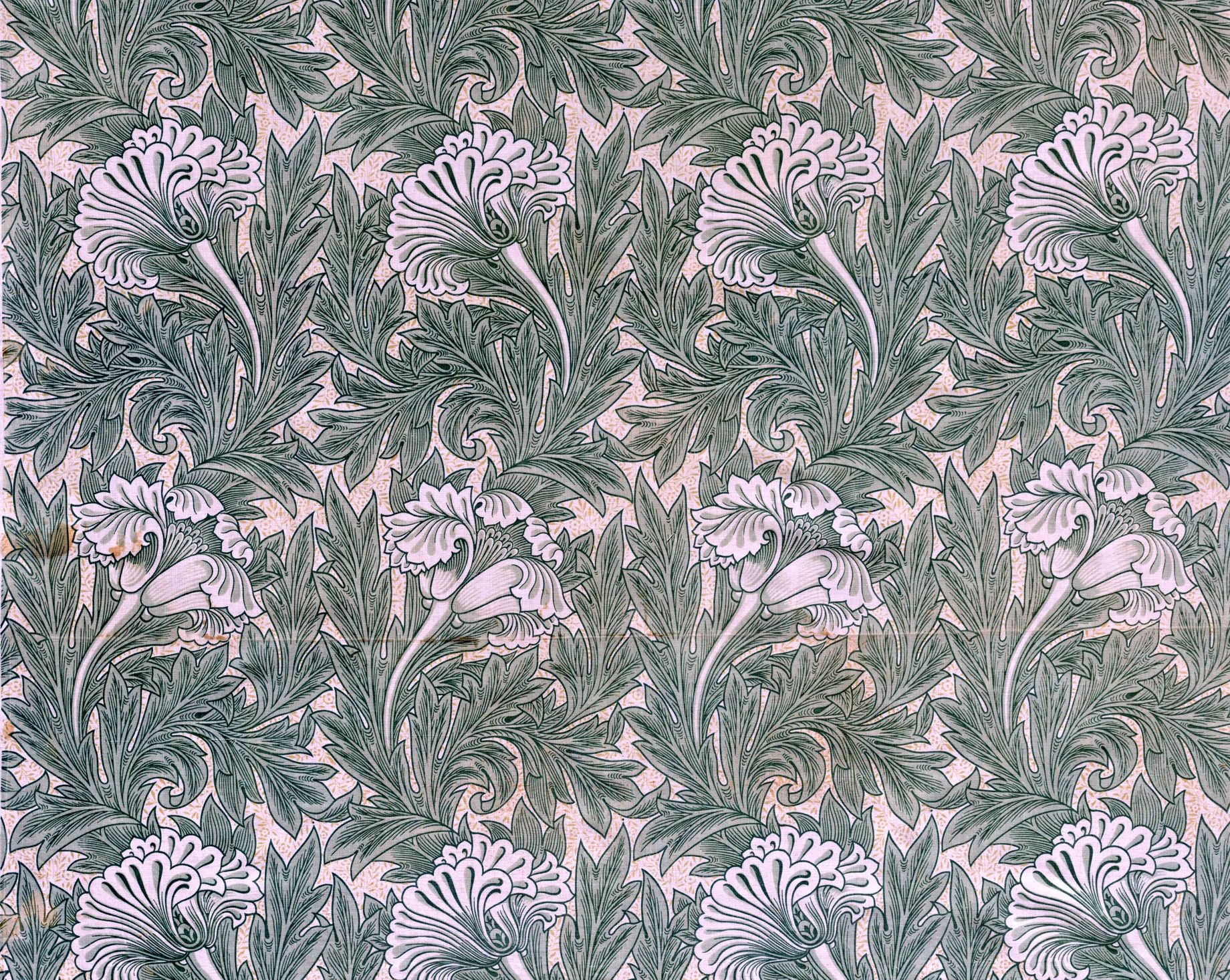
Tulip is an 1875 printed textile design by William Morris. The pattern features stylized, flared tulip heads surrounded by dense, curling acanthus foliage against a patterned ground.
Colourways
| Designed | 1875 |
|---|---|
| Designer | William Morris |
| Type | textile |
| Motifs | flowers |
| Colourway | Dark Green on Stone |
| Repeat | 8.7 × 19.3 in |
| Source | Cleveland Museum of Art. Licence: CC0. Museum record |
Order Tulip as a print
Format
Size (inches)
$40
Made to order. Shipping included in the US.
Seamless pattern file
One repeat tile, ready to fill any size in design software.
What Tulip shows
Tulip by William Morris shows large, stylized flower heads framed by heavy, curving acanthus leaves. The blossoms feature distinctive flared petals with ribbed shading that fan out from slender stems. Dense, deeply cut foliage twists through the composition, filling the frame so that very little bare space remains. A fine stippled pattern textures the ground behind the botanical elements, giving the surface extra visual depth.
The stems weave upward in serpentine curves, alternating the direction of the open blooms across the repeat. Each tulip head tilts gently, balanced by curled leaf tips that arch over and under adjacent stems. Fine line engraving defines the interior veins of every leaf, creating subtle tonal variations across the foliage. The result is a rhythmic, energetic botanical pattern that remains balanced across continuous lengths of cloth.
Who designed it and when
William Morris designed Tulip in 1875. In our guide to William Morris and his work, you can learn more about how his decorative arts firm, known as Morris & Co. after 1875, produced household furnishings that emphasized harmony and high-quality materials. Morris insisted on fair labor conditions and drew inspiration from historical botanical forms rather than the cluttered ornament common in industrial Victorian homes.
While later patterns in the firm’s catalog were created by colleagues like John Henry Dearle, museum records from the Cleveland Museum of Art and the Art Institute of Chicago confirm William Morris as the designer of Tulip. Textiles ranked among the most successful goods his firm offered, standing alongside later celebrated patterns such as the Strawberry Thief printed cotton.
How it was made and used
Tulip was produced as a textile rather than a wallpaper. The Cleveland Museum of Art records describe the original medium as roller printed cotton, manufactured in England during the nineteenth century. The design was intended for interior furnishings, bringing natural motifs into domestic rooms through curtains, draperies, and upholstery fabrics.
Printed cottons formed a major foundation of the firm’s business, which also produced embroidery, woven fabrics, carpets, and tapestries. Production of Tulip extended well beyond its initial release year. Museum objects show that fabric printers continued to produce runs of the pattern between 1917 and 1925 using Morris’s original 1875 design framework. You can explore other historic fabrics and wallpapers across the firm’s catalog in our complete collection of William Morris designs.
Colourways
This site presents Tulip in two distinct colourways taken directly from high-resolution, public-domain museum scans:
- Dark Green on Stone: Based on an 1875 printed cotton textile in the Cleveland Museum of Art, this colourway features dark sage-green foliage and pale tulip petals set against a soft, light stone ground.
- Teal: Sourced from a textile print dated 1917–1925 in the Art Institute of Chicago, this colourway uses deep teal and rich petrol-blue tones across the leaves, paired with warm cream blossoms against a peachy ground.
Tulip as a print
Tulip is available as an art print, printed and shipped by ArtsyWall in three formats: Archival Paper, Premium Canvas, and Framed Canvas. On textured cotton paper, the fine hatched lines of the foliage retain the sharp clarity of the original nineteenth-century cotton printing. In a canvas format, the pattern spreads across an unbroken surface that echoes the texture of historic furnishings.
Framed Canvas prints arrive ready to hang with attached wire and come in six wood finishes: black, white, gold, silver, walnut, and oak. The floating frame leaves a subtle gap around the canvas edge, letting the dense foliage of Morris’s design stand out cleanly on any wall.
Want Tulip on a whole wall? See Tulip wallpaper, sized to your wall.
Questions and answers
Who designed Tulip?
William Morris designed Tulip. He created the floral textile pattern in England for Morris & Co. during the 19th century. Although later designers like John Henry Dearle produced many patterns for the firm, museum records confirm that Morris himself conceived this design. Today, public domain scans of original museum textiles preserve Morris's historic arrangement of curving leaves and tulip blooms.
When was Tulip designed?
Tulip was designed in 1875 by William Morris. That same year marked the restructuring of his firm into Morris & Co., when printed textiles became an increasingly important part of the business. Historical printings continued over several decades, including later production runs between 1917 and 1925 that preserved Morris's original 1875 composition across different museum textile collections.
What does the Tulip pattern show?
The Tulip pattern shows large, flared tulip blossoms framed by heavy, curling acanthus foliage. The stylized flower heads open upward with lobed petals and ribbed interior markings. Thick stems curve through the composition to create a continuous vertical rhythm, while deeply serrated leaves fill the foreground. A fine, textured mottle covers the ground between the leaves and blooms.
Was Tulip a wallpaper or a fabric?
Tulip was a fabric rather than a wallpaper. Museum records classify the design as a printed cotton textile produced in 19th-century England. Printed cottons were among the most profitable merchandise Morris & Co. sold, providing durable patterns for Victorian household furnishings. The design repeat was specifically created to flow continuously across lengths of roller-printed cotton fabric.