Tulip and Rose by William Morris
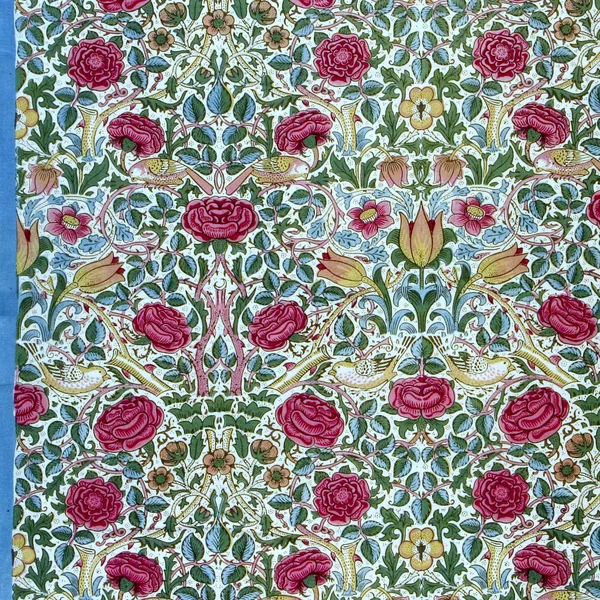
Tulip and Rose by William Morris is an 1876 textile pattern featuring paired tulips, bold red roses, and scrolling foliage. It brings Morris's balanced floral symmetry into modern interiors as an archival paper print or canvas.
| Designed | 1876 |
|---|---|
| Designer | William Morris |
| Type | textile |
| Motifs | flowers |
| Colourway | Ivory on Stone |
| Repeat | not measured |
| Source | Art Institute Chicago. Licence: CC0. Museum record |
Order Tulip and Rose as a print
Format
Size (inches)
$40
Made to order. Shipping included in the US.
Seamless pattern file
A repeat tile of this design, ready to fill any size in design software.
What Tulip and Rose shows
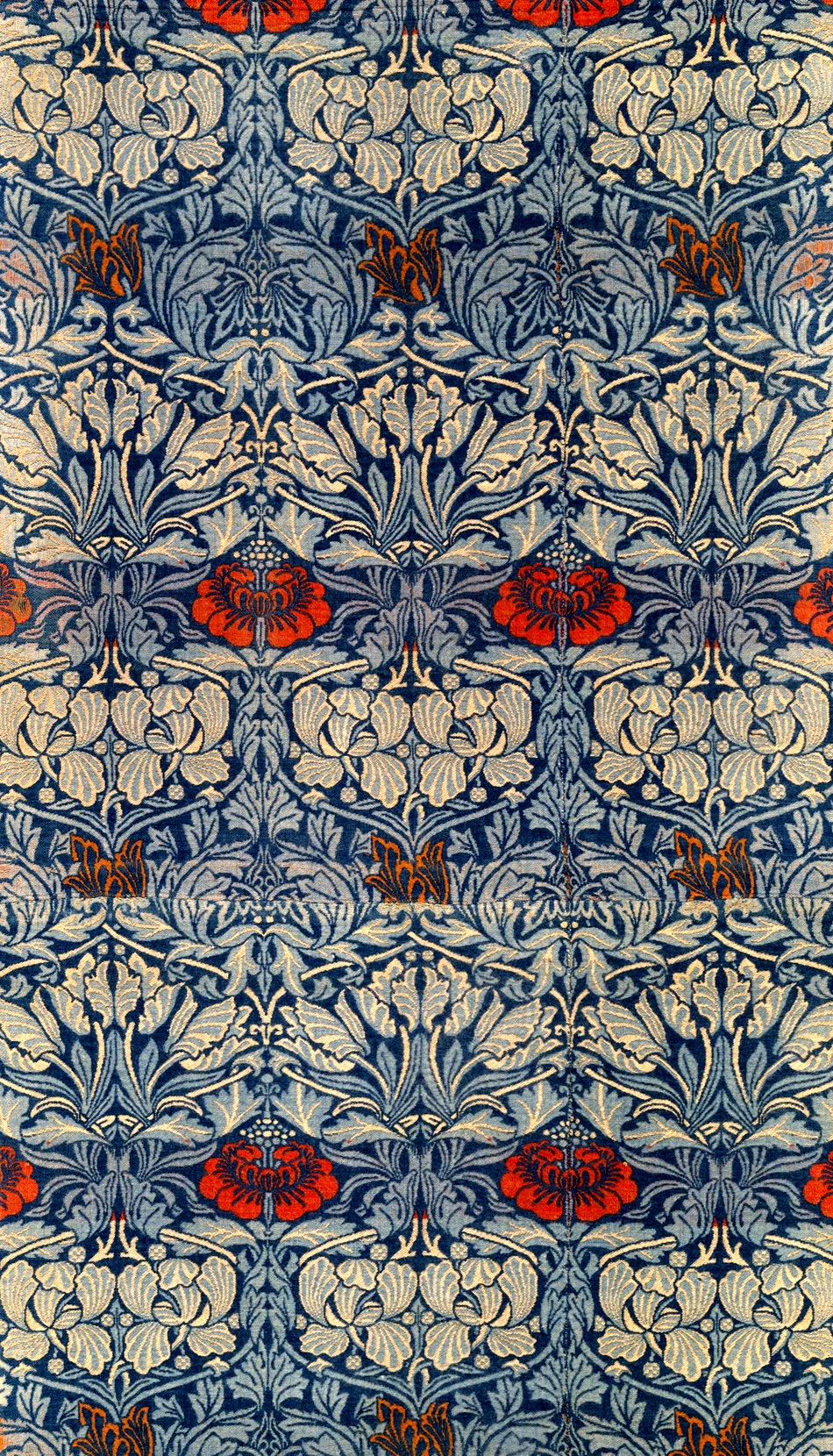
Tulip and Rose by William Morris is an 1876 textile pattern built around mirrored floral sprays, ruffled rose blossoms, and upward-reaching tulips. The design organizes garden flora into a disciplined, symmetrical repeat that feels orderly yet organic across a wide surface.
At the upper center of each vertical section, large fan-shaped clusters of pale, lobed leaves flare upward against a deep indigo-blue ground. Directly beneath these fan-like crests sit prominent blossoms rendered in a rich terracotta red. These ruffled, cup-shaped roses provide the warmest accents in the palette, drawing your eye to the center of each horizontal grouping.
Below the roses, pairs of wide ivory floral heads open outward with scalloped petals. Curved stems and dense serrated foliage fill the surrounding space, weaving between the larger flower forms. Smaller sprays of ochre and burnt-orange leaves sit lower in the repeat, adding secondary warm highlights against the cooler tones of stone, pale blue, and dark indigo. The composition repeats with bilateral symmetry, creating structured vertical columns across the image.
Who designed it and when
William Morris designed Tulip and Rose in 1876. The design record and the Art Institute of Chicago both date the design to 1876. While several well-known patterns associated with the historical firm were designed by John Henry Dearle, Tulip and Rose is an original work designed by Morris himself.
Morris completed the pattern during the 1870s as he expanded the firm’s textile catalog. You can learn more about his background and methods in our guide to William Morris. To see how this pattern fits alongside his other creations, browse every William Morris design in our library, or view his later 1883 pattern Strawberry Thief.
How it was made and used
Tulip and Rose was created as a textile rather than a wallpaper. The museum example scanned by the Art Institute of Chicago is a woven fabric piece that displays clear horizontal thread ribs across its surface. In the scan, a horizontal seam is visible running across the lower third of the fabric, showing where two woven sections join together.
The firm produced this design for decorative interior furnishings. In a woven textile, individual threads construct each leaf vein, petal edge, and background curve directly in the cloth. The dense arrangement of flowers and foliage ensures full coverage across the surface, giving the fabric a rich and continuous decorative texture.
Colourways
On this site, Tulip and Rose is offered in one colourway: Ivory on Stone. This name is our own descriptive label based on the museum scan, rather than a historical Morris & Co. trade name.
The Ivory on Stone colourway pairs a deep indigo-blue ground with pale stone and ivory foliage. The dark ground sets off the lighter acanthus-like leaves and wide flower heads, while terracotta-red roses and burnt-orange leaf sprays provide warm focal points. The balance of warm red and cool indigo gives this single colourway strong contrast and clarity.
Tulip and Rose as a print
Prints on this site are printed and shipped by ArtsyWall in three formats: Archival Paper, Premium Canvas, and Framed Canvas. Archival Paper provides a flat, fine-art presentation on textured cotton rag paper. Premium Canvas wraps the design around solid wood bars, while Framed Canvas places the canvas inside a wood floating frame. Frame finishes include black, white, gold, silver, walnut, and oak. On a wall, the bold indigo background and warm terracotta roses give Tulip and Rose strong presence. The symmetrical layout holds its shape well within a frame, creating an orderly focal point in any room.
Want Tulip and Rose on a whole wall? See Tulip and Rose wallpaper, sized to your wall.
Questions and answers
Who designed Tulip and Rose?
William Morris designed Tulip and Rose for his decorative firm. The historical record confirms his personal authorship of the pattern, rather than work by later firm designers like John Henry Dearle or May Morris. Morris developed numerous floral patterns throughout his career, and this 1876 design stands as one of his dedicated woven textile creations featuring stylized garden blooms.
When was Tulip and Rose designed?
William Morris created Tulip and Rose in 1876 as a textile design. Records from the Art Institute of Chicago and historical catalog entries date the pattern specifically to this year. While later productions and museum weavings date to subsequent decades, Morris completed the core botanical composition during the middle period of his textile experiments in the 1870s.
What does the Tulip and Rose pattern show?
The Tulip and Rose pattern shows a symmetrical arrangement of stylized tulips, clustered roses, and scrolling serrated foliage. Distinctive red blossoms anchor the center of the repeat alongside wide pale floral heads. Intricate acanthus-like leaves, slender stems, and upright floral sprays fill the surrounding ground, creating a dense, layered botanical rhythm across the entire surface of the fabric.
Was Tulip and Rose a wallpaper or a fabric?
Tulip and Rose was originally produced as a textile rather than a wallpaper. William Morris designed the pattern for woven furnishings, using textured thread structures to capture the detailed floral forms. Today, you can find the design adapted into modern wall decor formats, including unframed art paper, gallery-wrapped canvas, and framed canvas prints for interior display.