Tulip and Lily by William Morris
Tulip and Lily by William Morris is an 1875 floral textile pattern featuring repeating rows of stylized lilies and tulips framed by swirling foliage. It uses a compact half-drop repeat on a dark ground.
| Designed | 1875 |
|---|---|
| Designer | William Morris |
| Type | textile |
| Motifs | flowers |
| Colourway | Charcoal |
| Repeat | 4.6 × 6 in |
| Source | The Metropolitan Museum of Art. Licence: CC0. Museum record |
Order Tulip and Lily as a print
Format
Size (inches)
$40
Made to order. Shipping included in the US.
Seamless pattern file
One repeat tile, ready to fill any size in design software.
What Tulip and Lily shows
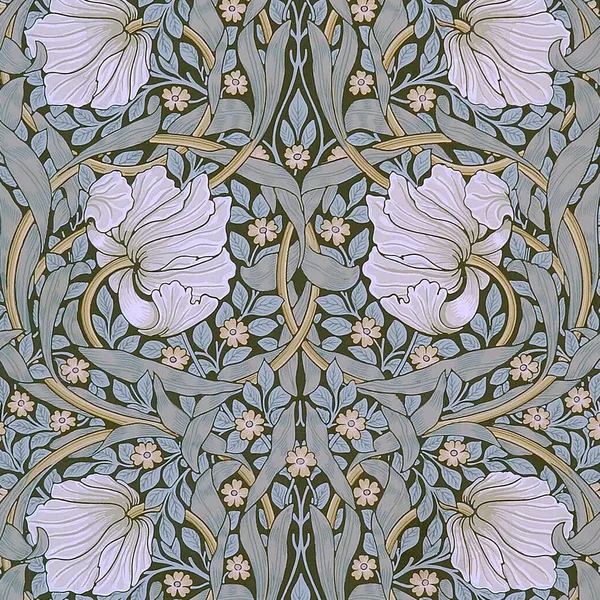
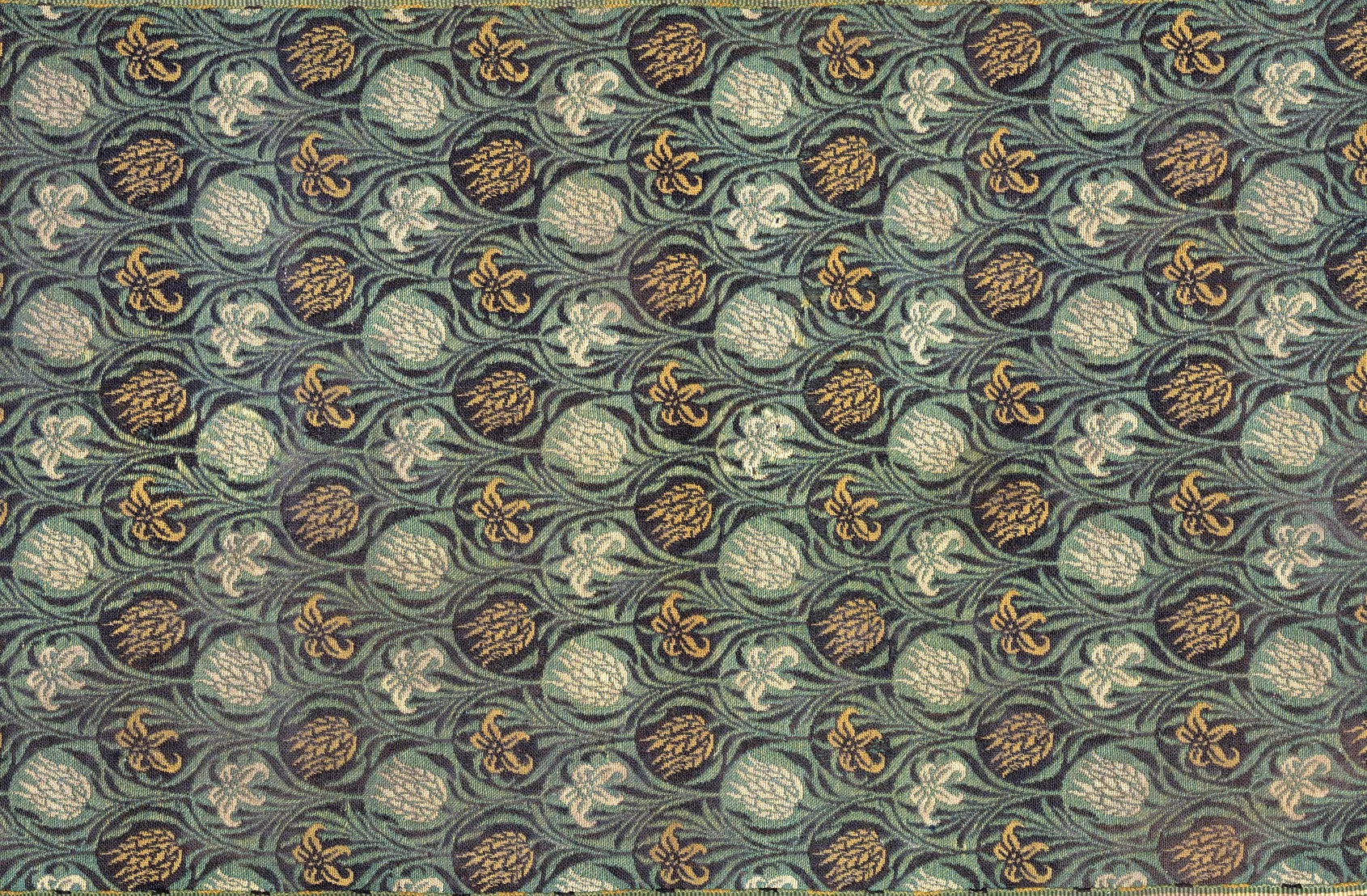
Tulip and Lily by William Morris presents a dense rhythm of garden flowers framed by curving foliage. The pattern features two primary floral forms that alternate across the surface. One form is a pale, rounded blossom that resembles a closed tulip or thistle head, textured with vertical woven lines. The other is a spreading, open lily flower rendered in warm golden-tan tones.
Swirling dark green and muted teal leaves wrap around each blossom, creating circular or oval frames. These foliage curves interlock to produce an all-over, scale-like rhythm across the fabric. Between the larger heads, smaller pale flowers with delicate petals fill the spaces. The repeat is compact, measuring about 4.6 by 6 inches in a half-drop arrangement. Every second column shifts down by half a repeat, preventing harsh vertical lines and creating continuous organic movement across the dark charcoal ground.
Who designed it and when
William Morris designed Tulip and Lily in 1875. During the mid-1870s, Morris produced many of his most recognized patterns for home furnishings. You can explore his wider career in our guide to William Morris and his work.
The design record dates the pattern firmly to 1875, while the scan from the Metropolitan Museum of Art notes that it was designed around 1875. In our index of every William Morris design, you can compare how Morris structured floral repeats during this decade. Unlike later patterns attributed to John Henry Dearle, museum records confirm Morris as the sole designer of Tulip and Lily.
How it was made and used
Morris designed Tulip and Lily as a textile. The museum specimen shows a woven fabric with visible structural threads, contrasting with printed cotton textiles such as Strawberry Thief.
The small repeat of about 4.6 by 6 inches made the pattern adaptable for domestic interiors. Its compact scale worked well for upholstery, cushions, and heavy curtain hangings where a large pattern might be cut awkwardly across seams. The half-drop repeat ensures that the motifs align smoothly across wide spans of cloth, maintaining balanced coverage across furniture and drapery.
Colourways
On this site, Tulip and Lily is available in one colourway named Charcoal. This name is our catalog label based on the high-resolution public-domain scan from the Metropolitan Museum of Art.
The Charcoal colourway features a deep, shadowy ground that highlights the woven motifs. Cream and pale celadon yarns bring light to the closed floral pods and delicate filler blossoms. Warm ochre and tan threads define the open lily petals, while deep olive and slate-green tones define the scrolling leaves.
Tulip and Lily as a print
ArtsyWall prints and ships Tulip and Lily in three formats: Archival Paper, Premium Canvas, and Framed Canvas. Archival Paper prints use heavyweight 340gsm cotton rag paper with a textured watercolor feel. Premium Canvas prints are hand-stretched over solid wood bars and arrive with a sawtooth hanger.
Framed Canvas prints come in wood floating frames with a hanging wire attached. You can choose from six frame finishes: black, white, gold, silver, walnut, and oak. On a wall, the dense floral repeat and deep charcoal ground produce a structured, decorative focal point. A black or walnut frame complements the dark background, while a gold or oak frame brings out the warm amber lily petals.
Want Tulip and Lily on a whole wall? See Tulip and Lily wallpaper, sized to your wall.
Questions and answers
Who designed Tulip and Lily?
William Morris designed Tulip and Lily in 1875. While many later textiles produced by Morris & Co. were created by his assistant John Henry Dearle, museum records from the Metropolitan Museum of Art confirm that Morris himself created this pattern. The design reflects his direct study of botanical forms and historical weaving techniques during the mid-1870s.
When was Tulip and Lily designed?
Tulip and Lily was designed in 1875. Museum collection records date the creation of the design to circa 1875. William Morris produced the pattern during an active period in the mid-1870s when he developed numerous repeating floral patterns for household textiles and wallpapers.
What does the Tulip and Lily pattern show?
The Tulip and Lily pattern shows an interlocking arrangement of stylized lilies, rounded tulip blossoms, and curving foliage. Warm tan lily flowers alternate with pale, textured tulip buds across a dark background. Smaller star-shaped blossoms fill the spaces between the main stems. The motifs repeat in a compact half-drop layout measuring about 4.6 by 6 inches.
Was Tulip and Lily a wallpaper or a fabric?
Tulip and Lily was designed as a textile rather than a wallpaper. The historical specimen preserved in the Metropolitan Museum of Art is a woven fabric. The compact repeat of roughly 4.6 by 6 inches made this durable pattern suitable for interior furnishings, including upholstery, heavy drapery, and decorative cushions.