Snakeshead by William Morris
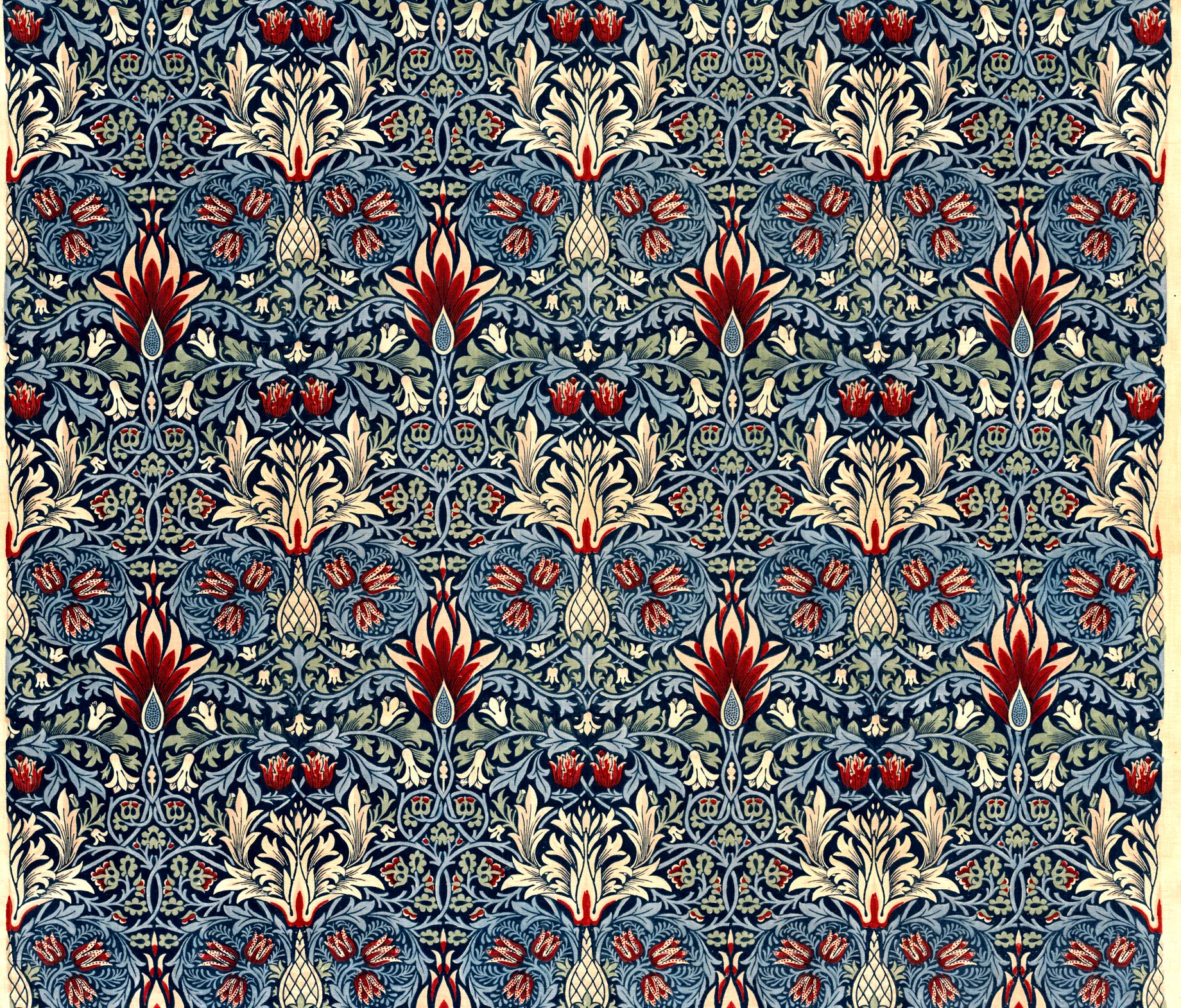
Snakeshead by William Morris is an intricate floral textile pattern designed in the late 1870s. It features the nodding fritillary flower arranged across dense foliage against a deep indigo ground.
| Designed | 1876 |
|---|---|
| Designer | William Morris |
| Type | textile |
| Motifs | flowers |
| Colourway | Indigo |
| Repeat | 8.9 × 11.5 in |
| Source | Cleveland Museum of Art. Licence: CC0. Museum record |
Order Snakeshead as a print
Format
Size (inches)
$40
Made to order. Shipping included in the US.
Seamless pattern file
One repeat tile, ready to fill any size in design software.
What Snakeshead shows
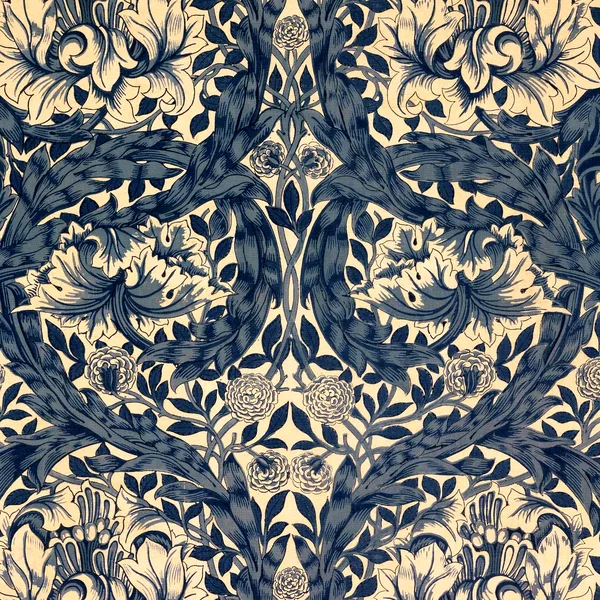
Snakeshead by William Morris presents a dense, rhythmic arrangement of botanical forms anchored by the nodding blooms of the fritillary. The fritillary, commonly called the snake’s head fritillary, was a wildflower Morris remembered from the damp meadows around Oxford. In this pattern, the characteristic bell-shaped blossoms appear in bold shades of deep red and cream, positioned upright and pendant across alternating registers.
Beneath and around the primary blossoms, stylized clusters of leaves fan outward in pale cream and soft sage green. Slender trailing stems weave between larger central palmettes, while tiny delicate florets and buds fill every pocket of the dark ground. The composition relies on strong vertical symmetry within each cluster, balanced by horizontal continuity across the repeat. Unlike open trellis patterns, the background here remains tightly covered with fine linework, creating an energetic and continuous textile surface.
Who designed it and when
William Morris designed Snakeshead in the late 1870s. Historical records present a slight difference in dating: the design record dates the pattern to 1876, whereas text from the Cleveland Museum of Art dates Morris’s work on the design to 1877. To explore where this pattern fits among his other creations, you can browse every William Morris design in our library, or read about his career in our guide to William Morris.
During this time, Indian silks were widely imported into Britain and held great favor in fashionable London circles. Morris studied these imported goods carefully. He adopted their comparatively small, dense motifs and intense color schemes, combining those foreign textures with native British flora. While later designs like Strawberry Thief introduced pictorial birds and garden strawberries, Snakeshead remains purely focused on formal botanical rhythm.
How it was made and used
Snakeshead was created as a printed cotton textile. The museum example preserved by the Cleveland Museum of Art is printed on plain weave cotton, produced in Walthamstow, England, in the early twentieth century. The repeat measures approximately 8.9 by 11.5 inches, an intimate scale designed for interior drapery and upholstery.
The pattern achieved its visual depth through careful block printing techniques. Strong reds and deep dark tones were fashionable during this brief period in English decoration before consumers drifted back toward paler pastel shades. Producing these rich shades on cotton cloth required specialized dyeing methods that Morris revived to replace harsh synthetic aniline dyes with traditional colorants.
Colourways
On this site, the pattern appears in one colourway named Indigo. This title is the site’s own descriptive label taken from the museum scan rather than an original Victorian trade name.
The Indigo colourway features a deep, near-black navy ground that emphasizes the bright foreground details. Crimson and deep wine-red tones articulate the prominent central fritillary petals and accent pods. Soft parchment cream highlights the outward-curving acanthus sprays, while muted moss greens and pale slate blues shade the foliage and lower bells. The high contrast between the pale leaves and dark ground gives the dense repeat remarkable clarity across a room.
Snakeshead as a print
Snakeshead works well as framed wall art because of its disciplined repeat and balanced symmetry. On Archival Paper, the textured 100% cotton rag surface absorbs the deep indigo background and enhances the warm cream tones of the foliage. Premium Canvas wraps the design neatly around solid wood bars, highlighting the tactile appearance of the original printed cotton cloth. Framed Canvas places the pattern within a floating wood frame, available in black, white, gold, silver, walnut, or oak, which separates the dark edges cleanly from your wall.
All prints are printed and shipped by ArtsyWall. If you are decorating an entire room rather than hanging a single print, you can also find this design as peel-and-stick wallpaper on williammorriswallpapers.com.
Want Snakeshead on a whole wall? See Snakeshead wallpaper, sized to your wall.
Questions and answers
Who designed Snakeshead?
William Morris designed the Snakeshead pattern. While later patterns from the firm were often created by John Henry Dearle or other assistants, historical records confirm Morris himself produced this design. The Cleveland Museum of Art holds an early twentieth-century printed cotton example of the pattern produced in Walthamstow, England, which credits the design to William Morris.
When was Snakeshead designed?
Historical sources differ slightly on the exact date. The design record dates Snakeshead to 1876, while museum records at the Cleveland Museum of Art date its design to 1877. During this period in the late 1870s, Morris took direct inspiration from imported Indian textiles while incorporating native English wildflowers into his botanical repeats.
What does the Snakeshead pattern show?
The Snakeshead pattern shows nodding fritillary wildflowers, known colloquially as snake's-head fritillaries, set amid layered leaves and smaller blossoms. Morris drew inspiration from the wildflowers he recalled seeing in the river meadows near Oxford. The composition displays stylized flower heads, scrolling foliage, and delicate background sprays that form an interlocking botanical repeat.
Was Snakeshead a wallpaper or fabric?
Snakeshead was designed as a printed textile rather than a wallpaper. Morris produced it as a printed cotton fabric, utilizing fine repeats suitable for soft furnishings and domestic drapery. The original printed cotton textiles were manufactured in England, featuring rich dyes applied to plain weave cotton cloth.