Rose and Lily by J.H. Dearle
Rose and Lily is a Morris & Co. woven textile designed by John Henry Dearle in 1893. Though often sought as a William Morris design, Dearle created the pattern using formal lilies, roses, and climbing stems.
| Designed | 1893 |
|---|---|
| Designer | J.H. Dearle |
| Type | textile |
| Motifs | flowers |
| Colourway | Red |
| Repeat | 11.2 × 18.6 in (estimated) |
| Source | LACMA. Licence: Public domain (LACMA open access). Museum record |
Order Rose and Lily as a print
Format
Size (inches)
$40
Made to order. Shipping included in the US.
Seamless pattern file
One repeat tile, ready to fill any size in design software.
What Rose and Lily shows
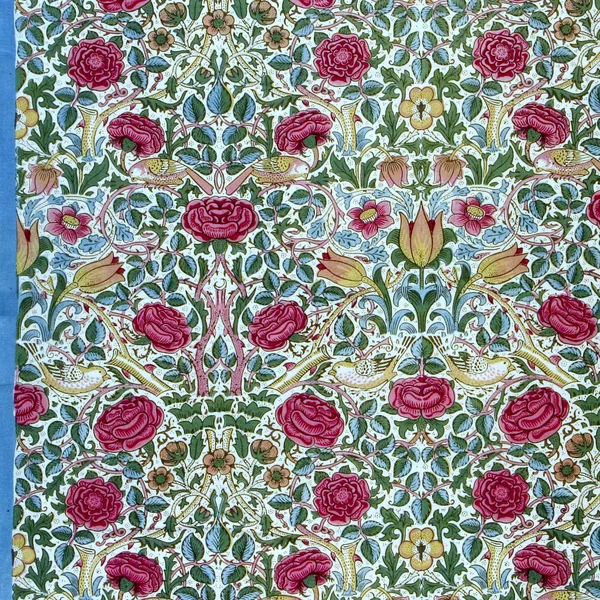
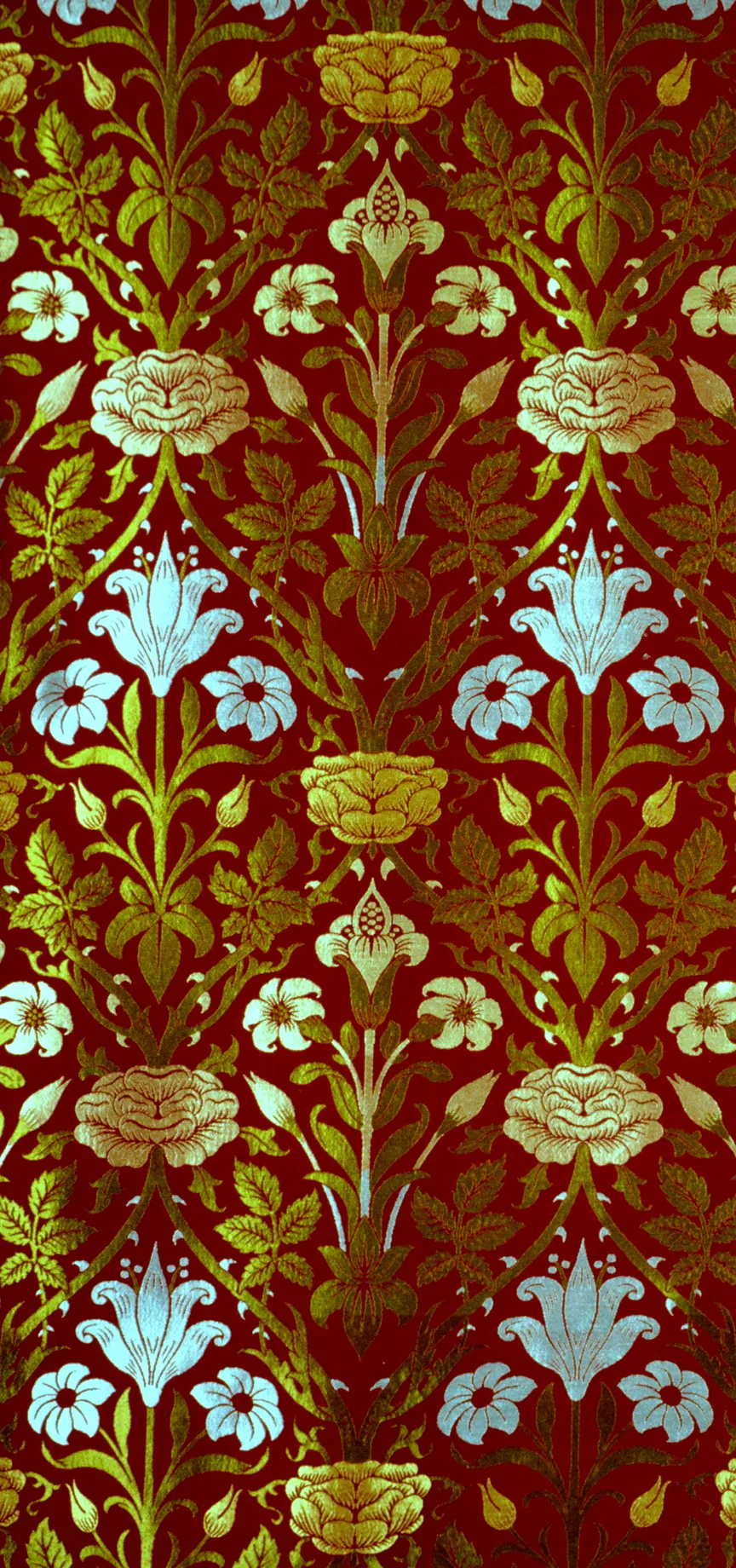
Rose and Lily William Morris searches frequently point to this design, yet the pattern was composed by John Henry Dearle for Morris & Co. in 1893. The pattern centers on a formal, symmetrical arrangement of garden flowers built along an ogival lattice. Bold green stems curve upward and cross one another to create diamond-shaped frames across the surface.
Inside these frames, upright white lilies flare open with pale petals and prominent stamens. At the lateral junctions of the stems sit full, golden-yellow rose blossoms, viewed from above with tightly packed petals. Slender rosebuds on curving offshoots flank the central blossoms.
Smaller white star-shaped flowers and pointed seed pods fill the background spaces between the primary blooms. Serrated green leaves with yellow-gold veining flank every stem. The dense botanical repeat rests against a deep red ground, producing a strong contrast between the dark backdrop and the pale lilies and golden roses. The estimated pattern repeat measures approximately 11.2 by 18.6 inches, creating a rhythmic vertical progression.
Who designed it and when
John Henry Dearle designed Rose and Lily in 1893. Dearle joined Morris & Co. as a showroom assistant in 1878 and soon became a design apprentice under William Morris. By 1890, Dearle had risen to become the firm’s head designer, supervising weaving and fabric printing at Merton Abbey. He later served as Art Director after Morris died in 1896.
Throughout his career, Dearle created many patterns that the public associated exclusively with Morris. You can explore how Dearle’s work fits within the broader history of the firm in our guide to William Morris. Dearle exhibited early patterns under Morris’s name, and retailers continue to sell his work under the Morris label today. Museum records reflect this shared history. The Los Angeles County Museum of Art catalog entry lists both John Henry Dearle and William Morris alongside Morris & Co., though Dearle is recognized as the principal designer. You can compare Rose and Lily with other historical patterns across every William Morris design in our library.
How it was made and used
Rose and Lily was produced as a woven furnishing textile rather than a printed paper or chintz. A museum length preserved at the Los Angeles County Museum of Art reveals that Morris & Co. manufactured the piece in England using a compound wool and silk twill. The museum fabric measures 27 inches wide by 141 3/4 inches long.
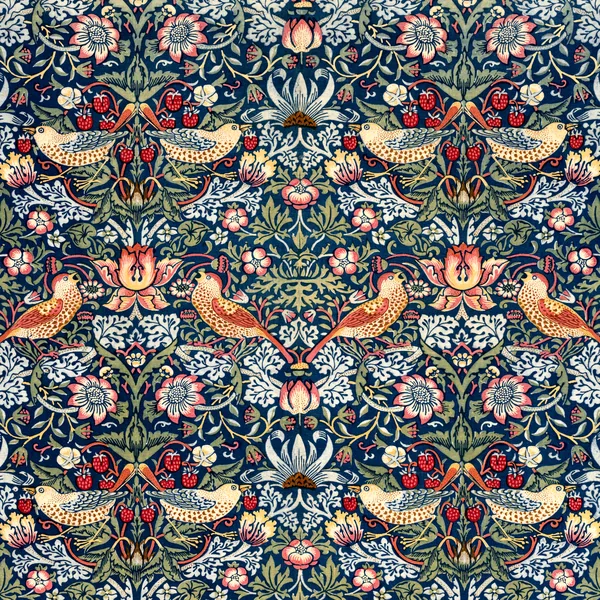
The compound twill technique combined heavy wool fibers with lustrous silk threads. This construction produced a substantial cloth with a subtle sheen on the raised details. While printed cottons such as Strawberry Thief relied on woodblock printing and indigo discharge baths, Rose and Lily achieved its pattern entirely on the loom. Morris & Co. used such heavy compound fabrics for domestic furnishings, including portieres, heavy window draperies, wall hangings, and upholstery.
Colourways
This site presents Rose and Lily in one colourway, labeled Red. This label is our own descriptive name taken from the museum scan, not an original Victorian trade title. The scan comes from an open-access public-domain record provided by the Los Angeles County Museum of Art.
The Red colourway pairs a deep, wine-red background with warm golden-yellow roses and olive-toned stems. Crisp white lilies and smaller accent flowers provide sharp highlights that stand out clearly against the darker tones. The balanced palette gives the floral motifs a stately, structured feel suitable for rooms with dark wood or warm neutral walls.
Rose and Lily as a print
Prints of Rose and Lily are printed and shipped by ArtsyWall in three formats: Archival Paper, Premium Canvas, and Framed Canvas. Archival Paper offers a flat, matte presentation on heavyweight cotton rag paper. Premium Canvas stretches the design over solid wood bars for an unframed look with wrapped edges. Framed Canvas places the stretched canvas inside a wood floating frame, leaving a slim visual gap between the edge of the artwork and the molding. Available frame finishes include black, white, gold, silver, walnut, and oak.
Framed on a wall, Rose and Lily reads as a balanced architectural composition. The dark red ground provides depth, while the vertical lattice of lilies and roses adds height to your interior space. A walnut or dark oak frame complements the warm tones of the foliage, while a gold frame echoes the yellow rose blossoms.
Want Rose and Lily on a whole wall? See Rose and Lily wallpaper, sized to your wall.
Questions and answers
Who designed Rose and Lily?
John Henry Dearle created the Rose and Lily pattern for Morris & Co. Although many buyers search for it under the name of William Morris, Dearle drew the pattern during his tenure as the firm's head designer. He oversaw fabric production at the Merton Abbey workshops from 1890 onwards and eventually became Art Director after Morris passed away in 1896.
When was Rose and Lily designed?
Rose and Lily was designed in 1893 during John Henry Dearle's time as head designer for Morris & Co. Surviving archival examples, including a woven textile length preserved by the Los Angeles County Museum of Art, date the fabric's English production to 1893. This places the design in the late Victorian period, three years prior to the death of William Morris.
What does the Rose and Lily pattern show?
The Rose and Lily pattern displays an interlocking trellis of climbing stems, stylized white lilies, golden rose blossoms, rosebuds, and serrated foliage set against a dark red background. Smaller white star-shaped flowers and pointed buds fill the diamond-shaped compartments across the repeat, creating a dense, formal arrangement of garden plants with symmetrical balance and rhythmic curves throughout the repeating textile layout.
Was Rose and Lily a wallpaper or a fabric?
Rose and Lily was produced as a woven fabric rather than a wallpaper. The historical textile firm Morris & Co. crafted the original material in England using a compound twill of wool and silk fibers. This specialized weaving method formed a thick, durable cloth with lustrous highlights, intended for interior furnishings like curtains, portieres, and furniture upholstery instead of paper wallcoverings.