Florence by J.H. Dearle
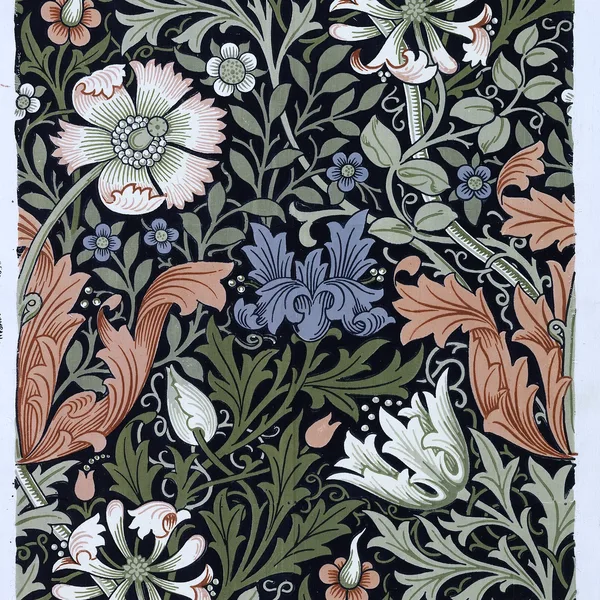
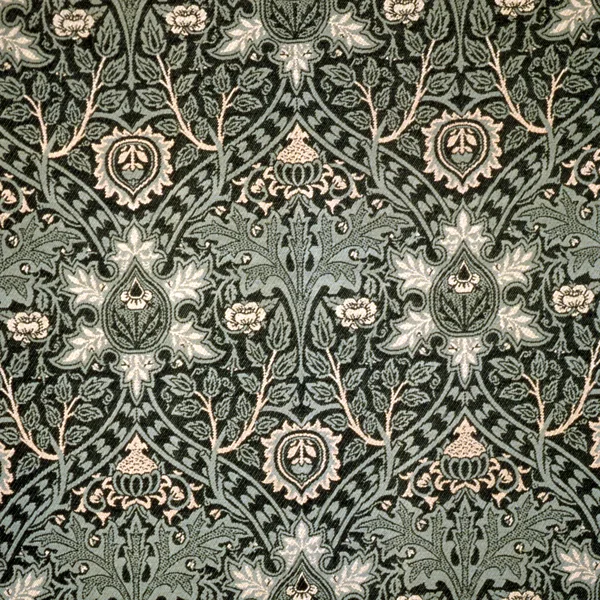
Florence is an 1890 Morris & Co. textile pattern designed by John Henry Dearle, often searched as a Florence William Morris design. It pairs curling acanthus foliage and bold flower heads across a dense dark ground.
| Designed | 1890 |
|---|---|
| Designer | J.H. Dearle |
| Type | textile |
| Motifs | flowers |
| Colourway | Black |
| Repeat | 12.7 × 17.1 in |
| Source | Art Institute Chicago. Licence: CC0. Museum record |
Order Florence as a print
Format
Size (inches)
$40
Made to order. Shipping included in the US.
Seamless pattern file
One repeat tile, ready to fill any size in design software.
What Florence shows
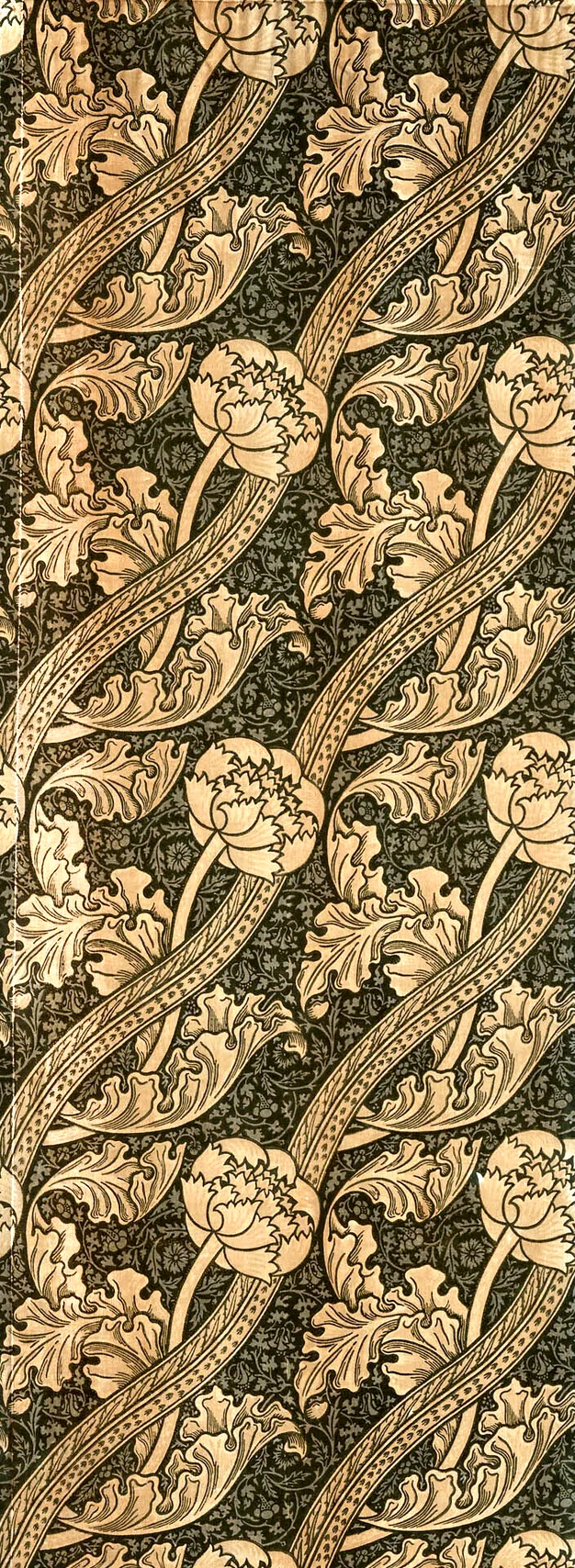
Florence is a repeating textile pattern centered on stylized floral blooms and vigorous curving foliage. While many buyers search for a florence william morris design, the work presents John Henry Dearle’s distinctive handling of botanical rhythm. Sweeping diagonal ribbons or bands divide the plane, edged with double borders and dotted interior details. Thick stems wind upward, terminating in cupped, layered flower heads that resemble stylized peonies or roses with ruffled petals.
Flanking each blossom are large, deeply lobed acanthus leaves that curl sharply backward. Dearle filled every leaf and petal with fine linear hatching, which gives the light tan motifs a woodblock or engraved texture. The ground behind these dominant elements is dark and packed with fine detail. A secondary layer of tiny sprigs, delicate foliage, and petite bud forms blankets the open areas, creating a two-layer depth between the foreground flowers and the dark background.
Who designed it and when
John Henry Dearle designed Florence around 1890 for the British decorative firm Morris & Co. Dearle joined the company in 1878 as a showroom assistant on Oxford Street, caught the attention of William Morris, and became a workshop apprentice. By 1890, Dearle took over as the firm’s chief designer, supervising textile printing and weaving at Merton Abbey.
Because Dearle often exhibited his creations under the Morris firm name, his contributions were long credited to Morris himself. Modern museum scholarship clearly identifies Dearle as the creator of Florence. The Art Institute of Chicago holds an original textile example of Florence in its collection, dating the design to circa 1890 and the physical manufacture to between 1890 and 1917. You can explore how his work fits into the wider history of Morris & Co. across our index of every William Morris design.
How it was made and used
Florence was produced as a printed or woven textile rather than a wall covering. Museum records note that the physical repeats measure approximately 12.7 by 17.1 inches. The diagonal movement of the ribbons and stems allows the block to tile smoothly, forming an unbroken rhythm when hung as drapery or used for upholstery.
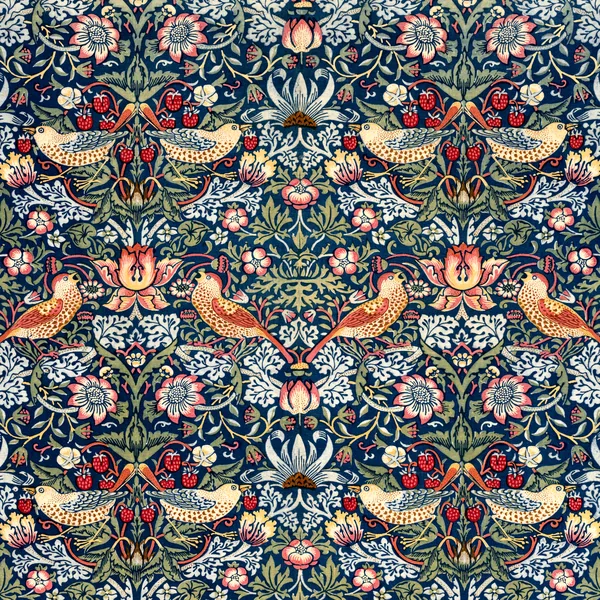
During this era, Morris & Co. created high-end furnishings for domestic interiors. Fabric designs like Florence competed with famous company classics, such as the well-known Strawberry Thief printed chintz. Dearle’s arrangement relied on strong contrast between pale organic shapes and dark, leafy grounds to provide visual warmth in Victorian rooms.
Colourways
This site presents Florence in a single historical colourway, labeled Black from the museum scan. It features light parchment-toned flowers, leaves, and scrolling ribbons set over a dark charcoal and black field. The tiny background flora appears in soft grey-green and muted olive tones, which keeps the contrast soft rather than harsh.
Florence as a print
Florence works well as framed wall art due to its bold diagonal sweep and crisp contrast. You can order the design printed and shipped by ArtsyWall in three formats: Archival Paper, Premium Canvas, and Framed Canvas.
Archival Paper provides a matte, textured finish on cotton rag paper, emphasizing the fine hatching on the flower petals. Canvas options highlight the textile origins of the pattern, stretching the design over solid wood bars. A Framed Canvas comes ready to hang with an attached wire, available in floating wood finishes including black, white, gold, silver, walnut, and oak.
Want Florence on a whole wall? See Florence wallpaper, sized to your wall.
Questions and answers
Who designed Florence?
John Henry Dearle designed Florence in 1890 for Morris & Co. Dearle trained directly under William Morris and rose to become the firm's chief designer in 1890, later serving as Art Director. Although people frequently search for Florence as a William Morris pattern, historical records credit Dearle as the pattern's true designer.
When was Florence designed?
Florence was designed around 1890. Museum records from the Art Institute of Chicago date the initial pattern design to circa 1890, with textile production running between 1890 and 1917. This places Florence right at the start of John Henry Dearle's tenure as head designer for Morris & Co.
What does the Florence pattern show?
The Florence pattern shows large, stylized flower heads supported by long curving stems and broad, deeply lobed acanthus leaves. Broad patterned bands sweep diagonally across the composition. Behind the main floral motifs lies a fine, dense background filled with tiny scrolling leaves and miniature floral sprigs set against a dark base.
Was Florence a wallpaper or a fabric?
Florence was produced as a textile rather than a wallpaper. Morris & Co. manufactured the design as a fabric between 1890 and 1917. The surviving museum scan preserved at the Art Institute of Chicago records an original pattern repeat measuring approximately 12.7 by 17.1 inches on woven material.