Compton by J.H. Dearle
Compton is a late Morris & Co. pattern designed by John Henry Dearle in 1896. Often attributed to William Morris, this layered botanical design features large curling leaves, detailed flower heads, and scrolling stems.
Colourways
| Designed | 1896 |
|---|---|
| Designer | J.H. Dearle |
| Type | textile |
| Motifs | flowers, leaves |
| Colourway | Black |
| Repeat | not measured |
| Source | Cooper Hewitt, Smithsonian Design Museum, via Wikimedia Commons. Licence: Public domain, Commons template {{PD-old-70-1923}} (Wikimedia Commons). Museum record |
Order Compton as a print
Format
Size (inches)
$40
Made to order. Shipping included in the US.
Seamless pattern file
A repeat tile of this design, ready to fill any size in design software.
What Compton shows
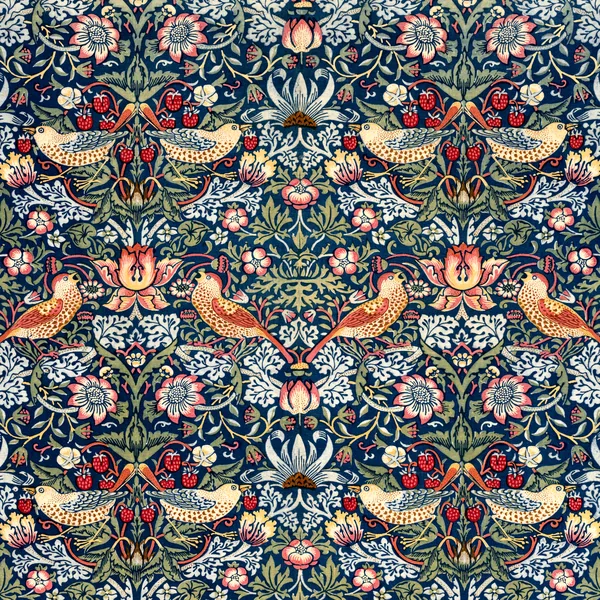
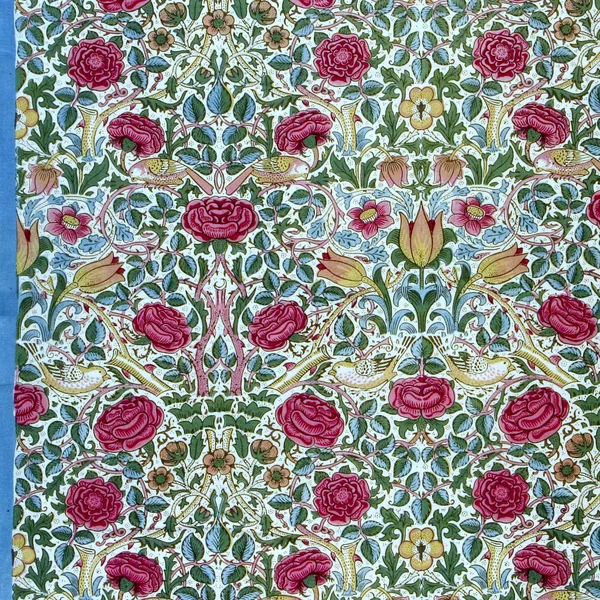
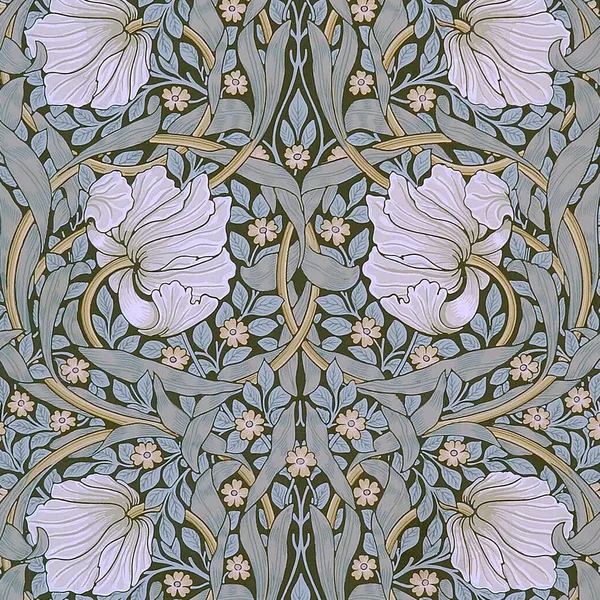
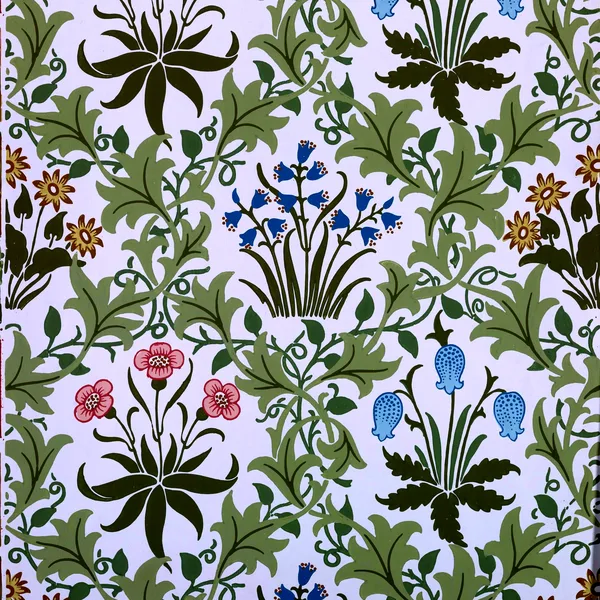
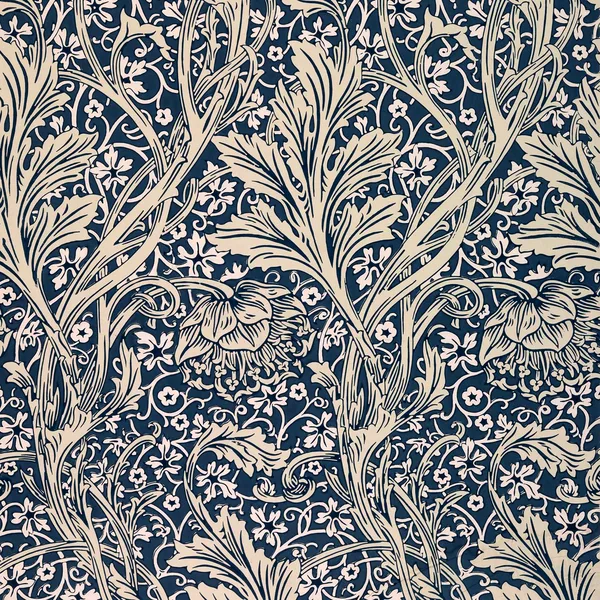
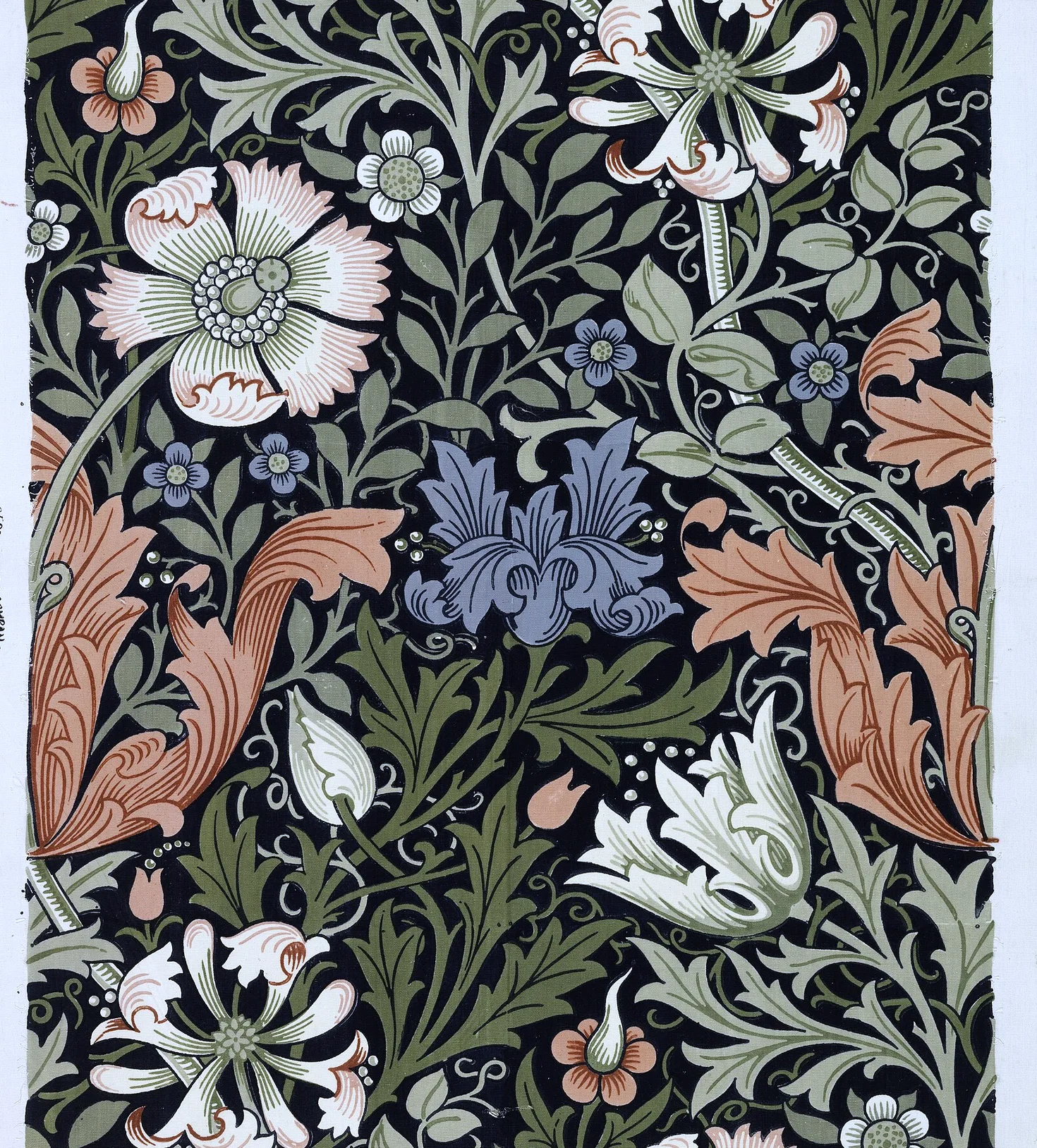
The Compton pattern by William Morris & Co. was designed by John Henry Dearle in 1896. This design presents a dense, intertwined field of botanical forms across a dark or light ground. At its center are large, open flower heads with radiating petals and dotted rings around their stamens. Surrounding these blossoms are bold, curling acanthus-style leaves in warm tones that sweep upward through the composition.
Interspersed between the primary motifs are smaller botanical elements: clusters of little star-like florets, nodding bell blossoms, and trailing stems lined with fine dots. Delicate foliage runs in layered curves beneath the larger flower heads, creating visual depth without leaving open empty space. Every stem and tendril connects into a continuous, climbing rhythm that fills the surface.
Who designed it and when
Compton was designed in 1896 by John Henry Dearle, rather than by William Morris himself. Dearle started working at the Oxford Street showroom of Morris & Co. in 1878 before training as an apprentice under Morris. Over the years, Dearle rose through the firm, becoming head designer by 1890 and Art Director after Morris died in 1896.
Because Dearle worked closely under Morris and exhibited work under the company name, many of his designs are still widely sought as William Morris patterns. You can explore other patterns across the firm’s history in our catalogue of designs, or learn about the founder’s career in our guide to William Morris. Dearle developed a distinctive style that embraced dense floral arrangements and Near Eastern influences while preserving the decorative principles of Morris.
How it was made and used
Museum records list Compton as both a printed textile and a wallpaper, showing that the firm adapted it for multiple surfaces. The design record on this site classifies it as a textile. A printed cotton specimen in the Cooper Hewitt collection was registered on February 27, 1896, and features large-scale flowers and vines printed across cotton cloth.
At the same time, records from the Metropolitan Museum of Art document Compton as a block-printed wallpaper produced by the printer Jeffrey & Co. for Morris & Co. in 1896. Surviving notes indicate that the wallpaper pattern received approval by William Morris before his death that year. Like famous Morris patterns such as Strawberry Thief, Compton was adapted to decorate domestic interiors through wall coverings and fabric furnishings.
Colourways
This site presents Compton in two distinct colourways sourced from museum scans. The colourway names reflect the digital scans available here rather than original Victorian trade names.
The first colourway is Black, taken from the Cooper Hewitt printed cotton specimen. It displays large-scale pink, white, green, and blue flowers set against a dark blue-black ground. The deep backdrop makes the pale flower petals and coral-toned acanthus leaves stand out with high contrast.
The second colourway is Teal on Ivory, based on the Metropolitan Museum of Art wallpaper scan. This version places soft peach foliage, ivory blossoms, and pale blue-grey petals against a warm, light background, giving the dense pattern an open, airy character.
Compton as a print
ArtsyWall prints and ships Compton in three formats: Archival Paper, Premium Canvas, and Framed Canvas. As a framed art print, Compton draws the eye with its intricate interlocking vines and contrasting floral tones. When set inside a floating wood frame, the repeating leaves and nodding flower heads gain clean borders that suit modern walls while keeping their period character. You can also view the pattern as peel-and-stick wallpaper on williammorriswallpapers.com. The design brings balanced color and movement to any interior.
Want Compton on a whole wall? See Compton wallpaper, sized to your wall.
Questions and answers
Who designed Compton?
John Henry Dearle designed Compton in 1896 for Morris & Co. While frequently sold under William Morris's name today, Dearle created the pattern toward the end of Morris's life. Dearle started in the company showroom in 1878, studied design, and became head designer by 1890 before taking over as Art Director following Morris's death in 1896.
When was Compton designed?
Compton was designed in 1896 and registered on February 27, 1896. Historical records from the Metropolitan Museum of Art note that William Morris approved the wallpaper design in 1896, the year he died. The design was produced by Morris & Co. as both a block-printed wallpaper printed by Jeffrey & Co. and as a printed cotton textile.
Was Compton a wallpaper or a fabric?
Compton was produced as both a wallpaper and a printed cotton textile. Historical records show that Jeffrey & Co. printed the pattern as wallpaper for Morris & Co. starting in 1896. Surviving museum specimens also include printed cotton fabrics registered in early 1896, showing that Morris & Co. issued the floral design across multiple interior furnishings.
What colours does Compton come in?
On this site, Compton is available in two colourways named Black and Teal on Ivory. The Black colourway reproduces a museum textile print with pink, green, blue, and white floral details against a deep dark ground. The Teal on Ivory colourway reproduces an archival wallpaper sample featuring warm peach foliage, soft blue petals, and cream tones on an ivory background.