Celandine by J.H. Dearle
Celandine is a Morris & Co. floral wallpaper pattern designed by J.H. Dearle, often searched as a William Morris design. It pairs upright blue and pink blossoms with curving green leaves.
| Designed | 1872 |
|---|---|
| Designer | J.H. Dearle |
| Type | wallpaper |
| Motifs | flowers, leaves |
| Colourway | Green on Ivory |
| Repeat | not measured |
| Source | Cooper Hewitt, Smithsonian Design Museum. Licence: CC0. Museum record |
Order Celandine as a print
Format
Size (inches)
$40
Made to order. Shipping included in the US.
Seamless pattern file
A repeat tile of this design, ready to fill any size in design software.
What Celandine shows
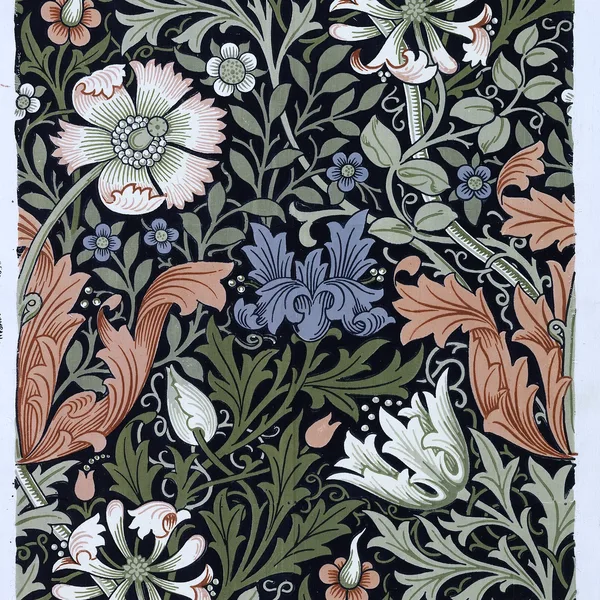
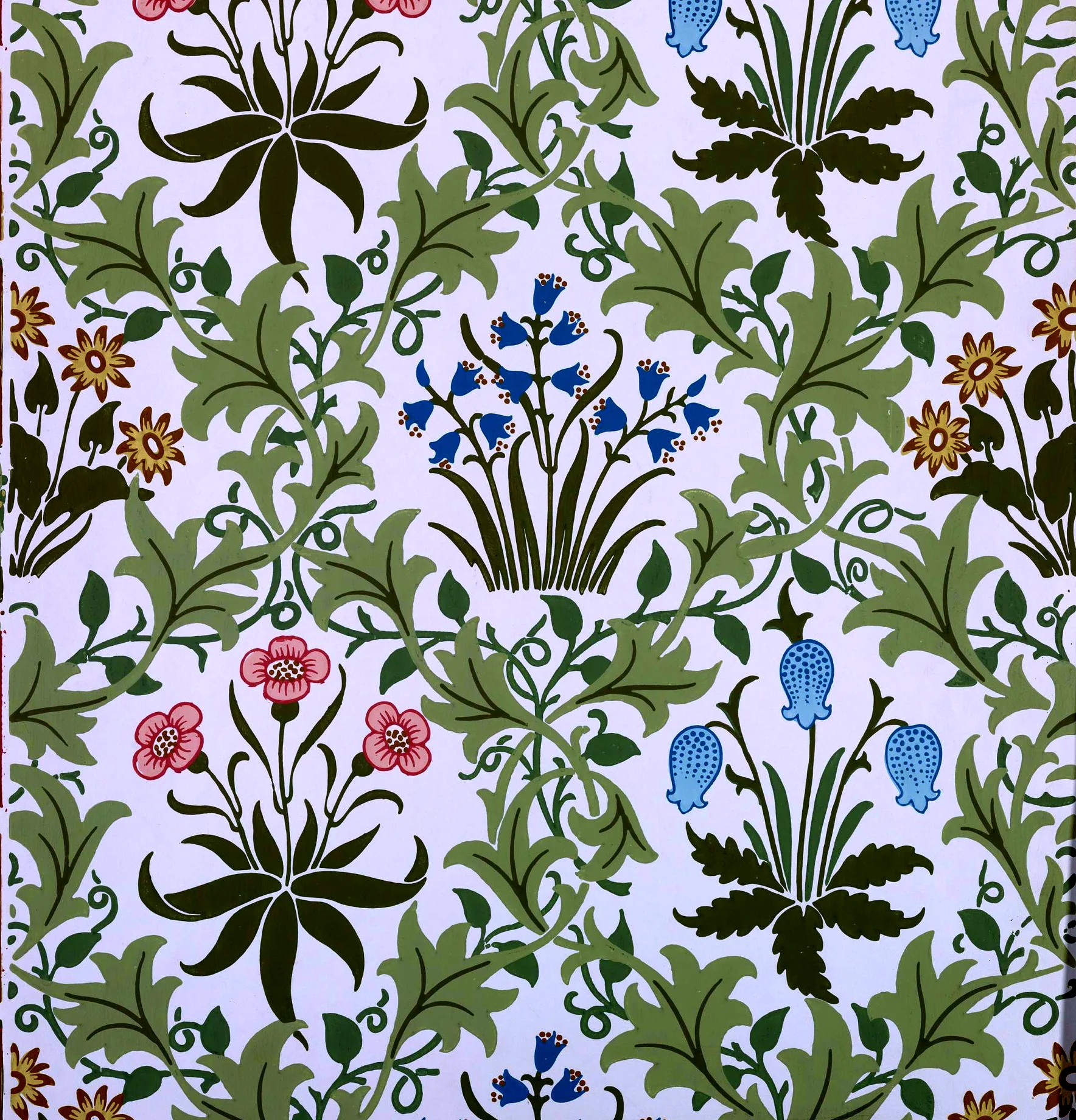
The Celandine William Morris pattern, created for Morris & Co. by J.H. Dearle, arranges garden and meadow flora across an ivory ground. In the center of each repeat, a cluster of blue bell-shaped flowers rises upright on slender dark stems. These bellflowers flare outward into delicate drooping blossoms. Below them, a companion spray bears rounded pink flowers with five petals, flanked by dark green pointed leaves.
Spreading acanthus-like leaves frame each floral group in pale and mid-green tones. The large serrated foliage curls outward and inward, creating oval compartments that enclose the blooms. Branching out from the central stems are small daisy-like flowers with yellow petals and dark brown centers. Deep olive foliage shaped like pointed stars anchors the lower sections. Thin curling tendrils emerge from the main stems, weaving between the leaves and maintaining an even spacing across the pale background.
Who designed it and when
John Henry Dearle designed Celandine for Morris & Co. Even though the pattern is widely sought after as a design by William Morris, the firm’s records attribute the work to Dearle. Dearle began his career with Morris & Co. in 1878 as an assistant in the Oxford Street showroom. He studied design and glass painting, showed exceptional skill as a draftsman, and eventually rose to head designer in 1890 and Art Director in 1896 after Morris passed away.
Records show conflicting dates for the design. The design record in our library lists 1872, while museum records, including the Cooper Hewitt collection, date surviving wallpaper examples to 1872–1882. Because Dearle began working for Morris & Co. in 1878, the sources differ on the exact timing of the pattern’s origin. You can see how Celandine compares to every William Morris design across the firm’s full production history.
How it was made and used
The firm issued Celandine as a wallpaper pattern rather than a printed fabric or woven textile. As a wall covering, the design relies on a vertical repeating structure. The flower sprays stand straight, while the curved acanthus leaves link from top to bottom and side to side across the wall surface.
This vertical organization gave Victorian rooms a structured, upright look without crowding the space. Unlike tightly packed patterns such as Strawberry Thief, Celandine leaves open areas of ivory ground visible between the leaves and stems. The motif arrangement allows light to reflect from the background, giving the room a lighter, more open visual effect while maintaining a continuous floral pattern.
Colourways
The site presents Celandine in one colourway: Green on Ivory. This label is our own descriptive name taken from the scan of the historical wallpaper, rather than an original nineteenth-century trade name.
Green on Ivory places soft sage and mid-green leaves against an unprinted ivory ground. The palette uses dark olive green for the low star foliage and plant stems, contrasting with the lighter foliage above. Accents of clear sky blue on the bellflowers, soft rose pink on the round blossoms, and warm yellow on the small star flowers punctuate the green leaves. The light background keeps every petal and leaf silhouette sharp.
Celandine as a print
ArtsyWall prints and ships Celandine in three formats: Archival Paper, Premium Canvas, and Framed Canvas. Archival Paper is a heavyweight 340gsm cotton rag paper with a textured watercolor feel, shipped unframed in a tube. Premium Canvas is an acid-free canvas stretched over solid wood bars with a sawtooth hanger. Framed Canvas places the stretched canvas into a wood floating frame, leaving a small gap around the edges. You can choose from six frame finishes: black, white, gold, silver, walnut, and oak.
Framed on a wall, Celandine functions as a balanced botanical print. The pale ivory ground prevents the design from feeling heavy, while the upright bluebells and pink blossoms provide focal points of color. The vertical lines and curving green leaves look sharp inside both clean black frames and natural wood finishes.
Want Celandine on a whole wall? See Celandine wallpaper, sized to your wall.
Questions and answers
Who designed Celandine?
John Henry Dearle designed Celandine for Morris & Co. While many retail listings still sell Celandine under the name of William Morris, company records and museum attributions credit Dearle as the designer. Dearle began working for Morris & Co. in 1878 and eventually rose to become the company's head designer and Art Director after Morris died.
When was Celandine designed?
The design record dates Celandine to 1872, though surviving museum collections date printings of the wallpaper to between 1872 and 1882. Sources differ slightly regarding the exact year of its creation, particularly because designer J.H. Dearle joined Morris & Co. in 1878. The firm produced the pattern during this active late nineteenth-century period of wallpaper manufacturing.
What does the Celandine pattern show?
The Celandine pattern shows a symmetrical arrangement of English meadow and woodland blossoms set against curving green foliage. Central upright clusters feature blue bell-shaped flowers rising on slender stems. Surrounding spaces contain pink round-petaled blossoms, small yellow star flowers, and deep olive leaves. The entire botanical composition repeats vertically across a pale, unpatterned ivory background.
Was Celandine a wallpaper or a fabric?
Celandine was produced as a wallpaper for Morris & Co. rather than a woven textile or printed cotton fabric. The pattern uses a structured vertical repeat created specifically to cover interior wall spaces. Historic surviving examples preserved in museum archives, including collections at the Cooper Hewitt, classify the pattern directly as printed wallpaper.