Ispahan by J.H. Dearle
Ispahan is an 1888 woven wool textile often sold as an ispahan William Morris pattern, though it was designed by John Henry Dearle for Morris & Co. The pattern pairs scrolling foliage with structured ogival strapwork.
| Designed | 1888 |
|---|---|
| Designer | J.H. Dearle |
| Type | textile |
| Motifs | flowers, geometric |
| Colourway | Green on Stone |
| Repeat | not measured |
| Source | LACMA. Licence: Public domain (LACMA open access). Museum record |
Order Ispahan as a print
Format
Size (inches)
$40
Made to order. Shipping included in the US.
Seamless pattern file
A repeat tile of this design, ready to fill any size in design software.
What Ispahan shows
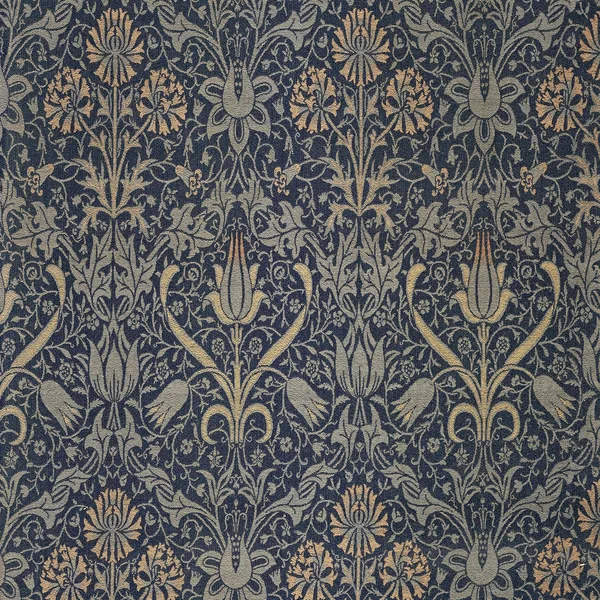
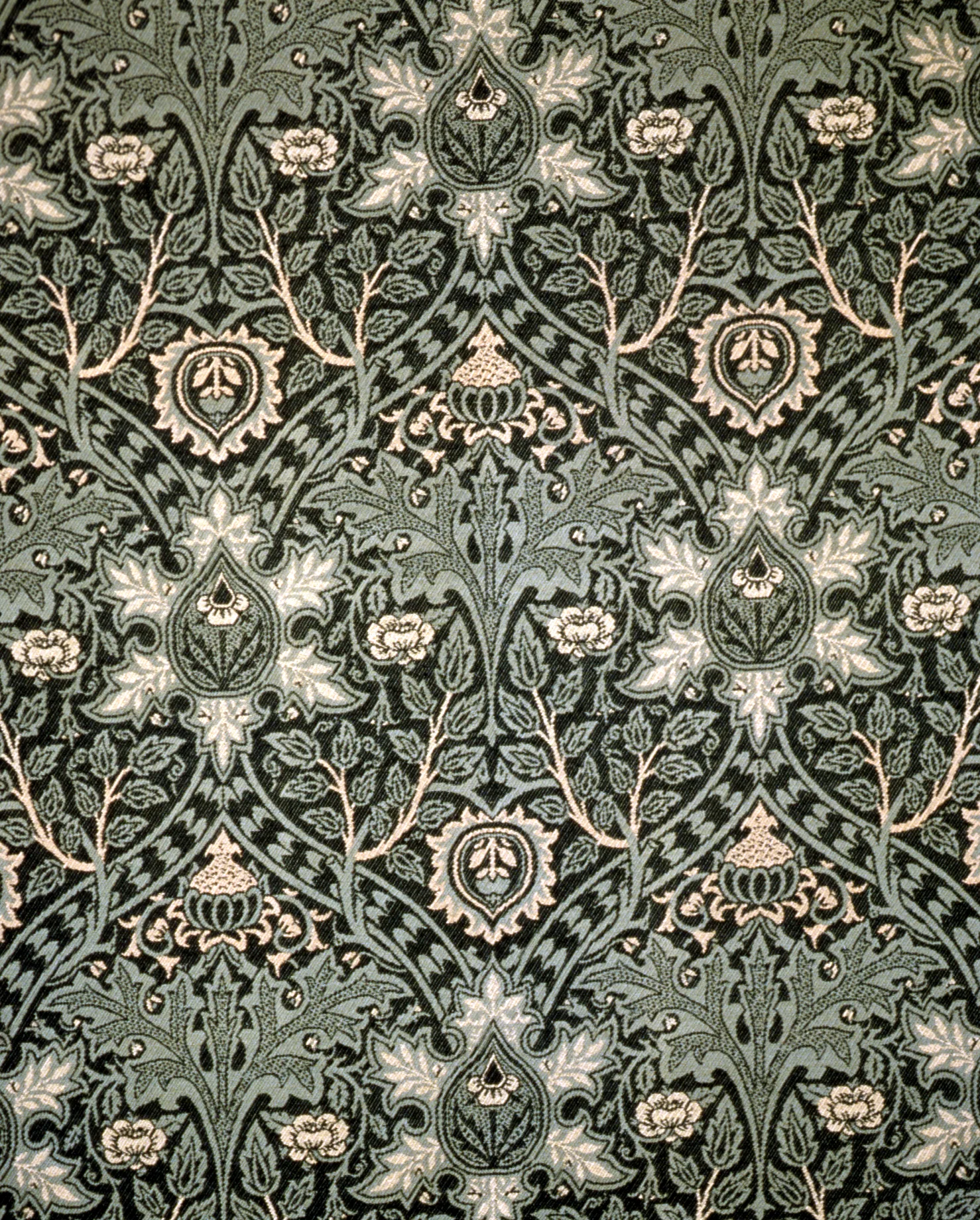
Although widely sought as an ispahan William Morris pattern, Ispahan is a structured repeating pattern designed by Morris’s apprentice and successor, John Henry Dearle. The design organizes botanical motifs within a rhythmic, interlocking ogival lattice. Prominent lobed medallions form the center of each repeating frame, housing stylized pomegranates or seed pods alongside small floral buds.
Thick foliate branches curve upward across the field, covered in serrated acanthus leaves and spiky foliage. Delicate, paler sprigs branch off the main stems, terminating in small white five-petaled rosettes that puncture the darker leafy field. Pointed lancet leaves and scrolling floral palmettes reinforce the vertical symmetry. A dark, textured ground creates depth behind the lighter sage, olive, and stone-colored details.
Who designed it and when
John Henry Dearle designed Ispahan in 1888 for Morris & Co. Dearle began working for the firm in 1878 as a teenager in the Oxford Street showroom. Recognizing his talent as a draftsman, William Morris trained Dearle in glass painting and weaving, making him Morris & Co.’s first weaving apprentice. You can read more about Morris’s partnership with his craftsmen in our guide to William Morris.
In the late 1880s, Dearle took on the design of repeating patterns for wallpapers and fabrics. Dearle exhibited many early patterns directly under Morris’s name, which led many buyers to assume Morris drew them. Dearle became head designer for Morris & Co. in 1890 and served as Art Director after Morris died in 1896. Historians note that Dearle introduced distinct Persian and Turkish influences into the firm’s output, a direction visible in the name and geometric organization of Ispahan.
How it was made and used
Morris & Co. produced Ispahan as a woven textile at their Merton Abbey works in Surrey. Surviving museum examples, such as a length measuring 51 1/2 inches in the Los Angeles County Museum of Art, are woven from wool using a compound twill weave. The twill structure created a heavy, durable fabric suitable for interior furnishings, portieres, and upholstery.
The compound weave allowed Dearle to build subtle textural shifts across the floral medallions and interlocking straps. Rather than relying on surface pigment like a printed chintz, Ispahan derived its depth from interlaced dyed wool yarns. Its formal, lattice-like structure shares geometry with traditional grid patterns like Diaper, while incorporating dense foliage across the twill ground.
Colourways
This site offers Ispahan in one colourway: Green on Stone. The palette presents sage and olive leaves against pale stone branches, accented by dark, deep-toned ground threads. Green on Stone is our catalog name for the scan and was not an original Victorian trade label.
The digital image comes from an open-access museum scan published by the Los Angeles County Museum of Art. The scanned textile length dates to circa 1888 and is in the public domain. To view this design alongside other textiles and wallpapers from the firm, explore our complete index of William Morris designs.
Ispahan as a print
You can order Ispahan as an art print printed and shipped by ArtsyWall. Three formats are available: Archival Paper, Premium Canvas, and Framed Canvas. The Archival Paper option uses 340gsm textured cotton rag paper, shipping rolled in a tube for custom framing. Premium Canvas is stretched over solid wood bars and includes a sawtooth hanger.
Framed Canvas prints arrive ready to hang with an attached wire. They feature wood floating frames available in six finishes: black, white, gold, silver, walnut, and oak. On a wall, Ispahan reads with architectural poise. The geometric strapwork provides order, while the dense Merton Abbey wool texture translates into rich, organic detail suitable for both modern and traditional rooms.
Want Ispahan on a whole wall? See Ispahan wallpaper, sized to your wall.
Questions and answers
Who designed Ispahan?
John Henry Dearle designed Ispahan for Morris & Co. Dearle trained directly under William Morris, starting as a shop assistant before becoming the firm's chief textile designer and later its Art Director. Because Morris & Co. often released works under Morris's name during this era, Ispahan is frequently misattributed to William Morris himself. The pattern reflects Dearle's personal interest in Middle Eastern design traditions.
When was Ispahan designed?
John Henry Dearle designed Ispahan in 1888. Museum records from the Los Angeles County Museum of Art date preserved lengths of the woven fabric to circa 1888. This period marked Dearle's rise within Morris & Co., when he began creating repeating patterns for woven textiles and wallpapers at the Merton Abbey works, just before becoming the firm's head designer in 1890.
Was Ispahan a wallpaper or a fabric?
Ispahan was originally produced as a fabric rather than a wallpaper. The historical Morris & Co. piece preserved at the Los Angeles County Museum of Art is a woven wool textile woven in compound twill at Merton Abbey. While never issued as historical wallpaper, the pattern is available today as fine art wall prints and canvas reproductions.
What colours does Ispahan come in?
On this site, Ispahan is available in one colourway named Green on Stone. This palette features muted sage and forest greens, creamy off-white blossoms, and dark background accents derived from a high-resolution museum scan of the original Merton Abbey wool weaving. The label Green on Stone is the site's modern catalog name rather than a historical Morris & Co. colour title.