Diaper by William Morris
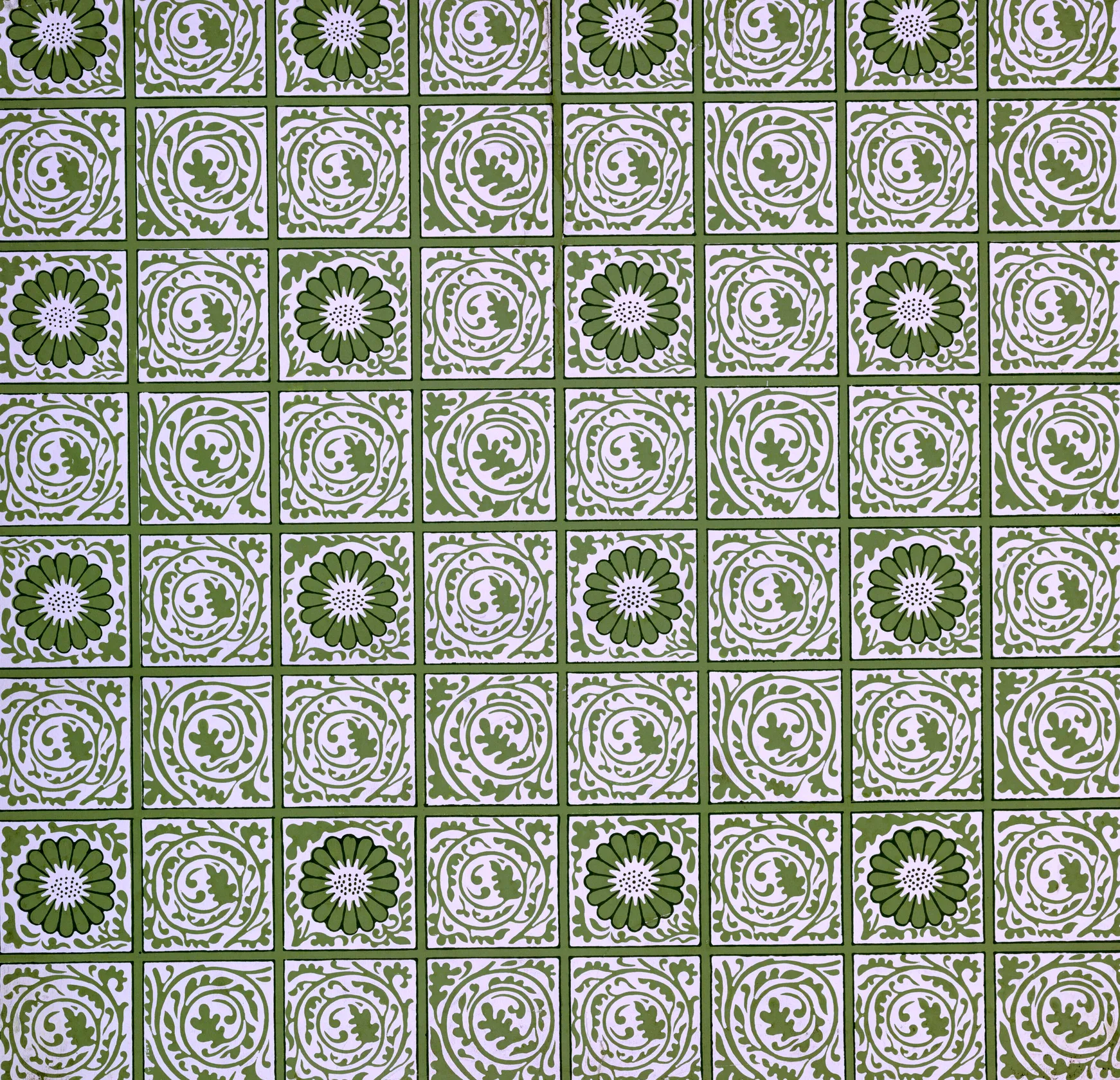
Diaper by William Morris is an 1863 wallpaper pattern arranged in a geometric grid of square tiles, alternating daisy-like blossoms with scrolling leaf rinceaux.
Colourways
| Designed | 1863 |
|---|---|
| Designer | William Morris |
| Type | wallpaper |
| Motifs | geometric, flowers |
| Colourway | Green |
| Repeat | 2.5 × 4.9 in (estimated) |
| Source | Cooper Hewitt, Smithsonian Design Museum, via Wikimedia Commons. Licence: Public domain (Wikimedia Commons). Museum record |
Order Diaper as a print
Format
Size (inches)
$40
Made to order. Shipping included in the US.
Seamless pattern file
One repeat tile, ready to fill any size in design software.
What Diaper shows
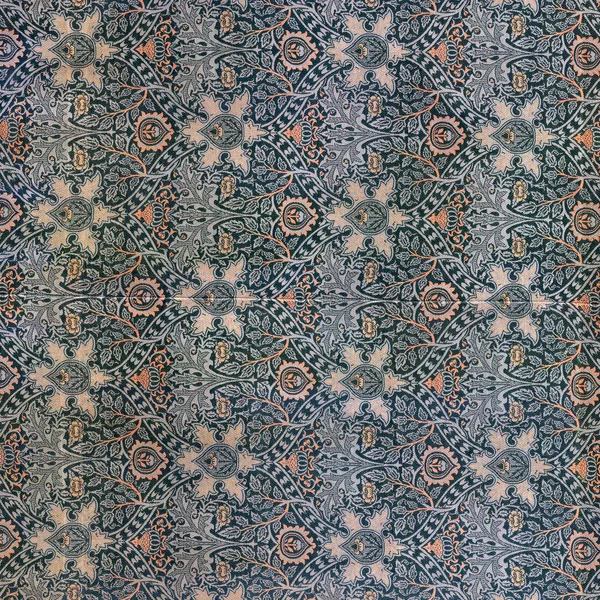
Diaper by William Morris organizes decorative botanicals into a strict geometric framework of square tiles. Unlike the dense, wandering boughs found in many later patterns, this early wallpaper layout holds every motif inside crisp grid lines. The structure alternates two distinct square panels across every row and column, creating a balanced, rhythmic field for interior walls.
One square tile contains an open flower with numerous slender petals that radiate outward from a dotted center, resembling a daisy or chrysanthemum bloom. Thin leaves fill the four corners of this square to frame the central floral disc. In the adjacent square, curling foliage rinceaux sweep around in a circular spiral. At the heart of each foliage scroll sits a lobed leaf, flanked by smaller sprigs that fill the surrounding corners.
This alternation creates a clear checkerboard effect across the surface. Because the flower heads and the swirling leafy medallions trade places from one row to the next, your eye moves diagonally as well as across the horizontal and vertical grid. The result is a disciplined pattern that balances formal architectural order with organic botanical curves.
Who designed it and when
Design records date Diaper to 1863 and attribute the pattern to William Morris. However, the historical sources differ regarding the attribution. The catalog record at the Cooper Hewitt museum lists the original artist as unknown, while Wikimedia Commons categories and period wallpaper records place it under the authorship of Morris.
During the early 1860s, Morris was developing his first wallpapers, establishing the foundational design principles that defined his career. You can explore his creative development in the guide to William Morris and his decorative output. Patterns from this initial phase often relied on explicit structural frameworks, using trellis lines, diagonal lattices, or square compartments to anchor garden flora. You can compare this approach to another structured design on the site, such as Tulip and Net, which similarly balances floral elements against an underlying linear framework. To see how Diaper fits alongside other patterns from Morris and his circle, browse every William Morris design in the collection.
How it was made and used
Diaper was produced as a block-printed wallpaper sidewall. Block printing involved carving the relief of the pattern into wooden printing blocks, coating the raised surfaces with distemper pigments, and hand-stamping the paper lengths roll by roll. Each distinct color tone required separate block impressions aligned precisely against the paper margin.
The Cooper Hewitt, Smithsonian Design Museum in New York City holds surviving sidewall specimens of Diaper dating from 1863–1870, cataloged under accession number 1941-74-2-a/f as a gift of Robert W. Friedel. In Victorian interiors, sidewall papers covered the main wall space between the wainscot or skirting board below and the frieze or cornice above. The rigid tile geometry of Diaper made it versatile for residential rooms, providing decorative surface texture without overpowering furnishings or architectural moldings.
Colourways
Historical museum documentation records five original color combinations for Diaper: dark blues on a blue ground, greens on white, neutral blue-green on olive, greens on light green, and reds on red. These variations offered choices ranging from low-contrast monochrome tones to brighter, light-ground printings.
On this site, the pattern is presented in several colourways derived from public-domain museum scans. The Green colourway features deep olive-green lines, petals, and foliage against an off-white ground. The Terracotta option displays rich orange-red lines and figures set against warm golden-yellow backgrounds. Additional options on the site include Ivory on Stone and Gold on Stone, which use light stone-toned grounds to highlight delicate line work. The colourway labels used here are site descriptions rather than historical names assigned by the manufacturer.
Diaper as a print
ArtsyWall prints and ships Diaper in three formats: Archival Paper, Premium Canvas, and Framed Canvas. Archival Paper presents the design on textured cotton paper that captures the crisp lines of the original woodblock impressions. Premium Canvas stretches the design over solid wood bars for a clean, frameless presentation. Framed Canvas places the canvas inside a wood floating frame, leaving a slight gap around the edges.
Framed on a wall, the square compartments of Diaper read with crisp architectural clarity. The balance of round daisy rosettes and swirling leaf medallions creates a refined, ordered accent in both contemporary and traditional rooms.
Want Diaper on a whole wall? See Diaper wallpaper, sized to your wall.
Questions and answers
Who designed Diaper?
William Morris is credited as the designer in design records, though museum catalog entries list the artist as unknown. Cooper Hewitt preserves historic sidewall specimens from the 1860s, and archival collections associate the work with Morris. The design reflects his early interest in structured historical repeating patterns.
When was Diaper designed?
The Diaper pattern dates to 1863 according to design records. Historic wallpaper sidewall samples preserved in museum collections are dated between 1863 and 1870. These dates place Diaper among the earliest wallpaper patterns produced during the formative years of Morris's decorative arts firm.
What does the Diaper pattern show?
Diaper displays a neat geometric grid of square compartments across the surface. One set of squares encloses swirling foliage rinceaux with lobed leaves, while alternating squares in alternate rows enclose a circular flower with radiating petals. The grid lines maintain an orderly architectural rhythm.
Was Diaper a wallpaper or a fabric?
Diaper was produced as a block-printed wallpaper rather than a woven or printed fabric. Historical records list it specifically as a sidewall paper produced in the 1860s. Surviving museum rolls and trimmed sheets demonstrate how the square grid pattern was designed to cover interior domestic walls.
.jpg)