Ispahan by William Morris
Ispahan by William Morris is an 1888 textile design featuring repeating floral palmettes set within a structured geometric grid. Here is the history of the pattern, what it depicts, and how it looks as a fine art print.
| Designed | 1888 |
|---|---|
| Designer | William Morris |
| Type | textile |
| Motifs | flowers, geometric |
| Colourway | Black |
| Repeat | not measured |
| Source | The Metropolitan Museum of Art. Licence: CC0. Museum record |
Order Ispahan as a print
Format
Size (inches)
$40
Made to order. Shipping included in the US.
Seamless pattern file
A repeat tile of this design, ready to fill any size in design software.
What Ispahan shows
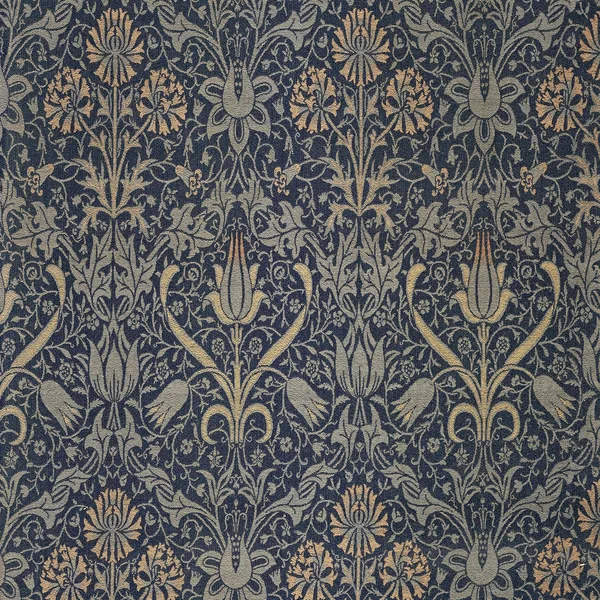
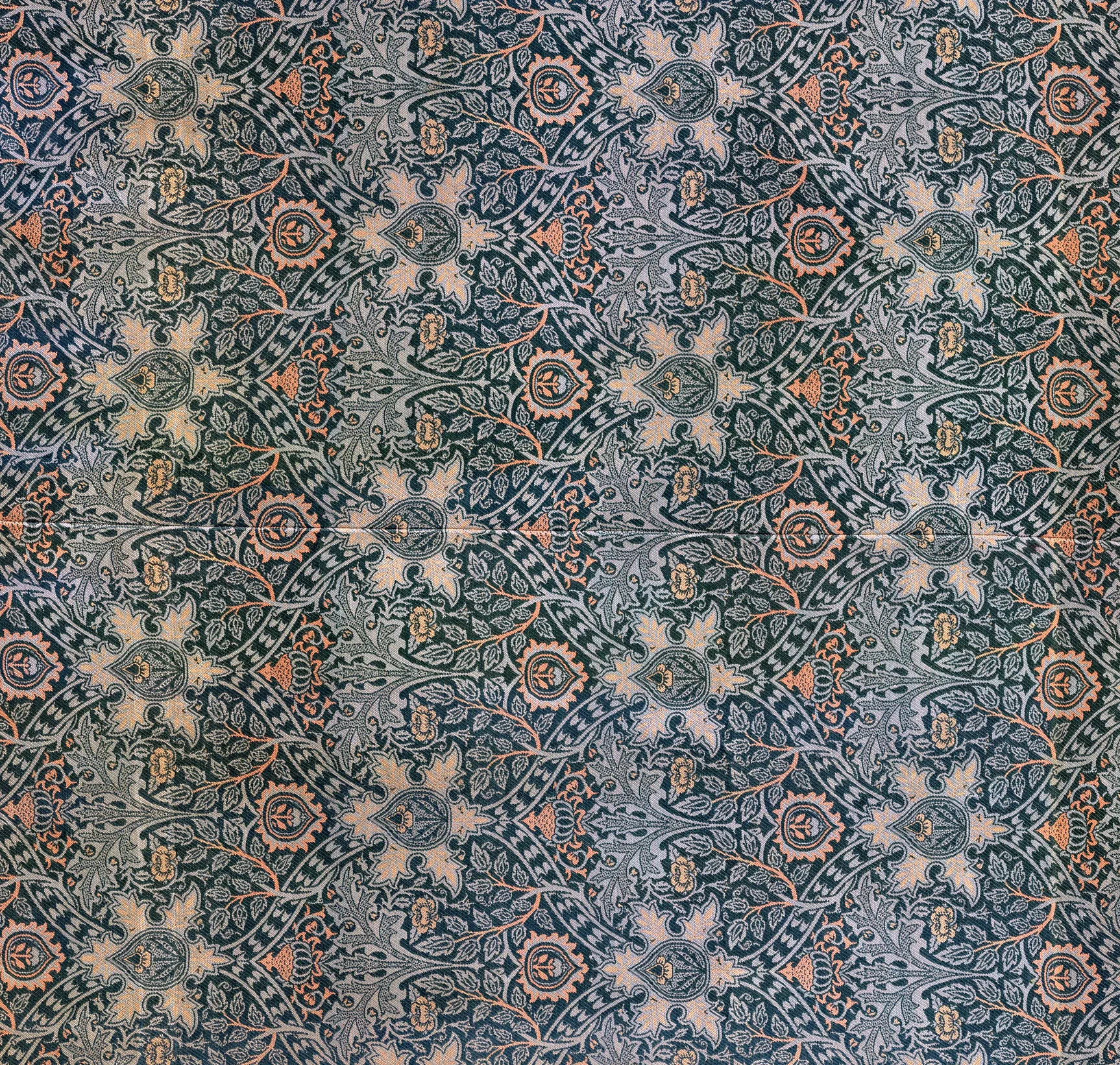
Ispahan by William Morris is an intricate textile design built on repeating floral and geometric forms. When you look at the pattern, you see a dense network of foliage and stylized blossoms set against a dark, near-black ground. A prominent feature is the large palmette or teardrop motif arranged in staggered, interlocking vertical rows. Inside each palmette sits a smaller flower bud, framed by saw-toothed leaves and curved tendrils that sweep upward and outward.
Between these primary medallions, Morris placed a field of leafy stems and small rounded flower heads. Scrolling vines with delicate acanthus-like serrations run across the surface, softening the underlying geometry. Pale tones of cream, muted grey, soft terracotta, and subtle peach contrast with the deep background. The overall layout produces a formal, symmetrical grid, balanced by organic curves that guide your eye across the surface.
Who designed it and when
William Morris designed Ispahan around 1888. By the late 1880s, Morris had spent decades studying historic decorative patterns from around the globe, translating their structures into original works for his firm. The design reflects his mature period, during which he combined formal eastern ornament with traditional English botanicals.
You can learn more about his career and artistic principles in our guide to William Morris, life and work. Ispahan stands alongside other late-period fabrics where structured repeats organize complex floral detail. To explore other textiles and patterns from across his career, browse every William Morris design in our library.
How it was made and used
Ispahan was designed as a textile. Rather than presenting loose, free-flowing plant forms, the design employs a disciplined lattice structure. This organized repeat was ideal for heavy fabrics meant to hang in folds, such as curtains, wall hangings, or portières, where a clear repeating motif prevents the pattern from getting lost in the shadows of the drape.
This geometric organization shares design principles with simpler diaper patterns, such as the Diaper pattern, where diagonal or diamond networks support repeating motifs. In Ispahan, Morris elaborated on that basic lattice framework, filling every intersection with layers of leaves, bell-shaped calyxes, and stylized rose or pomegranate forms. The structure balances density and rhythm, making the fabric bold from a distance yet rich in fine detail up close.
Colourways
On this site, Ispahan is available in one colourway: Black. This colourway features a dark, charcoal-black ground that makes the warm terracotta accents and soft greenish-grey leaves stand out in sharp relief.
The museum object scanned for this design is in the collection of The Metropolitan Museum of Art and is designated under a CC0 public-domain licence. In this colourway, subtle variations in tonal contrast bring out the layered foliage, giving the design depth without harsh brightness.
Ispahan as a print
Ispahan makes a striking wall art piece because its balance of floral detail and geometric structure creates a focal point in any room. The pattern reads clearly across an entire wall while offering intricate linework to examine up close.
Prints are printed and shipped by ArtsyWall in three formats: Archival Paper, Premium Canvas, and Framed Canvas. Archival Paper delivers clean detail with a textured matte finish. Premium Canvas is hand-stretched over solid wood bars and arrives ready to hang. Framed Canvas places the canvas inside a wood floating frame, available in six finishes: black, white, gold, silver, walnut, and oak.
Want Ispahan on a whole wall? See Ispahan wallpaper, sized to your wall.
Questions and answers
Who designed Ispahan?
William Morris designed the Ispahan pattern around 1888 for his decorative arts firm. Morris created the pattern as a textile design, combining geometric medallion structures with finely rendered leaves and flowers. Today, public-domain museum scans preserve his original textile work for fine art prints.
When was Ispahan designed?
Ispahan was designed by William Morris in approximately 1888. Created during the later years of his decorative arts career, the pattern represents his mature style, blending formal geometric lattice forms with lush botanical motifs into a dense, repeating textile pattern suitable for home decor.
What does the Ispahan pattern show?
The Ispahan pattern shows a dense, symmetrical arrangement of floral and geometric motifs. Staggered rows of large teardrop palmettes contain stylized flower heads surrounded by serrated acanthus leaves, smaller blossoms, and curving stems, all set against a dark, contrasting background. The overall repeat creates a rich, balanced visual rhythm.
Was Ispahan a wallpaper or a fabric?
Ispahan was originally designed as a textile rather than a wallpaper. William Morris created its structured, repeating geometric layout specifically for fabric furnishings, ensuring the balanced floral palmettes and repeating trellis shapes could hang gracefully across curtains, wall drapes, or woven upholstery.