Indian Diaper by William Morris
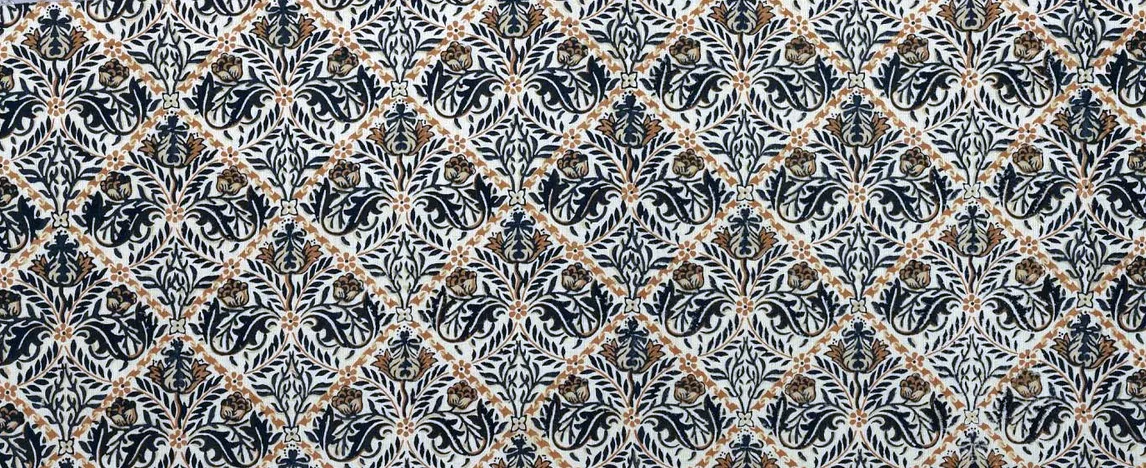
Indian Diaper by William Morris is an 1876 repeating textile pattern that frames stylized flowers and curling foliage inside a diamond lattice. It presents a compact geometric repeat across a light ground.
| Designed | 1876 |
|---|---|
| Designer | William Morris |
| Type | textile |
| Motifs | geometric, flowers |
| Colourway | Brown on Ivory |
| Repeat | 1.9 × 3.8 in (estimated) |
| Source | Cooper Hewitt, Smithsonian Design Museum. Licence: CC0. Museum record |
Order Indian Diaper as a print
Format
Size (inches)
$40
Made to order. Shipping included in the US.
Seamless pattern file
One repeat tile, ready to fill any size in design software.
What Indian Diaper shows
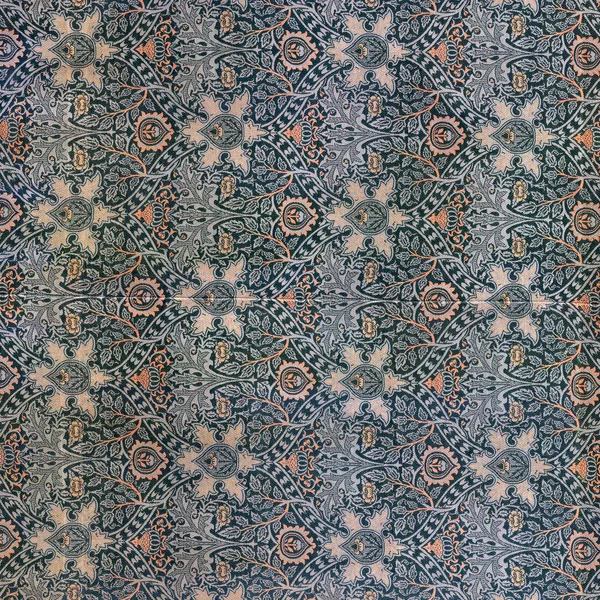
Indian Diaper by William Morris is an 1876 textile pattern defined by a diamond grid of floral ornament. The design organizes botanical motifs into a structured trellis known as a diaper pattern, where intersecting diagonal lines create repeating diamond compartments across the surface. Within each diamond frame, stylized foliage and floral buds branch outward in balanced pairs.
The primary motif inside each diamond unit consists of a central floral bud flanked by curling acanthus leaves. Small rounded blossoms in a warm ochre brown crown the scrolling sprays, balancing the dark navy tones of the foliage. The leaves show fine internal veining and serrated contours, standing out sharply against the pale ground.
Connecting the whole design is the geometric diamond lattice. The diagonal bands that outline each compartment are composed of small leaf and vine details. At every lattice crossing, a compact rosette anchors the intersection. A secondary floral spray sprouts between the main lozenges, ensuring an even distribution of ornament across the cloth. The repeat is close, measuring about 1.9 by 3.8 inches, which produces a tight visual rhythm.
Who designed it and when
William Morris designed Indian Diaper in 1876. The design dates to a decade when Morris spent substantial effort studying historical dyeing, weaving, and textile printing techniques. You can learn more about his background and philosophy in our guide to William Morris.
Historical sources note a slight difference in attribution details for this piece. While the title credits William Morris as the designer, the collection record at the Cooper Hewitt credits Morris & Co. as the maker. You can browse every William Morris design in our library to compare this pattern with other historical works. For another example of this geometric structure, see our page for Diaper.
How it was made and used
Indian Diaper was produced as a printed textile for interior furnishings. The design uses a half-drop repeat, where each adjacent vertical column shifts downward by half the height of the repeat tile. This construction prevents harsh horizontal stripes across a finished length of fabric.
The compact repeat dimensions of about 1.9 by 3.8 inches made the fabric versatile for domestic upholstery, curtains, and small decorative cushions. The original specimen used for our reproduction scan comes from the Cooper Hewitt collection, where it is preserved under a CC0 public-domain licence.
Colourways
This site presents Indian Diaper in one colourway: Brown on Ivory. This name is our site’s own descriptive label taken from the museum scan, rather than a historical trade name.
Brown on Ivory pairs dark navy leaves and warm brown floral accents against a pale off-white ground. The diamond trellis bands show warm ochre tones, while the dense foliage carries deep blue-black shades. This focused palette emphasizes the graphic clarity of the trellis and the clean lines of the plant forms.
Indian Diaper as a print
Prints of Indian Diaper are printed and shipped by ArtsyWall in three formats: Archival Paper, Premium Canvas, and Framed Canvas.
On a wall, the small-scale diamond lattice gives the design an organized, architectural presence. The geometric order keeps the intricate leaves and buds legible from a distance, while the fine floral details reward close viewing. Archival Paper offers a crisp matte presentation on 100% cotton rag paper. Premium Canvas wraps the pattern over solid wood bars. Framed Canvas sets the canvas inside a wood floating frame, available in black, white, gold, silver, walnut, and oak.
Want Indian Diaper on a whole wall? See Indian Diaper wallpaper, sized to your wall.
Questions and answers
Who designed Indian Diaper?
William Morris designed Indian Diaper in 1876. While the museum record at the Cooper Hewitt credits the firm Morris and Co. for the production of the fabric, the pattern title attributes the work directly to William Morris himself. The design remains an authentic nineteenth-century Arts and Crafts creation registered in our library as a textile pattern by Morris.
When was Indian Diaper designed?
Indian Diaper was designed in 1876. William Morris developed this repeating pattern during an active period of textile creation in the 1870s. The museum scan in our archive comes from a historic textile specimen produced around that date, illustrating the precise printing work Morris and his firm established for home furnishings during the Victorian era.
What does the Indian Diaper pattern show?
The Indian Diaper pattern shows stylized flowers, curled foliage, and small blossom rosettes arranged within a diagonal diamond trellis. Each diamond compartment encloses a symmetrical spray of leafy branches flanking an upright central bud. At the intersections of the geometric lattice lines, small floral florets tie the diaper grid together across a light ivory background.
Was Indian Diaper a wallpaper or a fabric?
Indian Diaper was created as a printed textile rather than a wallpaper. The historical design record documents it as a fabric intended for interior furnishings, using a tight half-drop repeat to cover cloth surfaces evenly. Today, you can explore the design as high-grade wall art printed on archival fine art paper or stretched artist canvas.