Powdered by William Morris
Powdered is an 1874 floral textile pattern designed by William Morris, featuring small garden blossoms scattered over a dense ground of pale willow-like leaves. ArtsyWall offers Powdered as custom wall prints and seamless pattern files.
| Designed | 1874 |
|---|---|
| Designer | William Morris |
| Type | textile |
| Motifs | flowers |
| Colourway | Stone on Ivory |
| Repeat | 6.5 × 6.6 in (estimated) |
| Source | Cooper Hewitt, Smithsonian Design Museum. Licence: CC0. Museum record |
Order Powdered as a print
Format
Size (inches)
$40
Made to order. Shipping included in the US.
Seamless pattern file
One repeat tile, ready to fill any size in design software.
What Powdered shows
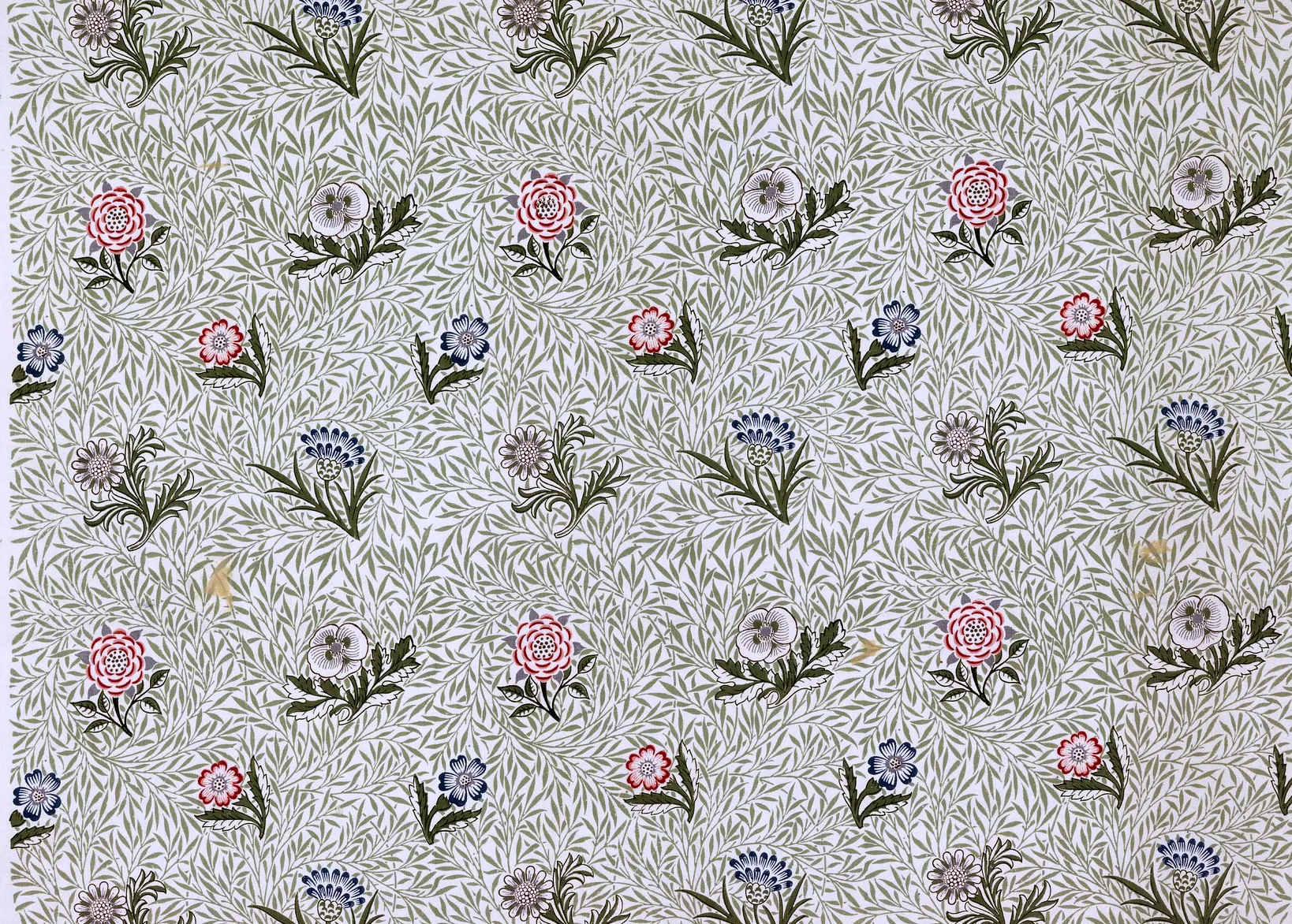
Powdered by William Morris is a floral textile design that presents individual garden flowers scattered across a dense ground of pale foliage. The design draws its name from the powdered effect of separate floral sprigs dotted over a neutral bed. Unlike intertwining patterns where thick stems guide the eye along sweeping diagonals, Powdered relies on small, distinct floral groupings that seem to float upon the foliage.
Beneath the blossoms sits a continuous field of narrow, willow-like leaves rendered in a soft sage tone. Across this quiet, textured backdrop, Morris set several species of blooming plants. You can spot rounded, cabbage-style pink roses, delicate white blossoms, fringed blue thistles, and star-shaped florets. Each small cutting includes its own dark green stem and serrated leaves, giving the sprigs visual weight against the pale, curving foliage below.
Because the floral sprigs repeat at modest intervals of roughly 6.5 by 6.6 inches, the overall impression is balanced and calm. The light ground prevents the detailed leaf work from feeling heavy, making the pattern read as a fine-grained field from across a room.
Who designed it and when
William Morris created Powdered in 1874. The design record credits Morris himself as the designer, though the sources differ slightly in their cataloging. The Cooper Hewitt museum, which holds surviving examples of the printed fabric, credits the manufacture to Morris & Co.
The year 1874 sat in a productive decade for the designer. During the early 1870s, Morris spent substantial time experimenting with textile dyes and printing blocks. You can learn more about his decorative methods in our guide to William Morris and his life and work. As you explore the wider catalog of every William Morris design, you will find that Powdered shares the botanical clarity of his early textile work before he turned to denser bird and animal motifs, such as those found in Strawberry Thief.
How it was made and used
Powdered was produced as a printed textile. The firm printed Morris patterns using carved woodblocks, applying mineral and vegetable dyes layer by layer to unbleached cotton or linen cloth. Each color in the design required a separate woodblock, cut by hand and aligned precisely on the fabric table.
The small scale of Powdered made it versatile for Victorian and Edwardian interiors. Morris & Co. recommended such printed fabrics for loose furniture covers, bedroom drapery, table covers, and decorative cushions. Surviving museum textiles demonstrate that the firm continued to print Powdered decades after its introduction, including editions printed around 1934.
Colourways
This site presents Powdered in one colourway based on the museum scan: Stone on Ivory.
Stone on Ivory sets dusty green, stone-colored willow leaves over a creamy ivory ground. The scattered flowers introduce points of accent color, including muted madder red, dusty rose, clear cornflower blue, and soft white. The darker green stems ground the brighter petals, creating a soft palette that fits both traditional interiors and light modern rooms.
Powdered as a print
ArtsyWall prints and ships Powdered in three formats: Archival Paper, Premium Canvas, and Framed Canvas.
On Archival Paper, the 340gsm textured cotton rag emphasizes the delicate linework of the pale willow ground and the crisp detail of each botanical sprig. On Premium Canvas and Framed Canvas, the pattern reads as a continuous woven surface, with the giclée inks maintaining clear color separation between the pale foliage and the deeper floral tones. In a wood floating frame, the pale ivory border and neat floral repeat provide an understated, architectural look suitable for bedrooms, hallways, or home offices.
Want Powdered on a whole wall? See Powdered wallpaper, sized to your wall.
Questions and answers
Who designed Powdered?
William Morris designed the Powdered pattern. The design record credits Morris directly, while some museum records at Cooper Hewitt attribute the production to Morris & Co. The pattern shows his characteristic approach to organizing natural flora into an orderly, repeating domestic print, setting detailed British garden blooms across a dense foil of stylized willow leaves.
When was Powdered designed?
William Morris created the Powdered design in 1874. Textile printings of the pattern continued for decades after its initial release. For example, museum collections such as Cooper Hewitt hold surviving textile examples of Powdered that the firm printed around 1934 from the original 1874 design specifications.
Was Powdered a wallpaper or a fabric?
Powdered was designed as a textile. William Morris produced the pattern as a printed fabric intended for interior furnishings. Today, the surviving textile scans allow you to appreciate the intricate repeat as framed wall art or as a digital seamless pattern file for personal design projects.
What does the Powdered pattern show?
The Powdered pattern displays an assortment of small garden flowers scattered across a background of leafy foliage. You can see pink multi-petaled roses, white blossoms, fringed blue flowers, thistle-like heads, and star-shaped florets with dark green stems, all resting over a dense layer of willow-like leaves.