Pink and Rose by William Morris
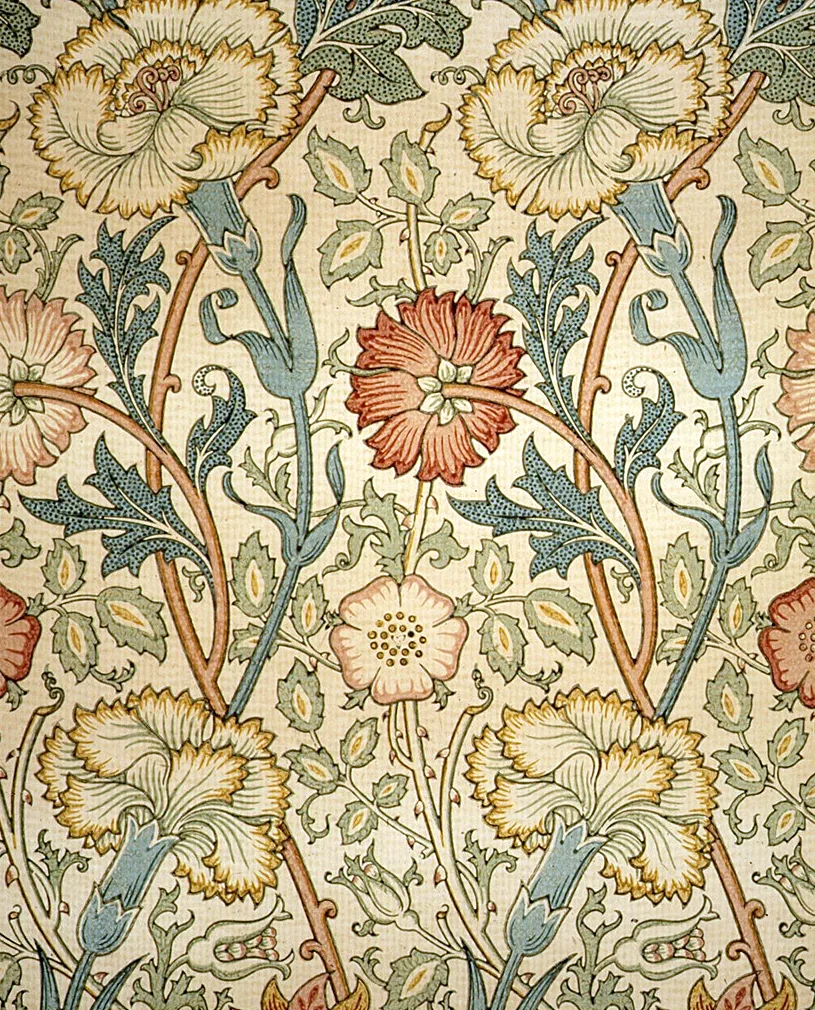
Pink and Rose by William Morris is an 1890 wallpaper pattern built around entwined carnations and wild roses. Discover the design history, view the detailed floral repeat, and order wall art prints.
| Designed | 1890 |
|---|---|
| Designer | William Morris |
| Type | wallpaper |
| Motifs | flowers |
| Colourway | Brown on Ivory |
| Repeat | not measured |
| Source | The Metropolitan Museum of Art. Licence: CC0. Museum record |
Order Pink and Rose as a print
Format
Size (inches)
$40
Made to order. Shipping included in the US.
Seamless pattern file
A repeat tile of this design, ready to fill any size in design software.
What Pink and Rose shows
Pink and Rose by William Morris presents a dense floral pattern dominated by two classic garden flowers: the pink (a traditional carnation) and the wild rose. Slender, curving stems wind upward through the surface, branching into leafy offshoots and carrying heavy, multi-petaled blossoms.
At the center of the movement are the large carnation heads, shown with ruffled, serrated petals that spread outward in warm golden-yellow and pale tones. Beneath these blooms sit elongated, bluish-gray calyxes flanked by spiky, toothed leaves. Contrasting with the ruffled carnations are rounded, multi-petaled flowers in a soft brick red or terracotta tone, viewed from above to reveal their radiating petals.
Set along the thinner vertical stems are five-petaled wild roses. These pale pink flowers feature delicate petals and exposed central clusters of stamens. Thorny briar stems twist between the larger flowers, weaving behind and in front of the foliage. The background is a pale, speckled ivory ground that lets the earthy greens, soft blues, and warm floral tones stand out clearly.
Who designed it and when
William Morris designed Pink and Rose in 1890. By this time, Morris had spent decades mastering pattern construction, running his manufacturing workshops, and writing poetry and political essays. You can read more about his career in our guide to William Morris and his life’s work.
In 1890, Morris was also founding the Kelmscott Press, yet he continued to supply original patterns for interiors. While later patterns from the firm often came from his talented colleague John Henry Dearle, museum records attribute Pink and Rose directly to Morris himself. The pattern reflects his mature handling of nature, balancing energetic growth with formal decorative discipline.
You can browse our complete collection of William Morris designs to see how his approach evolved from his earliest patterns in the 1860s to his final wallpapers in the 1890s.
How it was made and used
Pink and Rose was created as a wallpaper. Morris & Co. produced its wallpapers using hand-carved woodblocks, printing each color separately with mineral-based pigments on long rolls of paper. The process required exact registration so that the complex overlapping vines, stems, and petals aligned across the repeat.
The pattern uses a vertical repeat where stems snake upward in gentle serpentine lines. This upward movement gave Victorian rooms a sense of height and natural vitality. Rather than striving for photographic realism, Morris organized his botanical observations into flat, readable shapes that suited flat plaster walls.
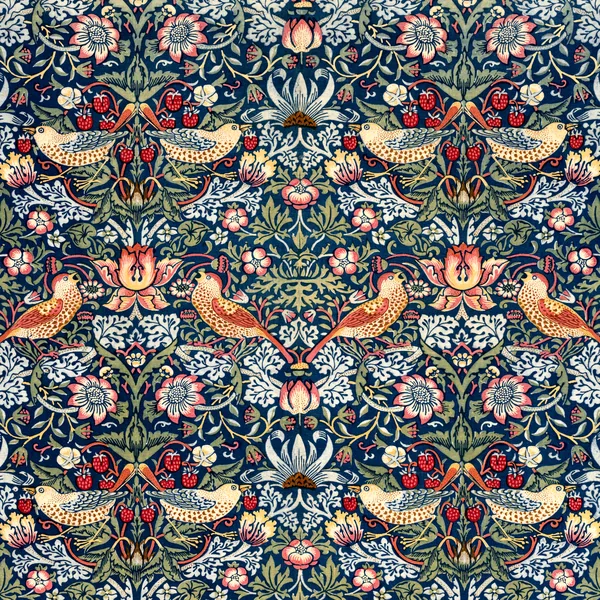
Unlike textiles such as the celebrated Strawberry Thief chintz, which relied on complex indigo discharge and block printing on cotton, Pink and Rose was developed purely as a wall covering. Its scrolling stems and varied flower heads were scaled to cover entire parlors, hallways, or drawing rooms without fatiguing the eye.
Colourways
This site presents Pink and Rose in one colourway: Brown on Ivory. This presentation is based on a public-domain museum scan from the Metropolitan Museum of Art, where the preserved wallpaper specimen dates to circa 1890.
The Brown on Ivory colourway features a warm, pale ivory ground with subtle flecking. Soft terracotta and brownish-red petals balance against pale gold carnations, muted sage green foliage, and dusty slate-blue leaves. The palette gives the design an earthy, understated quality that pairs well with both vintage woodwork and clean modern interiors.
Pink and Rose as a print
Prints on this site are printed and shipped by ArtsyWall in three formats: Archival Paper, Premium Canvas, and Framed Canvas. Each print is made to order to ensure crisp botanical detail and rich, accurate color reproduction.
On Archival Paper, the textured 100% cotton rag paper emphasizes the historic character of the original woodblock print, mirroring the matte texture of antique wallpaper. On Premium Canvas and Framed Canvas, the pattern reads with bold presence. Framed Canvas arrives ready to hang in a floating wood frame, available in black, white, gold, silver, walnut, or oak finishes. A walnut or oak frame complements the warm terracotta and golden hues, while a clean black frame gives the Victorian floral structure a sharp, contemporary border.
Want Pink and Rose on a whole wall? See Pink and Rose wallpaper, sized to your wall.
Questions and answers
Who designed Pink and Rose?
William Morris designed the Pink and Rose pattern. He created the floral design for his decorative firm during the later period of his career. Unlike several later patterns produced by the firm that were created by John Henry Dearle, museum records confirm that Morris personally designed Pink and Rose.
When was Pink and Rose designed?
William Morris designed Pink and Rose in 1890. The pattern dates from the final decade of Morris's life, when his botanical compositions showed an easy, fluid rhythm. Surviving wallpaper specimens in museum archives, including the Metropolitan Museum of Art, date from circa 1890.
What does the Pink and Rose pattern show?
Pink and Rose shows an intricate arrangement of carnations and wild roses entwined across winding briar stems. The composition features large ruffled carnation heads, rounded blossoms with radiating petals, and delicate five-petaled roses with exposed stamens, all framed by serrated leaves on a light ground.
Was Pink and Rose a wallpaper or a fabric?
Pink and Rose was originally designed as a wallpaper rather than a textile. The firm issued it as a printed wall covering in 1890. While Morris designed many famous woven and printed chintz fabrics, Pink and Rose served as an interior wallpaper.