Peony by Kate Faulkner
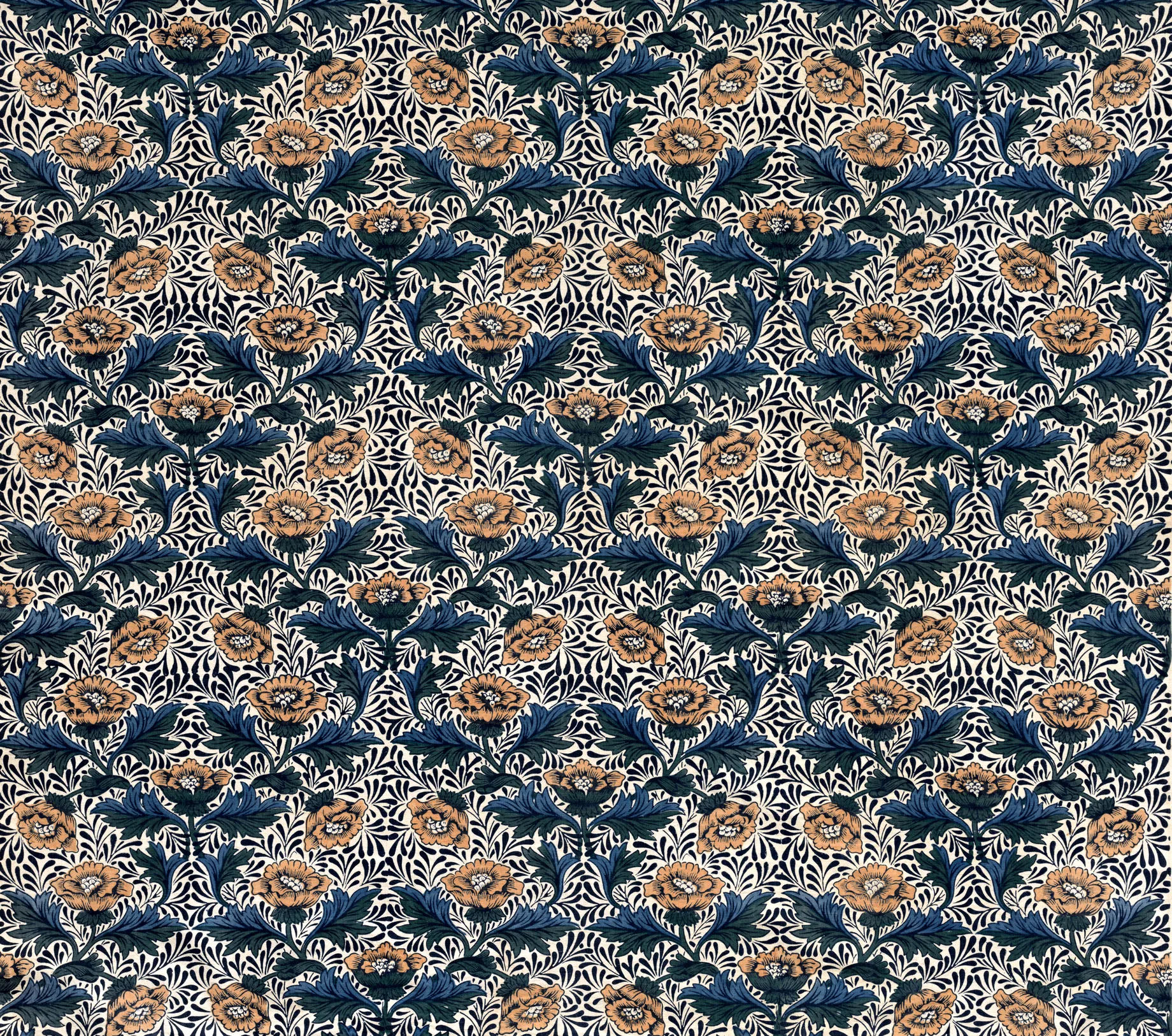
Peony is a Morris & Co. floral pattern designed by Kate Faulkner, often sought among William Morris textile prints. It features warm ochre peony blooms set against dark foliage and a dense, light leaf ground.
| Designed | date unknown |
|---|---|
| Designer | Kate Faulkner |
| Type | textile |
| Motifs | flowers |
| Colourway | Black |
| Repeat | 6 × 11.4 in |
| Source | Cleveland Museum of Art. Licence: CC0. Museum record |
Order Peony as a print
Format
Size (inches)
$40
Made to order. Shipping included in the US.
Seamless pattern file
One repeat tile, ready to fill any size in design software.
What Peony shows
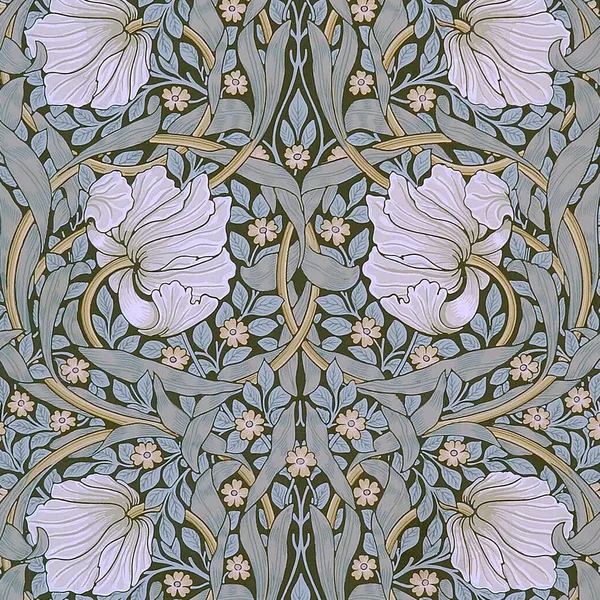
Peony by Kate Faulkner is a floral textile design created for Morris & Co. and widely admired among William Morris peony patterns. The layout centers on rows of open peony blossoms rendered in warm, golden ochre tones. Substantial blue-green leaves cup each flower head, spreading outward across the print in balanced symmetry.
Between the main flower heads, smaller buds branch to either side. A fine background tracery of pale cream leaves fills every gap against the dark ground. The design follows an alternating rhythm across the fabric. Unlike sweeping, open floral prints, Peony builds a tight, continuous field of botanical detail where the warm flower heads stand forward against dark foliage.
Who designed it and when
Kate Faulkner designed Peony for Morris & Co. She was the sister of Charles Faulkner, an early business partner of William Morris. While modern shoppers often seek this print under Morris’s name, Faulkner produced several distinctive patterns for the workshop. You can learn more about the workshop’s history in our overview of William Morris and his circle.
Morris maintained a progressive view of women in design, encouraging Faulkner and her contemporaries to produce professional decorative work. In addition to textiles, Faulkner designed wallpapers, embroideries, painted tiles, pottery, and plasterwork for the firm. The original design date for Peony is not recorded. A printed cotton panel in the Cleveland Museum of Art carries a date of 1920, though Faulkner died in 1898. The print remained in Morris & Co.’s catalog well into the twentieth century. To see how her work compares with other workshop designers, explore every William Morris design in our archive.
How it was made and used
Peony was manufactured as a printed textile. The surviving archival piece at the Cleveland Museum of Art is printed on plain weave cotton. The pattern repeats at approximately 6 by 11.4 inches in a half-drop arrangement. In a half-drop repeat, adjacent vertical columns shift downward by half the repeat height, softening lines and preventing rigid bands across wide yardage.
This small, almost square repeat is characteristic of Kate Faulkner. Morris tended toward larger, expansive compositions such as Strawberry Thief, whereas Faulkner favored compact, detailed surfaces. Morris & Co. supplied printed cotton fabrics like Peony for home furnishings, including curtains, slipcovers, and general upholstery. The dense botanical ground provided an alternative to the plain domestic needlecrafts common in middle-class Victorian homes.
Colourways
On this site, Peony is presented in its Black colourway, sourced from the Cleveland Museum of Art scan. The design pairs a dark ground with pale cream filler leaves, creating strong contrast behind the foreground flora. Deep blue-green acanthus-like leaves cup the warm ochre and mustard petals. Subtle hatching on the petals gives each bloom depth, while the dark ground keeps the pale filler branches crisp across the repeat.
Peony as a print
You can order Peony as an art print for your home, printed and shipped by ArtsyWall. The design comes in three formats: Archival Paper, Premium Canvas, and Framed Canvas. Archival Paper provides a textured, fine art cotton rag finish. Premium Canvas is stretched over solid wood bars for an unframed look. Framed Canvas adds a wood floating frame, offered in black, white, gold, silver, walnut, and oak finishes. With its dark ground and compact repeat, Peony reads with exceptional clarity in a black or walnut frame, bringing balanced Arts and Crafts pattern to smaller nooks or feature gallery walls.
Want Peony on a whole wall? See Peony wallpaper, sized to your wall.
Questions and answers
Who designed Peony?
Kate Faulkner designed Peony for Morris & Co. She was the sister of Charles Faulkner, one of the founding partners of the decorative arts firm. Faulkner contributed several patterns to the company, including designs for wallpapers, embroideries, tiles, pottery, and plasterwork. Her brother worked closely with William Morris, who promoted Faulkner's work and encouraged women to take active roles in decorative design.
When was Peony designed?
The exact design year for Peony is not recorded in historical records. A printed cotton panel preserved at the Cleveland Museum of Art lists a production date of 1920. However, Kate Faulkner lived from 1841 to 1898, meaning the original pattern was drawn during the nineteenth century, prior to her death, and continued in production by Morris & Co. in later decades.
Was Peony a wallpaper or a fabric?
Peony was produced as a printed fabric. The historical example held in museum collections is printed on plain weave cotton. Morris & Co. sold printed cotton textiles for interior furnishings such as drapery, upholstery, and cushion covers. While Kate Faulkner did create wallpaper patterns for the firm during her career, Peony was manufactured and cataloged as a printed cotton textile.
What does the Peony pattern show?
The Peony pattern shows rows of stylized peony blooms arranged in an alternating half-drop repeat. Warm ochre and tawny blossoms are supported by deep blue-green foliage. Behind these primary flowers, a dense white and cream leafy filigree covers the dark ground. The tight, compact repeat gives the surface an intricate, balanced texture that contrasts sharply with William Morris's wider botanical patterns.