Mallow by Kate Faulkner
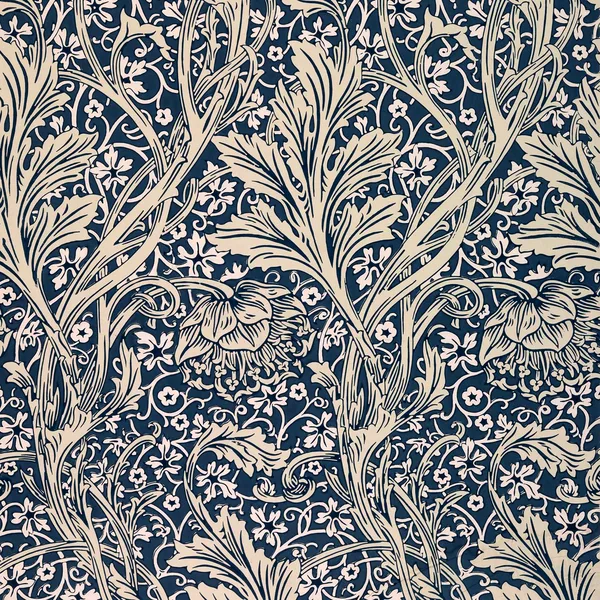
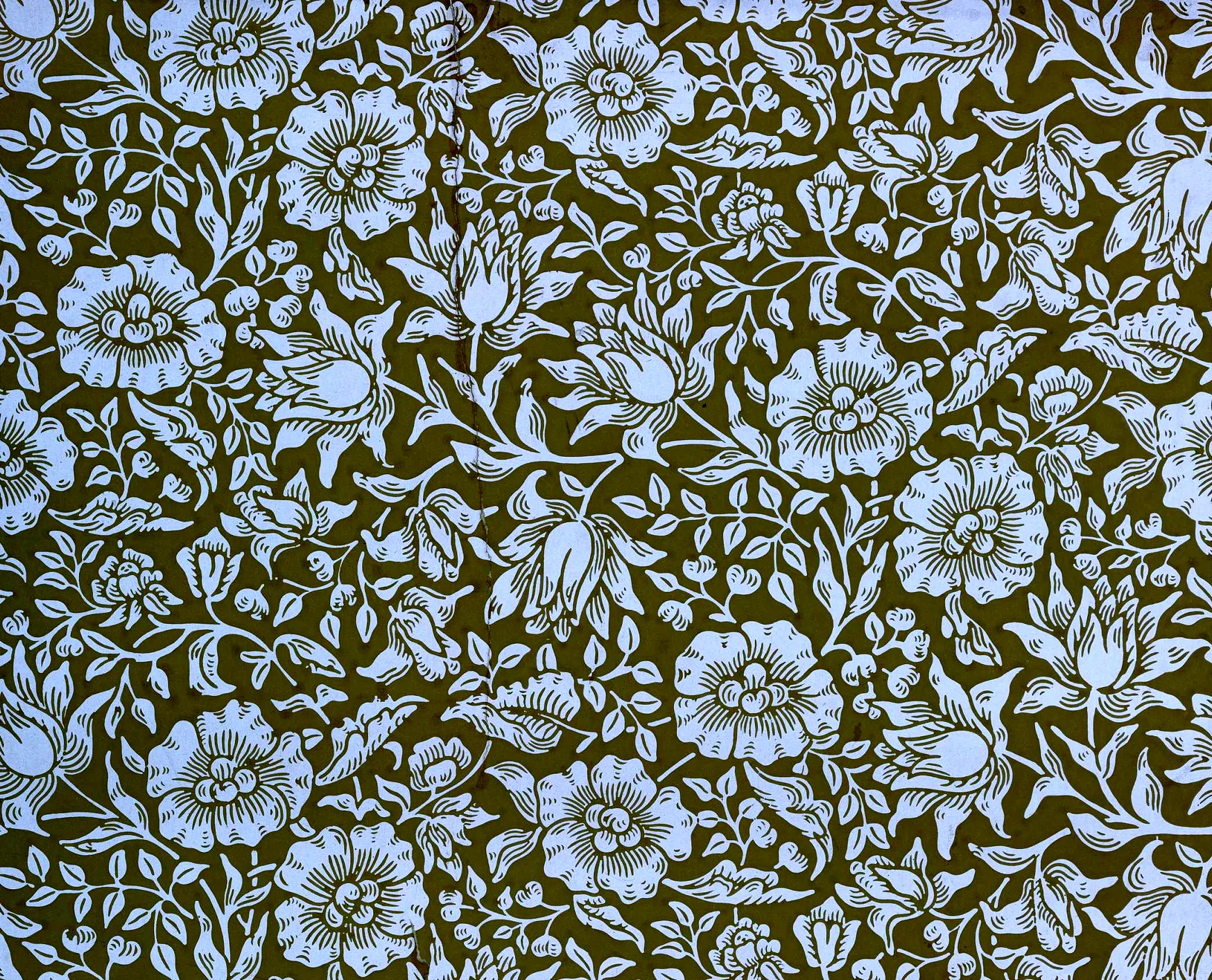
Mallow is an 1879 wallpaper pattern designed by Kate Faulkner for Morris & Co. The design features open mallow blossoms, pointed petals, and winding leafy stems across a dense botanical ground.
| Designed | 1879 |
|---|---|
| Designer | Kate Faulkner |
| Type | wallpaper |
| Motifs | flowers, leaves |
| Colourway | Blue |
| Repeat | 9.8 × 11.7 in (estimated) |
| Source | Cooper Hewitt, Smithsonian Design Museum. Licence: CC0. Museum record |
Order Mallow as a print
Format
Size (inches)
$40
Made to order. Shipping included in the US.
Seamless pattern file
One repeat tile, ready to fill any size in design software.
What Mallow shows
Mallow is an 1879 wallpaper pattern associated with the William Morris circle, designed with a rich botanical structure. When you study the pattern, your eye moves through an unbroken rhythm of flowering plants and winding foliage. Large, rounded blossoms spread across the surface, showing radiating petal veins and distinct seed centers. Alongside these wide circular blooms, pointed multi-lobed flowers angle upward on delicate stalks.
A network of slender stems connects the flora, weaving behind and between each bloom. Dense clusters of small notched leaves, tender buds, and trailing tendrils fill the intervening spaces. The design maintains an even distribution of shapes with no single focal point dominating the visual field. The layered linework gives the foliage depth, creating a lively organic field that remains balanced across a repeated drop.
Who designed it and when
Kate Faulkner designed Mallow in 1879 for Morris & Co. While many buyers search for Mallow as a William Morris pattern, historical records from the firm and museum collections credit Kate Faulkner as the artist. She was the sister of Charles Faulkner, one of the founding partners of Morris, Marshall, Faulkner & Co., and contributed several notable patterns to the decorative firm.
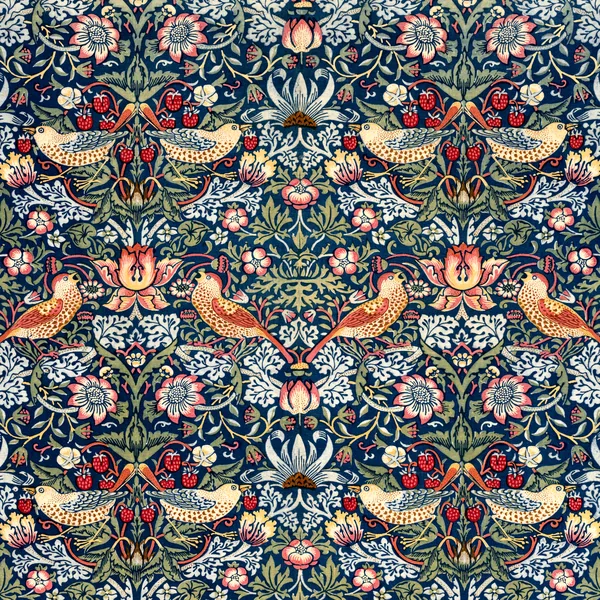
Morris & Co. employed both male and female designers across different media, though Kate Faulkner was one of the few women whose wallpaper designs entered regular commercial production. Her work reflects the same decorative principles championed by William Morris, focusing on nature, stylized floral motifs, and flat pattern repeats. You can compare Faulkner’s floral draughtsmanship with Morris’s own work by browsing our complete directory of William Morris designs, which includes later textiles like Strawberry Thief.
How it was made and used
Mallow was produced as a wallpaper, intended to decorate domestic interiors of the late nineteenth century. In keeping with Morris & Co. production standards, wallpapers of this era were printed from carved wooden blocks on long rolls of paper. The rhythmic spacing of the floral motifs allowed the paper to hang smoothly along vertical wall surfaces, forming an unbroken decorative expanse.
The dense arrangement of stems and petals served a practical interior purpose. Victorian rooms often featured tall ceilings and divided wall spaces, such as dados and friezes. A continuous floral pattern softened harsh architectural lines and brought natural forms indoors. The balanced layout prevented visual gaps, making Mallow an adaptable choice for both expansive sitting rooms and narrow hallways.
Colourways
This site offers Mallow in one colourway, labeled Blue, taken directly from a public-domain museum scan at the Cooper Hewitt, Smithsonian Design Museum. The name Blue reflects the collection record, though the scan reveals delicate light floral forms set against a deep olive-toned ground. Fine white and pale linework defines the interior veins of every petal, leaf, and stem.
Because the design relies on a single dominant contrasting scheme, the silhouettes of the blooms stand out crisply against the field. The two-tone structure highlights the fine details of Kate Faulkner’s drawing without overwhelming the viewer with contrasting hues. This clarity makes the pattern easy to coordinate with natural wood finishes, painted trim, and neutral home decor.
Mallow as a print
You can order Mallow as an art print, printed and shipped by ArtsyWall in three formats: Archival Paper, Premium Canvas, and Framed Canvas. Archival Paper prints use heavyweight 340gsm cotton rag paper with a textured watercolor feel. Premium Canvas prints are hand-stretched over solid wood bars and arrive with a sawtooth hanger attached. Framed Canvas prints arrive in a solid wood floating frame in your choice of black, white, gold, silver, walnut, or oak, complete with a hanging wire ready for immediate display. When framed, the dense floral lines of Mallow provide a striking accent for modern or traditional walls. If you want to install the pattern as peel-and-stick wallcovering instead, you can find Mallow wallpaper on our sister site.
Want Mallow on a whole wall? See Mallow wallpaper, sized to your wall.
Questions and answers
Who designed Mallow?
Kate Faulkner designed Mallow for Morris & Co. While many people associate the pattern with William Morris, historical records confirm that Faulkner created the design. She was an artist and decorator who contributed several wallpaper designs to the Morris firm, making her one of the few women recognized by name in its catalogue.
When was Mallow designed?
Mallow was designed in 1879 by Kate Faulkner for Morris & Co. The firm registered and produced the pattern as a commercial wallpaper during that year. Surviving museum specimens, including prints preserved at the Cooper Hewitt, Smithsonian Design Museum, confirm the 1879 production date for this floral design.
Was Mallow a wallpaper or a fabric?
Mallow was originally produced as a wallpaper rather than a woven or printed textile fabric. Morris & Co. released the pattern in 1879 as a repeating wallcovering printed from carved woodblocks. The structured vertical flow of flowers and leaves was planned specifically to decorate walls in nineteenth-century residential interiors.
What does the Mallow pattern show?
The Mallow pattern shows an intricate, repeating botanical field filled with stylized mallow blossoms and dense foliage. Wide, circular flowers with veined petals appear alongside flared, upright blossoms. Winding stems, serrated leaves, and small flower buds run throughout the background, creating a continuous, rhythmic network of plant life across the entire design.