Peacock and Dragon by William Morris
Peacock and Dragon is an 1878 woven wool textile pattern designed by William Morris. It features pairs of peacocks and winged dragons set amid stylized foliage and large palmettes.
Colourways
| Designed | 1878 |
|---|---|
| Designer | William Morris |
| Type | textile |
| Motifs | birds, animals, trees |
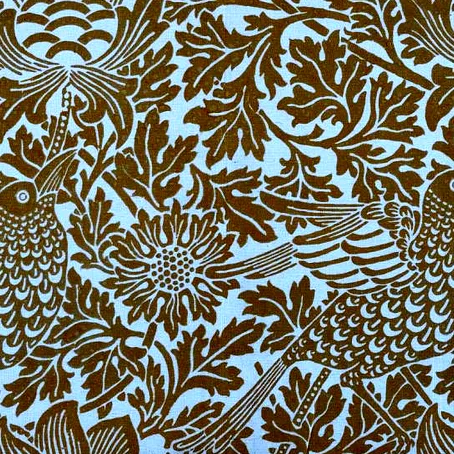
| Colourway | Brown |
| Repeat | 33.1 × 43.4 in |
| Source | Cleveland Museum of Art. Licence: CC0. Museum record |
Order Peacock and Dragon as a print
Format
Size (inches)
$40
Made to order. Shipping included in the US.
Seamless pattern file
One repeat tile, ready to fill any size in design software.
What Peacock and Dragon shows
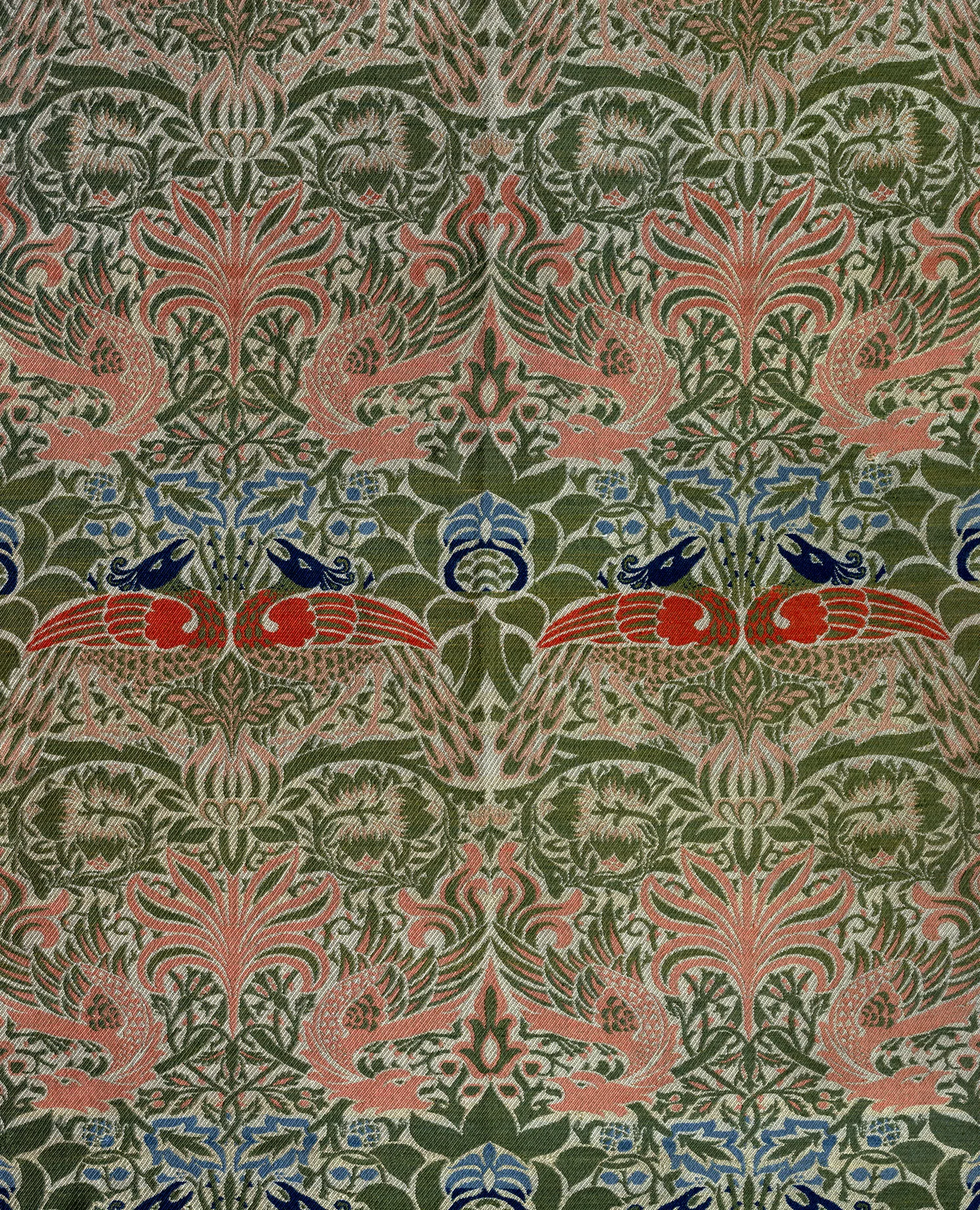
Peacock and Dragon by William Morris presents paired mythical and natural creatures against a dense thicket of leaves and branches. Across the horizontal band, pairs of peacocks face inward toward each other. These birds display deep blue crested heads, curved beaks, and wings detailed in brick red, while their bodies and tails carry delicate speckled textures.
Directly above the birds, paired winged dragons or serpents face outward amid large flowering palmettes. Their bodies arch in soft pink and coral tones, accented with scale-like feathering and curling tails. Between and around these creatures, tall floral sprays, pointed leaves, and thistle-like blooms rise upward. The ground is packed with foliage, leaving no open space. Broad fan-shaped acanthus leaves spread out in pink and green, creating a rhythmic, symmetrical repeat across the cloth.
Who designed it and when
William Morris designed Peacock and Dragon in 1878. Morris was deeply involved in textile design during this period, studying historical woven hangings and traditional dyeing methods. You can explore his full career in our guide to William Morris and see how this pattern fits among every William Morris design in our library.
The year Morris created Peacock and Dragon, he visited the London shop of dealer Vincent Robinson. Robinson had reconstructed a room from Damascus, which Morris described as being filled with vermilion, gold, and ultramarine. That encounter directly influenced the rich, exotic motifs in the pattern. Morris drew inspiration from eastern fabrics and medieval European traditions to build a striking, balanced composition. This design shares its bold animal pairings with other Morris patterns from the era, such as Brother Rabbit.
How it was made and used
Morris created Peacock and Dragon as a heavy woven wool textile rather than a printed fabric or wallpaper. He intended it to serve as a woven wall hanging, much like the medieval textiles he admired, to add warmth and insulation to cold stone walls. The Cleveland Museum of Art describes the fabric structure as a weft-faced compound twill woven in thick wool.
Morris considered this pattern the closest he came to realizing his ideal of medieval-style wall hangings. Its heavy weight and dense weave gave it the substance needed to drape well as curtains or cover large wall expanses. During the late nineteenth century, Peacock and Dragon became one of the most popular patterns among Morris & Co. clients, who originally could order it in five distinct colorways.
Colourways
Historically, Morris & Co. offered the pattern in five colorways. On this site, you can view and order three colourways derived from public-domain museum scans: Brown, Dark Green, and Charcoal.
The Brown colourway comes from a scan provided by the Cleveland Museum of Art. It pairs earthy olive and moss greens with coral dragons, brick-red peacocks, and cream accents. The Dark Green colourway, based on a scan from the Metropolitan Museum of Art, deepens the foliage into rich forest greens, setting off the vibrant blue heads and red wing coverts of the peacocks. The Charcoal colourway, also sourced through the Metropolitan Museum of Art, offers deep, shadowy contrast that emphasizes the structural repeat of the palmettes and leaves.
Peacock and Dragon as a print
You can bring this woven pattern into your home as a print produced and shipped by ArtsyWall. ArtsyWall offers the design in three formats: Archival Paper, Premium Canvas, and Framed Canvas. On Archival Paper, the print highlights the subtle variations and fibrous textures of the original woven wool. The Premium Canvas format gives the heavy botanical repeat a tactile quality similar to cloth stretched over a frame.
Framed Canvas arrives ready to hang in a solid wood floating frame, available in six finishes: black, white, gold, silver, walnut, and oak. When framed, the strong symmetry of the facing peacocks and arching dragons creates an orderly, grounding focal point on any wall.
Want Peacock and Dragon on a whole wall? See Peacock and Dragon wallpaper, sized to your wall.
Questions and answers
Who designed Peacock and Dragon?
William Morris designed Peacock and Dragon for his decorative arts firm. He drew direct inspiration for the pattern after seeing a Persian-style room reconstructed from Damascus in a London showroom. Morris aimed to recapture the warmth and weight of historic wall hangings. While some Morris patterns were later created by colleagues such as John Henry Dearle, museum records confirm Peacock and Dragon came entirely from Morris himself.
When was Peacock and Dragon designed?
William Morris designed Peacock and Dragon in 1878. In that same year, Morris visited the London shop of Vincent Robinson, where an exotic room interior influenced his design choices. The woven wool textile quickly became one of the firm's most favored patterns among late-Victorian homeowners, remaining in steady commercial production for many years following its initial release.
Was Peacock and Dragon a wallpaper or a fabric?
Peacock and Dragon was designed strictly as a woven wool fabric, not a wallpaper. Morris created it as a heavy weft-faced compound twill to serve as wall hangings and portieres. He wanted thick, substantial textiles that could insulate cold masonry walls in the manner of medieval rooms. The firm did not issue Peacock and Dragon as a block-printed wallpaper.
What does the Peacock and Dragon pattern show?
The Peacock and Dragon pattern shows horizontal bands of paired, inward-facing peacocks beneath paired outward-facing winged dragons. The peacocks feature dark blue heads, curved crests, and bright red wings, while the dragons arch gracefully with feathered scales. Between these mythical and natural beasts, Morris placed upright leafy branches, large palmette blossoms, and lush acanthus leaves arranged in a balanced, mirror-image repeat.