Brother Rabbit by William Morris
Brother Rabbit by William Morris is an 1882 printed textile pattern featuring paired rabbits and perched birds set among dense woodland foliage. Morris designed this symmetrical pattern for printed cotton fabric using indigo discharge printing.
| Designed | 1882 |
|---|---|
| Designer | William Morris |
| Type | textile |
| Motifs | animals, birds, leaves |
| Colourway | Indigo |
| Repeat | 4.9 × 7.5 in (estimated) |
| Source | Other, via Wikimedia Commons. Licence: Public domain (Wikimedia Commons). Museum record |
Order Brother Rabbit as a print
Format
Size (inches)
$40
Made to order. Shipping included in the US.
Seamless pattern file
One repeat tile, ready to fill any size in design software.
What Brother Rabbit shows
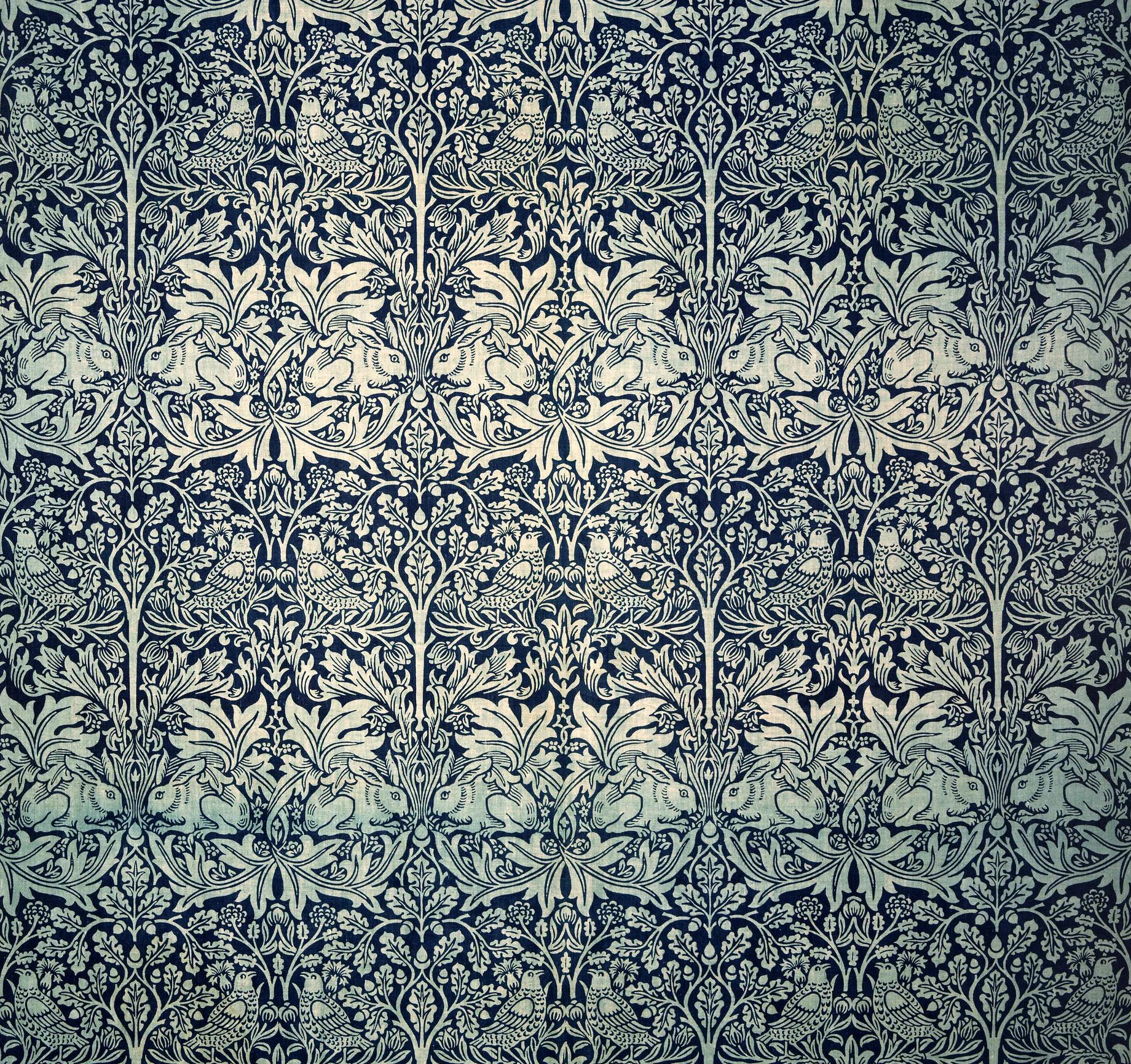
Brother Rabbit by William Morris is a dense, repeating textile pattern built around mirror-image pairs of woodland creatures. At the center of the vertical repeat, two crouching rabbits face inward toward one another amid curling leaves. Directly above each pair of rabbits sits a pair of birds perched on slender branches, also turned face to face.
The background fills entirely with botanical growth. You can see lobed oak leaves, clusters of small acorns, and radiating thistle blossoms springing from upright central stems. Thick foliate scrolls curl around the rabbits’ bodies, framing them in leafy medallions. The pattern repeats in alternating symmetrical columns, giving the entire surface a rhythmic, mirrored cadence with no bare background space.
Who designed it and when
William Morris designed Brother Rabbit in 1882. The pattern was registered on May 20, 1882, as recorded in museum archives. You can read more about his career in our guide to William Morris and explore other patterns in our catalog of every William Morris design.
The sources differ slightly on the title of the work. While the design record lists the pattern as Brother Rabbit, the Philadelphia Museum of Art records its accession under the title Brer Rabbit. Both names refer to the same 1882 creation by Morris, produced during the same fertile period that led to famous textiles like Strawberry Thief.
How it was made and used
Brother Rabbit was produced as a printed cotton textile rather than a woven cloth or a wallpaper. The Philadelphia Museum of Art specimen is cataloged as an indigo discharge-and block-print on cotton plain weave, measuring approximately 333 millimeters in height by 876 millimeters in width.
In this process, cotton cloth was dyed completely in a vat of dark indigo. Bleaching discharge paste was then printed onto the dyed fabric with carved wooden blocks to remove color and reveal the light design lines. This discharge method produced crisp white and light details on a deep indigo ground without muddy edges. The resulting cotton cloth served as interior furnishing fabric for curtains, loose covers, and upholstery in Victorian homes.
Colourways
On this site, the design is offered in one colourway named Indigo. This colourway features a dark blue indigo ground filled with off-white and pale cream figures and botanical growth.
The crisp contrast between the dark indigo base and the pale figures makes every leaf, bird, and rabbit outline legible across the repeat. Because the design relies on two tones, the balance of light and dark remains clear across large wall surfaces. While historic dye workshops produced varying shades, the single colourway on this site directly reproduces the registered museum textile scan.
Brother Rabbit as a print
Brother Rabbit is available as an art print printed and shipped by ArtsyWall in three formats: Archival Paper, Premium Canvas, and Framed Canvas. Archival Paper offers an unframed cotton rag finish, while Premium Canvas provides a ready-to-hang stretched piece. Framed Canvas choices include floating wood frames in black, white, gold, silver, walnut, and oak. When framed, the tight symmetry of the mirrored rabbits and perched birds creates a balanced focal point on a wall. The deep indigo ground anchors the composition, while the fine botanical detail draws viewers in close. If you prefer this pattern on your walls as a wallcovering, you can find Brother Rabbit wallpaper at our sister site.
Want Brother Rabbit on a whole wall? See Brother Rabbit wallpaper, sized to your wall.
Questions and answers
Who designed Brother Rabbit?
William Morris designed the Brother Rabbit pattern. He created the design for his decorative arts firm, drawing inspiration from traditional folklore and British wildlife. Museum records from the Philadelphia Museum of Art confirm Morris as the designer, though the museum lists the textile under the title Brer Rabbit. His work combined stylized natural forms with symmetrical repeats.
When was Brother Rabbit designed?
Brother Rabbit was designed in 1882. The design was officially registered on May 20, 1882, as shown by surviving records at the Philadelphia Museum of Art. Morris produced the print during an active period of experimenting with indigo dye techniques at his workshop, creating some of his most recognized animal and bird patterns during this decade.
What does the Brother Rabbit pattern show?
The Brother Rabbit pattern shows mirrored pairs of crouching rabbits and perched birds enclosed within dense botanical elements. Oak leaves, acorns, and thistle-like blossoms surround the animals along vertical curving branches. The figures face one another in strict horizontal symmetry, creating a structured woodland scene where light motifs emerge clearly against a dark indigo background.
Was Brother Rabbit a wallpaper or a fabric?
Brother Rabbit was originally designed as a printed fabric rather than a wallpaper. The historical specimen preserved in the Philadelphia Museum of Art is an indigo discharge-and block-print on cotton plain weave. The durable cotton material was intended for domestic furnishings such as drapes and furniture coverings, though the pattern is also reproduced today as wallcoverings and art prints.