Lily by William Morris
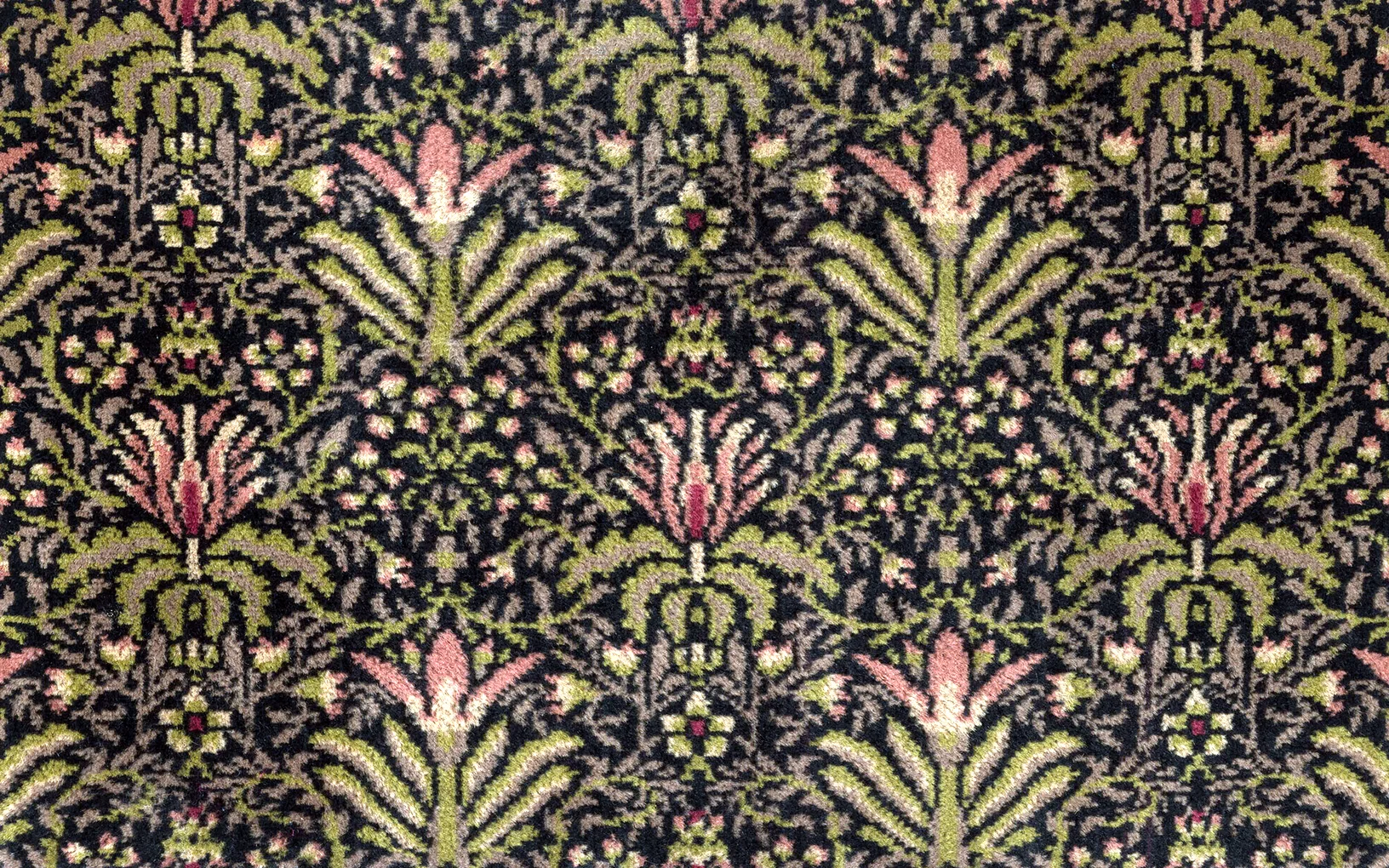
Lily by William Morris is an 1877 floral textile pattern centered on stylized pink lily blossoms and dense foliage against a dark ground. It balances symmetrical vertical growth with fine, interlacing leaves.
| Designed | 1877 |
|---|---|
| Designer | William Morris |
| Type | textile |
| Motifs | flowers |
| Colourway | Black |
| Repeat | 8.9 × 9 in |
| Source | Art Institute Chicago. Licence: CC0. Museum record |
Order Lily as a print
Format
Size (inches)
$40
Made to order. Shipping included in the US.
Seamless pattern file
One repeat tile, ready to fill any size in design software.
What Lily shows
Lily by William Morris presents a tightly packed floral pattern built around stylized pink lilies standing upright across the surface. The design organizes botanical forms into a rhythmic, repeating grid. Each prominent lily blossom opens upward with soft pink and rose petals, framed by pale sage green leaves that curve outward from the base. Between the primary flower heads, smaller budding forms and secondary blooms rise in vertical alignment.
Look closely at the surface and you see a dense network of foliage filling every open space. Muted green leaves and small greyish sprigs interlace tightly across a dark black ground. The stems bend and curve to create subtle heart-shaped and vase-like contours around the floral centers. The repeat measures about 8.9 by 9 inches, creating a compact pattern that feels rich and structured without sprawling. The contrast between the dusty pink petals and the deep black background gives each flower a clear, crisp outline.
Who designed it and when
William Morris designed Lily in 1877. By this point in his career, Morris had spent over a decade refining his principles of pattern construction. You can read more about his career in our guide to William Morris and his life and work. During the late 1870s, he turned much of his attention toward textiles, exploring how natural forms could repeat across fabric without losing their organic vitality.
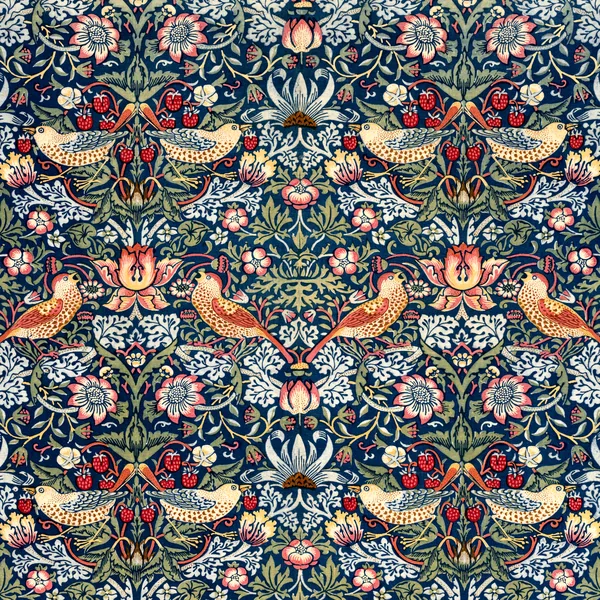
In the firm’s catalog of patterns, Lily arrived several years before famous printed cottons such as Strawberry Thief from 1883. While later works featured birds and fruit among garden foliage, Lily focuses entirely on floral and leaf structures. The 1877 design reflects Morris’s preference for flat, balanced ornament based on English garden plants rather than three-dimensional shading. You can browse every William Morris design in our library to see how his approach evolved across wallpapers and textiles.
How it was made and used
The design record classifies Lily as a textile. Surviving museum examples, including the specimen preserved at the Art Institute of Chicago, record that the textile design was created by 1877 and produced between 1877 and 1940. The tight repeat of roughly 8.9 by 9 inches made it suitable for furnishings, drapery, or upholstery where a smaller, controlled pattern was desirable.
Morris believed that textile design required a firm geometric skeleton to keep repeating flowers from becoming chaotic. In Lily, you can see how the vertical stems anchor the composition while the branching leaves soften the underlying structure. The texture of the woven fabric softened the printed pigments, giving the pink petals and green foliage an earthy, tactile appearance. The design remained in production across multiple decades, demonstrating the lasting utility of its compact repeat.
Colourways
Our site offers Lily in one colourway, named Black. This colourway is based directly on the historical textile scan from the Art Institute of Chicago. The scan reproduces the antique piece under a public-domain CC0 licence, showing the original surface texture and dye tones.
In this Black colourway, the ground is a deep, matte dark tone that recedes behind the foliage. The primary lily petals appear in shades of muted dusty rose and pale pink, accented with touches of deeper magenta near the base of the blooms. Surrounding leaves and stems feature olive green, sage, and pale greyish-tan tones. These quiet, nature-derived shades give the pattern a balanced, grounded character that works well in rooms with wood finishes or warm neutral walls.
Lily as a print
You can order Lily as a print in three formats, printed and shipped by ArtsyWall: Archival Paper, Premium Canvas, and Framed Canvas. Archival Paper uses a heavyweight 340gsm cotton rag with a subtle texture that captures every fine line of the leaf tracery. Premium Canvas presents the pattern stretched over solid wood bars without a frame. Framed Canvas places the canvas in a wooden floating frame, available in black, white, gold, silver, walnut, and oak finishes. Framed in dark walnut or black, the pink lilies stand out crisply against the dark ground, making a striking focal point on any wall.
Want Lily on a whole wall? See Lily wallpaper, sized to your wall.
Questions and answers
Who designed Lily?
William Morris designed Lily in 1877. The pattern is one of his documented textile designs, created during a productive decade when he focused closely on repeating fabric patterns. Although some patterns sold under the Morris name were later created by John Henry Dearle or other firm designers, historical museum records confirm that Lily is an authentic William Morris design.
Was Lily a wallpaper or a fabric?
Lily was designed as a textile rather than a wallpaper. Morris created the repeating pattern specifically for fabric production, with museum specimens recording manufacture from 1877 through 1940. Its compact repeat of about 8.9 by 9 inches made the pattern practical for curtains, covers, and upholstery. Today, you can also purchase the textile design reproduced as fine art prints for your walls.
What colours does Lily come in?
On this site, Lily comes in one colourway called Black. The design features soft pink and dusty rose flower petals paired with sage, olive green, and greyish-tan foliage. These botanical elements sit against a deep, dark ground that emphasizes the upward symmetry of each blossom. The palette derives directly from an antique museum textile scan preserved at the Art Institute of Chicago.
How does Lily look framed?
Lily looks crisp and structured when framed, especially in dark finishes like walnut or black that echo the deep ground. The vertical arrangement of pink blossoms draws the eye upward, while the dense green and grey leaf tracery creates continuous texture across the frame. In a floating frame, the canvas edges remain visible, giving the historical textile repeat a clean, contemporary presentation.