Grafton by William Morris
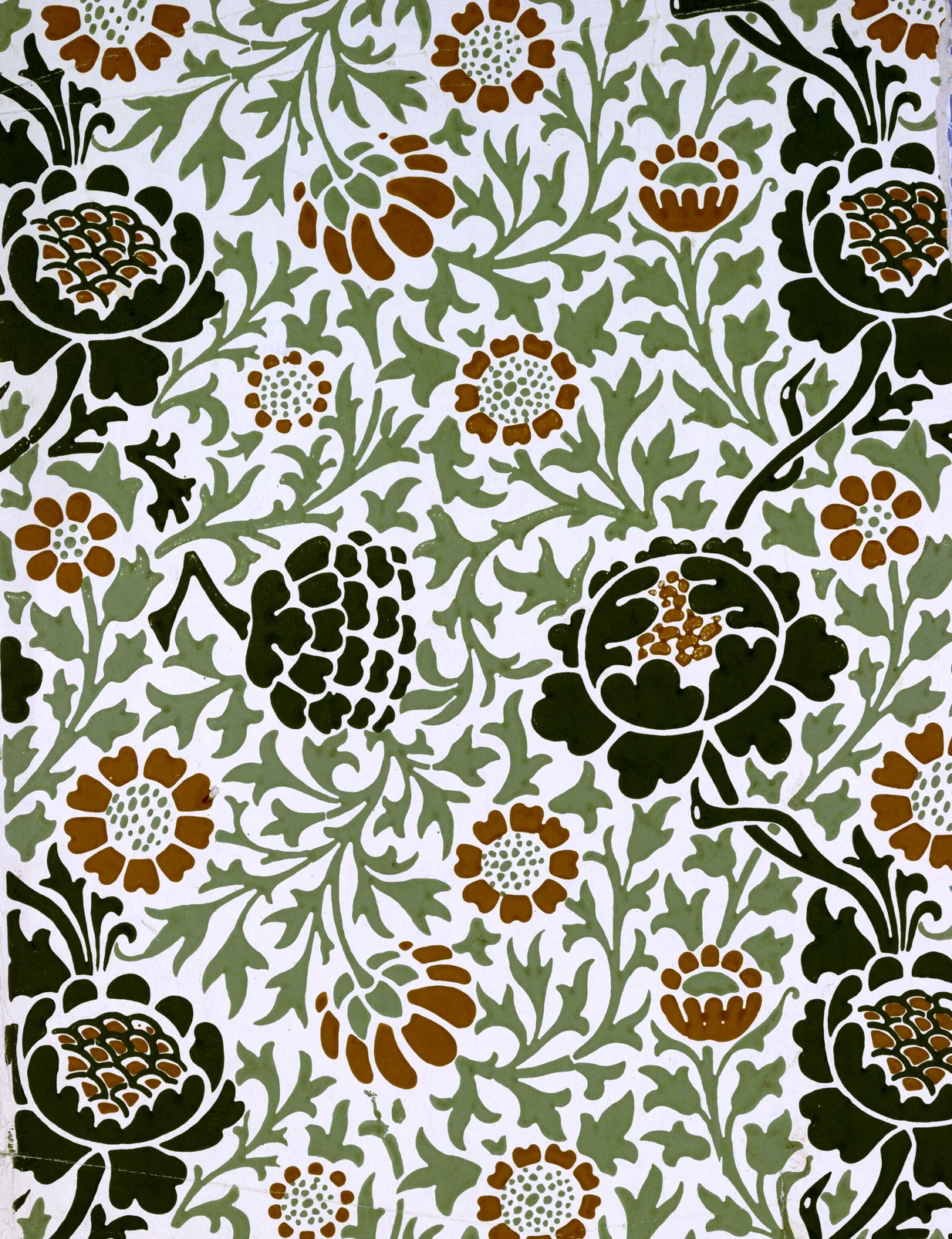
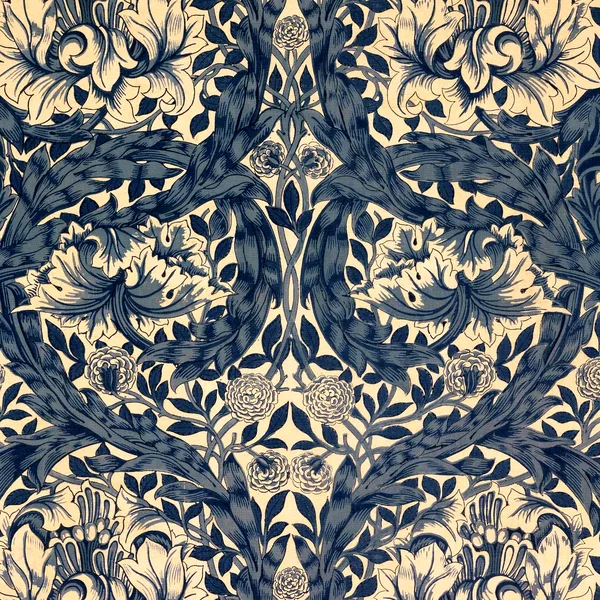
Grafton by William Morris is an 1883 English wallpaper design featuring vertical serpentine vines, stylized flower heads, and an underlay of layered foliage against a light ground.
| Designed | 1883 |
|---|---|
| Designer | William Morris |
| Type | wallpaper |
| Motifs | flowers |
| Colourway | Gold on Ivory |
| Repeat | not measured |
| Source | Cooper Hewitt, Smithsonian Design Museum, via Wikimedia Commons. Licence: Public domain (Wikimedia Commons). Museum record |
Order Grafton as a print
Format
Size (inches)
$40
Made to order. Shipping included in the US.
Seamless pattern file
A repeat tile of this design, ready to fill any size in design software.
What Grafton shows
Grafton by William Morris is a botanical wallpaper pattern structured around climbing vertical vines and stylized floral blooms. Two primary floral rhythms run through the surface. First, thick serpentine stems curve upward, carrying large flower heads with cupped petals and stippled seed centers. Second, an underlay of leafy arabesques fills the negative space with lobed, branching acanthus foliage.
You can spot several distinct flower types across the repeat. Large dark green blossoms resemble clustered artichokes or pinecones with tight scales. Flanking them are open round rosettes with radiating petals finished in rich golden brown, centered around dotted seed disks. Smaller bell-shaped and cup-shaped blossoms cling to the curving branches. The foliage alternates between deep forest green on the heavy vines and a softer sage or olive tone across the leaf tendrils. Crisp white ground peeks through the leaves, giving the dense pattern open breathing room.
Who designed it and when
William Morris designed Grafton in 1883. The design record and the Cooper Hewitt, Smithsonian Design Museum catalog both record Morris as the designer, with the initial printing executed by Jeffrey & Company.
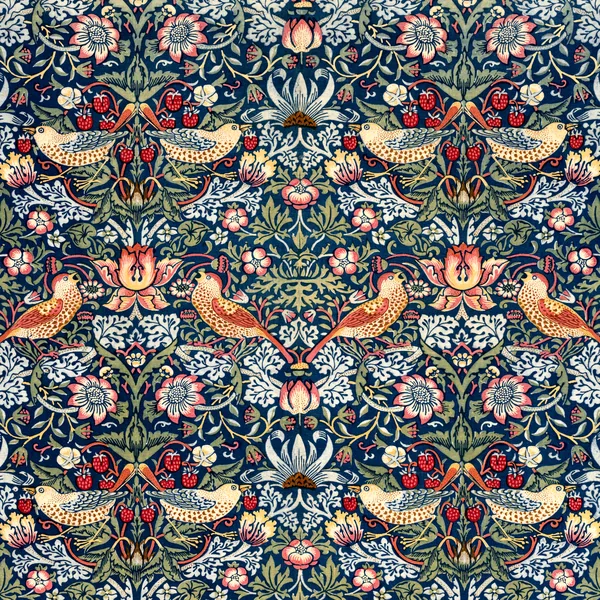
The year 1883 was an active period for the designer. During this time, Morris produced some of his most recognized pattern work, including printed cotton textiles such as the Strawberry Thief chintz. You can explore the full timeline of his career in our guide to William Morris and see where Grafton fits among every William Morris design preserved in public museum archives.
How it was made and used
Grafton was manufactured as a sidewall wallpaper using traditional block printing on paper. Jeffrey & Company, the prominent wallpaper firm, printed the pattern for Morris & Co. The process used hand-carved wood blocks to apply each color of ink onto long paper rolls.
In Victorian interior schemes, a sidewall paper covered the primary section of a domestic wall between the floor wainscot and the frieze. The surviving museum specimen at the Cooper Hewitt measures 44 by 47 centimeters (17 5/16 by 18 1/2 inches). The vertical movement of the serpentine vines served an architectural purpose, drawing the eye upward to create a sense of height in high-ceilinged drawing rooms and parlors.
Colourways
On this site, Grafton is available in a single colourway named Gold on Ivory. This name is our catalog label based on the original museum scan rather than a historical Victorian sales name.
The colourway matches the original printing preserved in museum collections. The ground is a clean, pale ivory that provides maximum contrast. Against this light base, the pattern pairs two shades of botanical green with a warm chestnut brown. The dark forest green anchors the thick climbing stems and layered buds, the lighter olive green defines the surrounding arabesque foliage, and the warm brown highlights the flower petals and speckled seed centers.
Grafton as a print
ArtsyWall prints and ships Grafton in three formats: Archival Paper, Premium Canvas, and Framed Canvas. If you prefer unframed art, Archival Paper is printed on 340gsm, textured, 100% cotton rag paper with a fine watercolor texture, shipped rolled in a sturdy tube. For an unframed wall piece with depth, Premium Canvas is hand-stretched over solid wood bars and arrives ready to hang with a sawtooth hanger.
Framed Canvas encases the stretched canvas inside a solid wood floating frame, leaving a slim gap so the canvas appears to hover. You can select from six wood frame finishes: black, white, gold, silver, walnut, and oak. When framed, Grafton reads as a bold architectural piece. The vertical green stems create clean structure on the wall, while the warm gold-brown rosettes add warmth against bright or neutral room surfaces.
Want Grafton on a whole wall? See Grafton wallpaper, sized to your wall.
Questions and answers
Who designed Grafton?
William Morris designed the Grafton pattern. Historical records and the Cooper Hewitt museum collection attribute the wallpaper to William Morris, with the original manufacturing completed by Jeffrey & Company in England. Morris created the sidewall design to combine dense botanical growth with climbing stems and stylized floral blooms.
When was Grafton designed?
Grafton was designed in 1883. That year was a prolific period for Morris, who developed several famous patterns for both textiles and wall coverings. The Cooper Hewitt museum preserves a paper specimen block-printed in 1883, showing the vertical serpentine layout and color scheme of green and brown inks on a pale ground.
What does the Grafton pattern show?
The Grafton pattern shows vertical serpentine vines, flowering blooms, and an underlay of leafy arabesques. Its plant motifs include large blossoms with stippled centers, pinecone-shaped green buds, and small daisy-like flowers with brown petals. The foliage intertwines dark green and olive leaves across a plain white ground, creating a rhythmic, layered garden scene.
Was Grafton a wallpaper or a fabric?
Grafton was produced as a wallpaper rather than a fabric. Historical museum records classify the pattern as a sidewall paper, intended to cover the main wall surfaces of a room. Jeffrey & Company printed the design using hand-carved woodblocks and colored inks on long rolls of paper for Morris & Co.
.jpg)