Flower Pot by William Morris
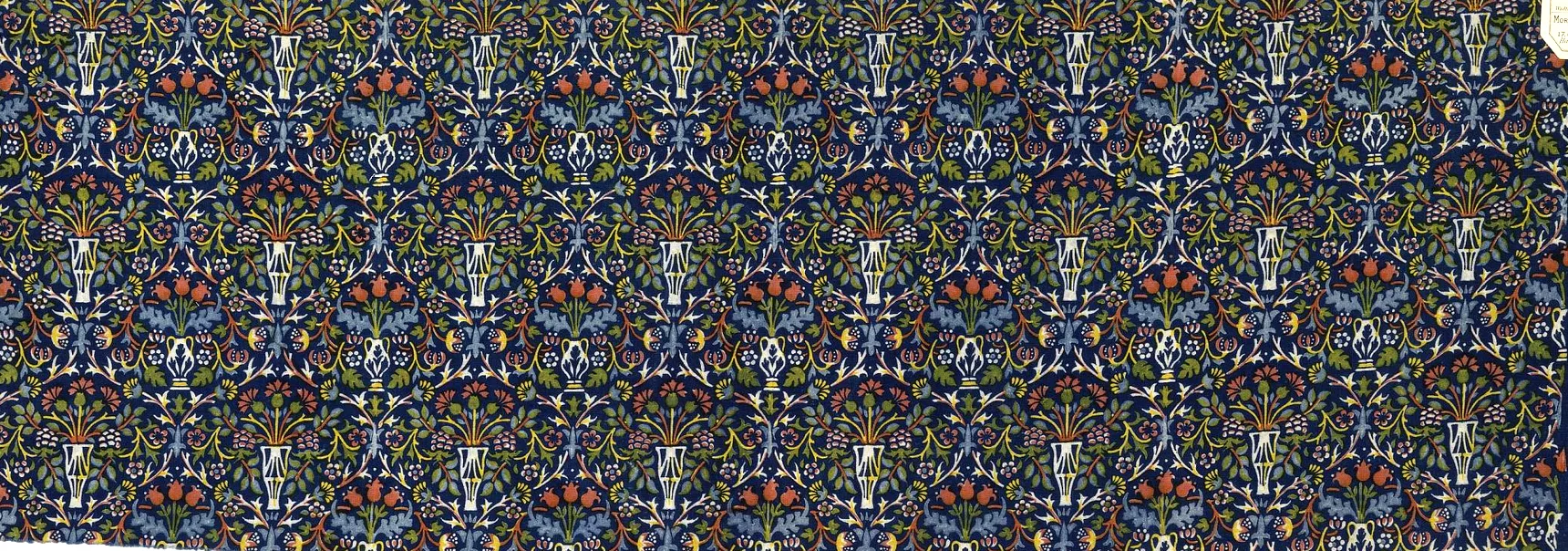
Flower Pot by William Morris is an 1883 textile pattern featuring rows of small vases filled with flowers. Set against a deep indigo ground, the design repeats delicate arrangements of blossoming plants across a balanced, symmetrical grid.
| Designed | 1883 |
|---|---|
| Designer | William Morris |
| Type | textile |
| Motifs | flowers |
| Colourway | Indigo |
| Repeat | 2.4 × 2.5 in (estimated) |
| Source | Cooper Hewitt, Smithsonian Design Museum. Licence: CC0. Museum record |
Order Flower Pot as a print
Format
Size (inches)
$40
Made to order. Shipping included in the US.
Seamless pattern file
One repeat tile, ready to fill any size in design software.
What Flower Pot shows
Flower Pot by William Morris is an 1883 textile pattern structured around neat, repeating rows of vessels overflowing with garden flora. The composition alternates between two distinct container shapes arranged in vertical columns: a slender fluted vase on a pedestal and a rounded, two-handled urn. Each container holds an upright bouquet of stems bearing bell-like terracotta-red buds, spiky flowering heads, and rounded seed heads or fruit clusters.
Between and around the pots, mirrored leaves and trailing stems interlock across a dark indigo-blue background. Broad, scalloped leaves in pale blue-grey branch outward beneath the pots, while sage-green foliage, golden-yellow buds, and tiny white starry flowers fill the surrounding spaces. The entire pattern relies on strict vertical symmetry, yet the gentle curving of the leaves prevents the grid from feeling rigid. Because the pattern repeat is unusually compact (estimated at roughly 2.4 by 2.5 inches), the individual motifs create a dense rhythm across the fabric.
Who designed it and when
Flower Pot was designed in 1883. Design records credit William Morris as the designer, although the museum records at the Cooper Hewitt note Morris & Co. as the maker. In our directory of every William Morris design, you can explore how his workshop approached pattern across different mediums during this era.
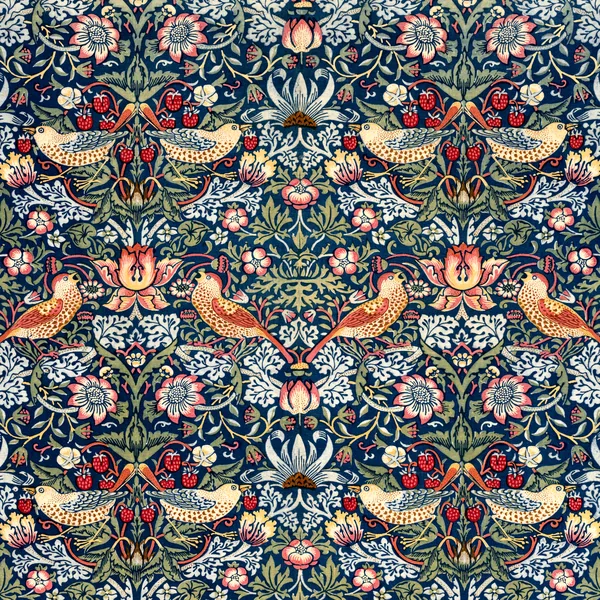
The year 1883 was an active period of textile production for Morris. During that same year, he registered several famous patterns, including Strawberry Thief. While Strawberry Thief featured bold birds and fruit in a large layout, Flower Pot took a more concentrated approach, packing delicate flora and decorative pottery into an intimate scale.
How it was made and used
Flower Pot was created as a printed textile. Unlike broad wall hangings or large-scale furnishing chintzes, its diminutive repeat size of approximately 2.4 by 2.5 inches made it suitable for smaller decorative applications and light upholstery where a close, continuous repeat was desirable.
The scan presented here comes from an original piece preserved in the collection of the Cooper Hewitt, Smithsonian Design Museum, released under a CC0 public domain licence. The museum record dates the object design to 1883.
Colourways
This site offers Flower Pot in one colourway: Indigo. Note that Indigo is this site’s label based on the museum scan, not an official historical trade name from Morris & Co.
This colourway features a deep midnight indigo ground that provides rich contrast for the lighter pigments. The vessels stand out in crisp white with dark and golden-yellow line work. Earthy terracotta red defines the primary blossoms, while the foliage balances cool grey-blue fronds with warm olive and sage-green leaves. Scattered accents of ochre yellow appear on the calyxes and secondary flower petals, creating a warm harmony over the dark background.
Flower Pot as a print
ArtsyWall prints and ships Flower Pot in three formats: Archival Paper, Premium Canvas, and Framed Canvas. On Archival Paper, the textured 340gsm cotton rag captures the fine, stippled linework of the original 1883 textile scan. On Premium Canvas and Framed Canvas, the rich indigo tones stretch neatly across solid wood bars for an edge-to-edge presentation.
When framed, the miniature scale of Flower Pot creates an intriguing visual effect. From across a room, the repeating urns and vases resolve into a balanced geometric lattice. Up close, the eye discovers the intricate details of the tiny red buds and mirrored leaves. A Framed Canvas in oak or walnut complements the earthy terracotta and sage tones, while black or white frames bring out the clean outlines of the vases.
Want Flower Pot on a whole wall? See Flower Pot wallpaper, sized to your wall.
Questions and answers
Who designed Flower Pot?
William Morris is credited as the designer of Flower Pot in design records, though museum sources at the Cooper Hewitt credit the production to Morris & Co. The pattern reflects the close floral observation and medieval-inspired symmetry typical of the workshop during the early 1880s.
When was Flower Pot designed?
Flower Pot was designed in 1883. That same year, William Morris created several other famous textile designs for Morris & Co. The original museum specimen preserved in the Cooper Hewitt collection confirms 1883 as the design date for this dense floral textile.
Was Flower Pot a wallpaper or a fabric?
Flower Pot was a fabric rather than a wallpaper. The design was produced as a printed textile featuring a very small repeat of roughly 2.4 by 2.5 inches. This close, fine scale made the material well suited for light domestic furnishings, covers, and accessories.
What colours does Flower Pot come in?
Flower Pot is presented on this site in one colourway named Indigo. This colourway features a deep indigo-blue background paired with white and yellow vases, terracotta-red flower buds, sage-green foliage, and soft blue-grey leaves. Indigo is a descriptive name for this scan rather than an original trade label.