Flower Garden by William Morris
Flower Garden by William Morris is an 1879 textile pattern built from mirrored floral bouquets, trailing leaves, and small blossoms set against a dark ground.
Get Flower Garden
Seamless pattern pack: Flower Garden only
- Seamless tile, 3018 × 3600 px JPG, 10.1 × 12 in at 300 dpi
- 12 × 12 in digital paper sheet, 3600 × 3600 px JPG
- Junk journal page, A4 and US Letter
- Dollhouse wallpaper sheets, 1:12 and 1:24 scale, A4 and US Letter
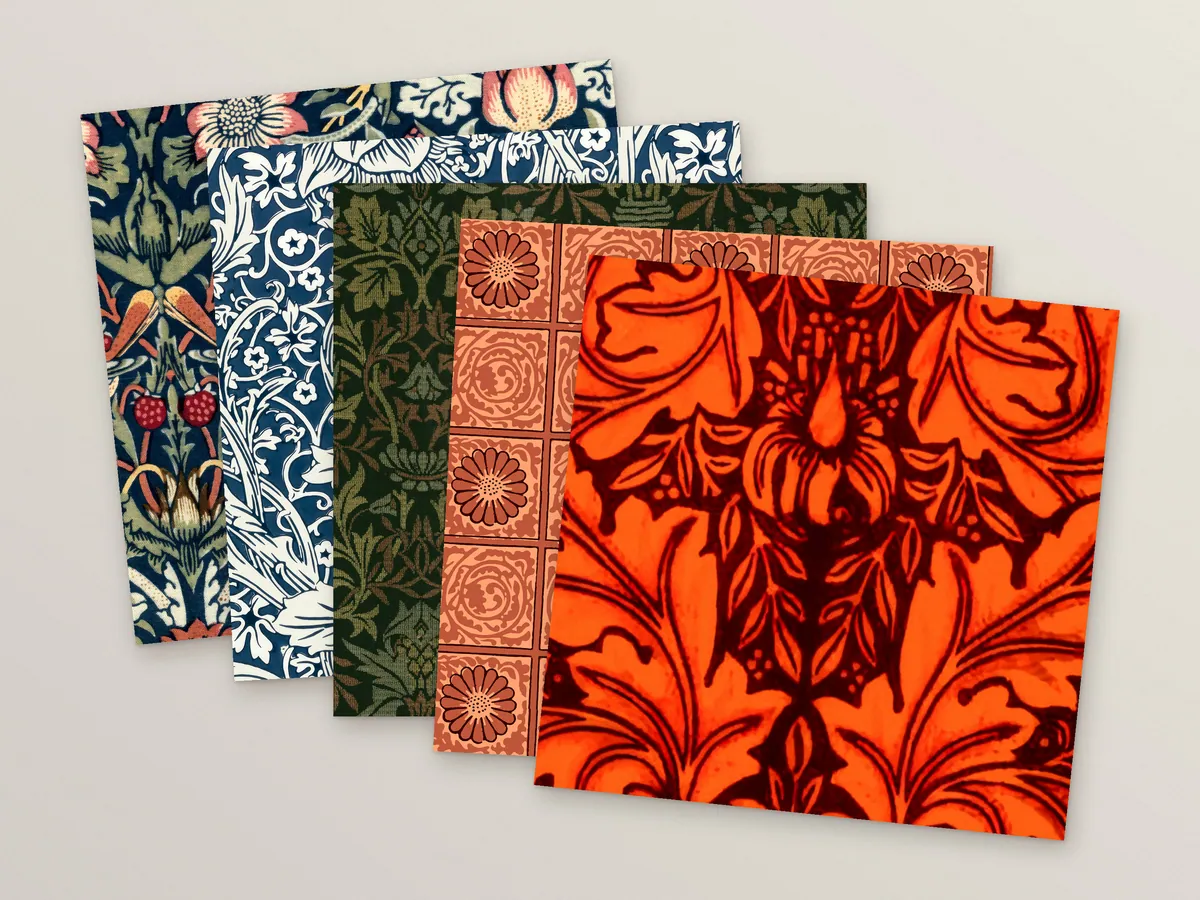
William Morris Seamless Patterns, Vol 1
Flower Garden + 12 more designs: seamless tiles and sheets.
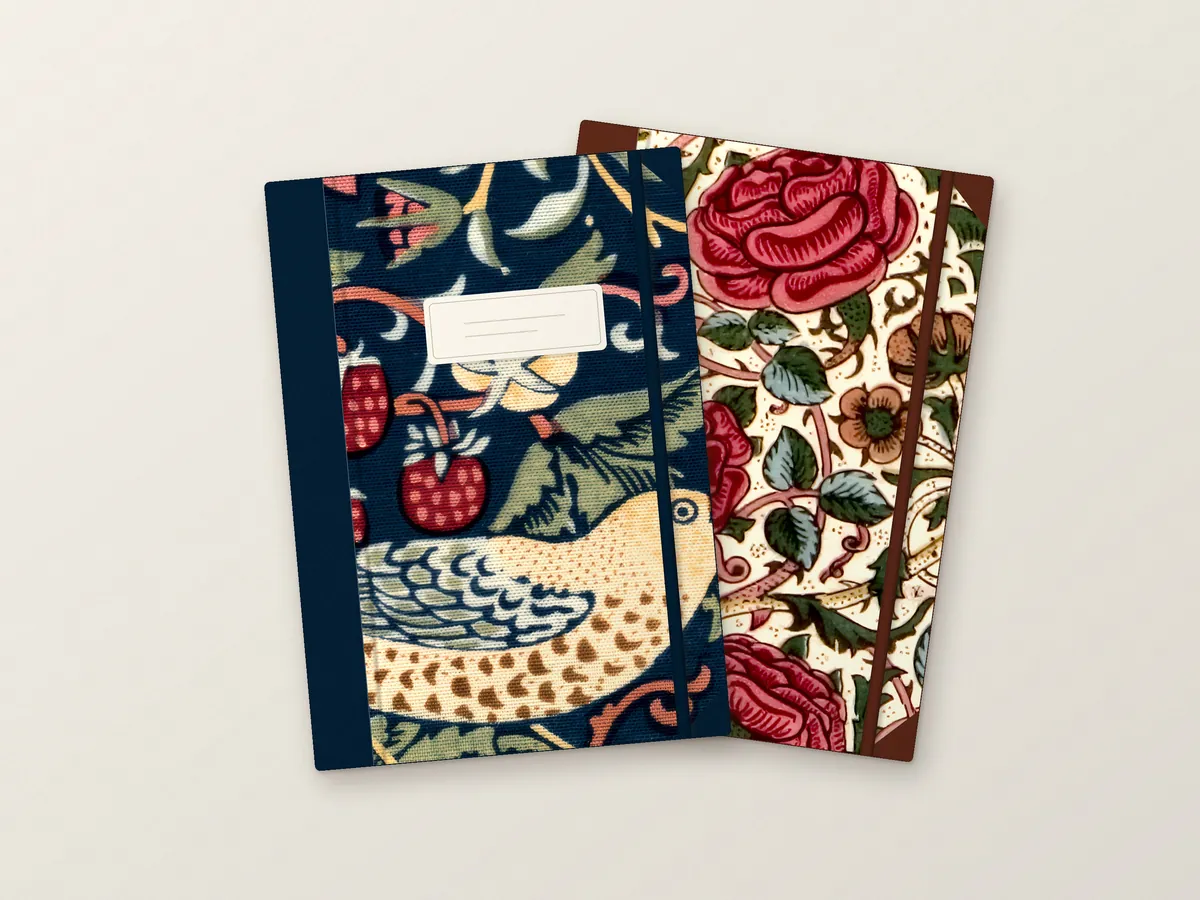
William Morris Junk Journal Pages
Flower Garden + 23 more designs: junk journal pages.
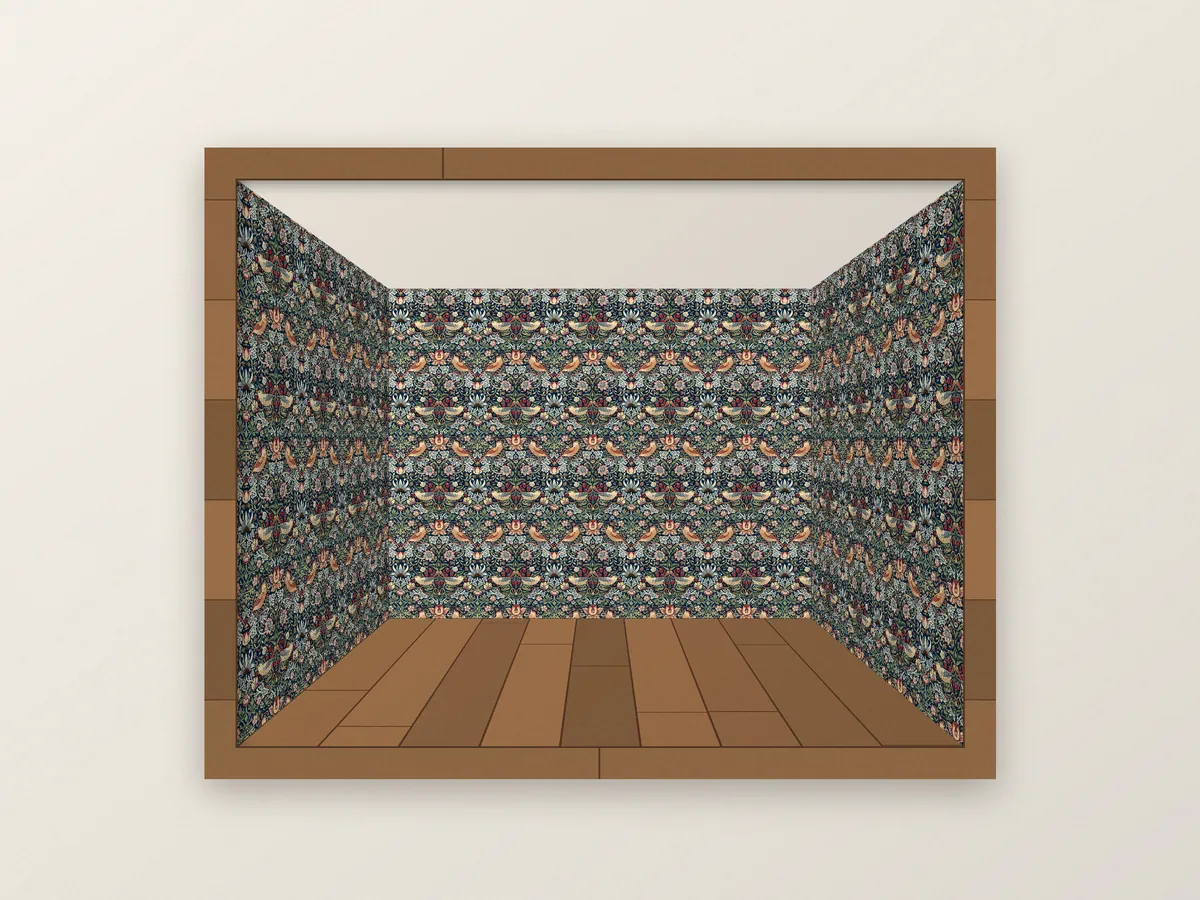
William Morris Dollhouse Wallpapers, 1:12 and 1:24 Scale
Flower Garden + 23 more designs: dollhouse wallpapers.
Personal use licence. No refunds on downloads unless the file is faulty.
| Designed | 1879 |
|---|---|
| Designer | William Morris |
| Type | textile |
| Motifs | flowers |
| Colourway | Black |
| Repeat | 10.1 × 12 in tile, straight repeat (true size not known) |
| Redrawn from | The Metropolitan Museum of Art. Licence: CC0. Museum record |
Seamless repeat
The clean tile joins edge to edge: copies placed side by side and top to bottom show no seam. Pick your screen size and press True size to see the pattern at its real size.
Where the design comes from
The clean file is redrawn from a museum original. These are the museum scans of Flower Garden, public domain or free to use.
Flower Garden (1879), designed by William Morris. Source: The Metropolitan Museum of Art, 221483. Museum record
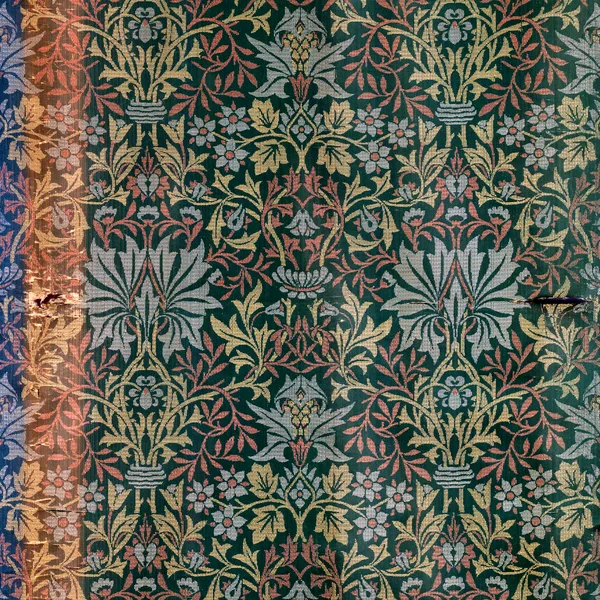
The Metropolitan Museum of Art. CC0. Museum record
What Flower Garden shows
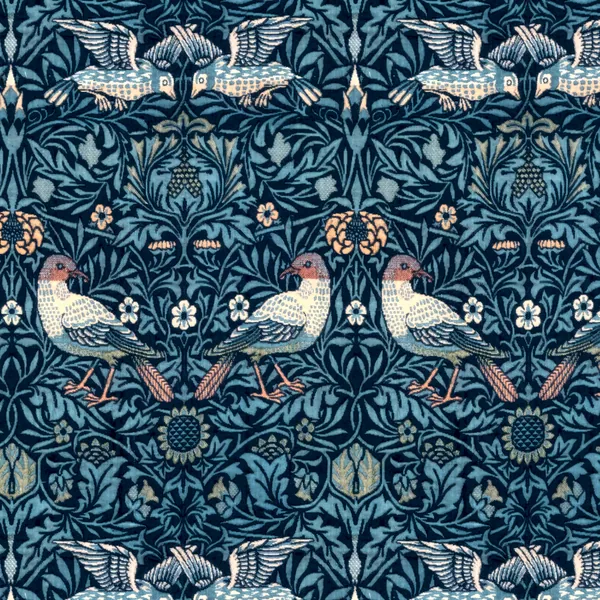
Flower Garden by William Morris is an intricate floral textile pattern structured around vertical symmetry. A central bouquet anchors the composition, set inside a basket or urn-like foliate base. Broad palmette leaves in a silvery pale blue flare outward from the center, flanked by stylized leaves in warm golden yellow.
Intertwining stems in dusty salmon pink weave between the main leaf clusters. Small five-petaled starry blossoms in soft blue and white dot the field, alongside hanging bell-shaped flowers and serrated leaflets. The elements repeat across a deep blackish-green ground, filling nearly the entire surface with dense, layered foliage.
Who designed it and when
William Morris designed Flower Garden in 1879. By the late 1870s, Morris was deeply invested in expanding his firm’s range of woven and printed fabrics for domestic interiors. To learn more about his career and pattern philosophy, read our guide to William Morris.
In our directory of every William Morris design, patterns from this period demonstrate his move toward balanced, repeating botanical rhythms. While later favorites like Strawberry Thief introduced birds and animals, Flower Garden focuses purely on plant forms and architectural symmetry.
How it was made and used
Flower Garden was produced as a textile rather than a block-printed wallpaper. Close inspection of the museum scan reveals the fine horizontal and vertical ribbing of a woven cloth. Morris placed great emphasis on how a pattern behaved when woven, ensuring that colors and motifs retained clarity across the textured surface of threads.
As a furnishing fabric, Flower Garden was meant to bring nature into Victorian rooms. Its structured vertical repeat allowed the pattern to hang gracefully as curtains, portieres, or wall coverings. The balanced bouquets and trailing foliage maintain their visual rhythm whether laid flat or draped in folds.
Colourways
On this site, Flower Garden is presented in one historical colourway called Black. The design features an intense dark ground that sets off the lighter vegetal pigments. The scan for this edition comes from the Metropolitan Museum of Art under an open-access CC0 license.
The palette combines deep, shadowy tones with soft, luminous highlights. Dusty rose and salmon pink define the winding vine network, while the primary foliage leaves appear in pale straw and ochre tones. The central acanthus-like sprays and delicate starry flowers glow in a cool, silvery blue-white, giving the dark textile a balanced warmth and coolness.
Flower Garden as a print
The Flower Garden pattern pack is for sale in the buy box at the top of this page: seamless repeat tiles of one or more of its colourways. Once you have a file, print it yourself, at home or at a print shop, under the personal licence. You may print it at any size, on paper, fabric or other material, for your own use, including as a gift. The seamless repeat tile lets you scale the pattern up or down and tile it across a larger surface, such as a wall panel, a cushion cover or a length of fabric, without a visible join. See the pattern file licence for what you may and may not do.
Questions and answers
Who designed Flower Garden?
William Morris designed Flower Garden. He created the floral pattern for Morris & Co. during a prolific period of fabric and furnishing design. Although some patterns from the firm were produced by assistants such as John Henry Dearle, museum archives and historical records attribute Flower Garden directly to Morris himself.
When was Flower Garden designed?
Flower Garden was designed in 1879. The pattern dates from the late Victorian period, when Morris was developing complex floral arrangements for interior furnishings. Surviving historical examples from that era, including the original museum textile scanned for this collection, confirm 1879 as the date of Morris's initial design.
What does the Flower Garden pattern show?
Flower Garden shows an intricate field of stylized floral bouquets, branching vines, and small starry blossoms arranged in vertical symmetry. Prominent fan-shaped foliage sprays rise from ribbed bases, flanked by curving golden-yellow leaves, trailing coral-pink stems, and delicate pale blue flower heads against a very dark background.
Was Flower Garden a wallpaper or a fabric?
Flower Garden was produced as a fabric rather than a wallpaper. The design record classifies it as a textile, and original surviving pieces in museum collections show a woven cloth structure. The pattern repeats symmetrically across the cloth surface, providing rich decoration suitable for drapery and home furnishings.
Related designs
Want Flower Garden on a whole wall? See Flower Garden wallpaper, sized to your wall.