Daisy by William Morris
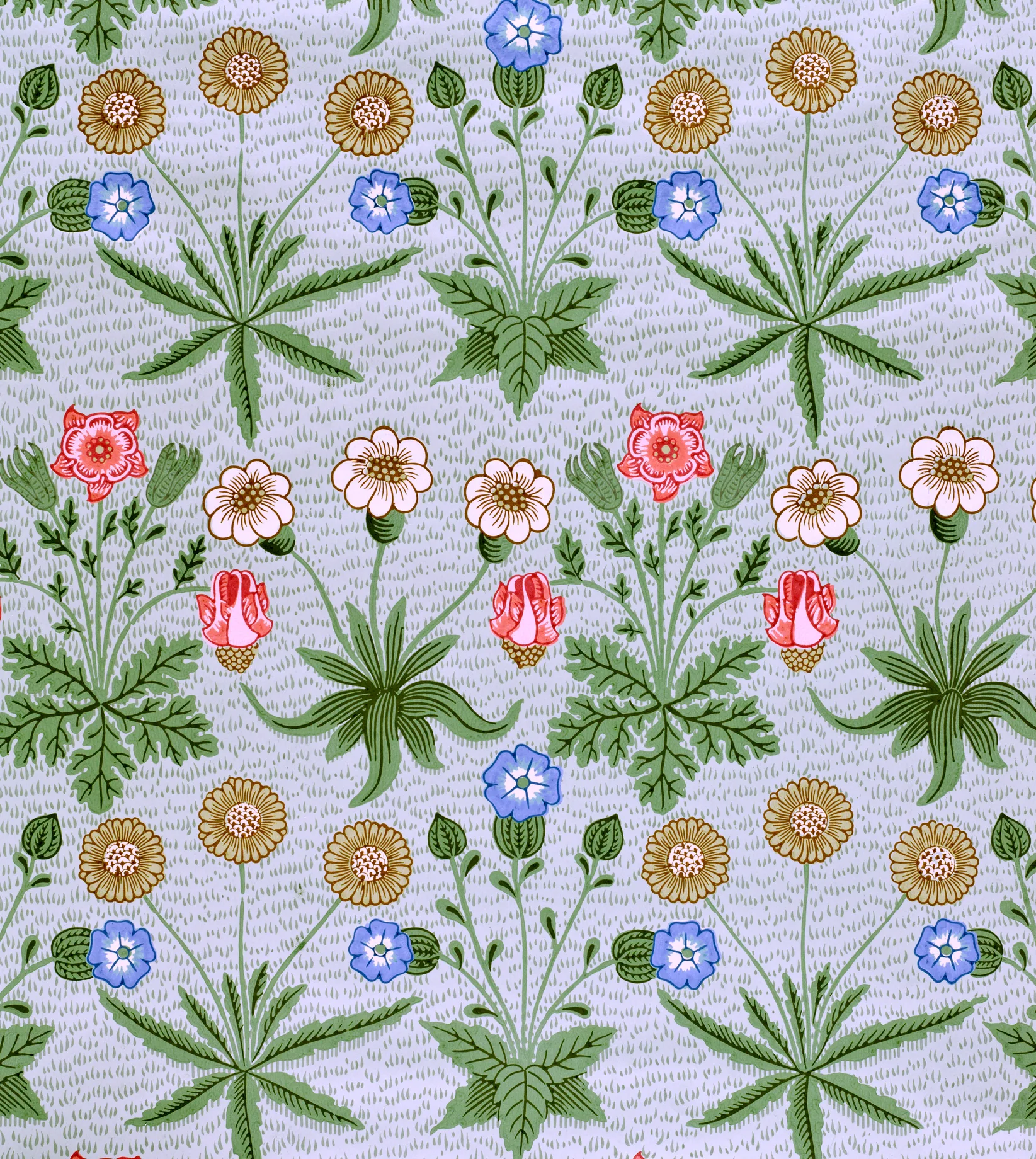
Daisy is an 1862 wallpaper pattern designed by William Morris featuring clusters of meadow flowers. It presents daisies, columbines, and sweet Williams set over a delicate grass-flecked ground.
Colourways
| Designed | 1862 |
|---|---|
| Designer | William Morris |
| Type | wallpaper |
| Motifs | flowers |
| Colourway | Green on Ivory |
| Repeat | 10.5 × 14 in (estimated) |
| Source | LACMA. Licence: Public domain (LACMA open access). Museum record |
Order Daisy as a print
Format
Size (inches)
$40
Made to order. Shipping included in the US.
Seamless pattern file
One repeat tile, ready to fill any size in design software.
What Daisy shows
Daisy by William Morris is an early floral wallpaper pattern based on simple garden blossoms. The design organizes botanical clumps across a pale, grass-flecked background. You see distinct groupings of flowering plants arranged in neat, repeating intervals. These clusters include white and yellow daisies, nodding columbines, and pink sweet Williams, all growing from low leafy mounds.
The background is filled with tiny vertical strokes that suggest blades of grass in a lawn or meadow. Upright stems rise from serrated green leaves, carrying round daisy heads with circular centers, bell-like columbine blossoms, and closed buds. Small blue flowers sit beside darker green leaves, providing points of contrast against the paler backdrop. The composition feels open and rhythmic rather than dense or tangled.
Who designed it and when
William Morris designed Daisy in 1862. The pattern was among his earliest wallpaper designs, created shortly after he helped establish the decorative arts firm Morris, Marshall, Faulkner & Co. You can learn more about his career in our guide to William Morris. While Morris developed the pattern in 1862, museum records indicate that the firm first printed it for commercial sale in 1864.
The surviving museum records show minor differences regarding attribution and dates. A specimen held by the Los Angeles County Museum of Art attributes Daisy directly to William Morris with a design date of 1862 and a first print date of 1864. In contrast, the catalog record from the Cooper Hewitt, Smithsonian Design Museum dates its sidewall to 1864 and lists an unknown artist, though related catalog records credit Morris.
How it was made and used
Daisy was manufactured as a hand block-printed wallpaper. Craftsmen carved individual wooden blocks for each separate color in the pattern, applying them by hand to long rolls of paper. The museum sheets record dimensions of roughly 70 1/2 by 20 1/8 inches for full panels, with repeat dimensions measuring approximately 10.5 by 14 inches. Each layer of paint required careful registration so the grass flecks, leaves, and petals aligned across the wall.
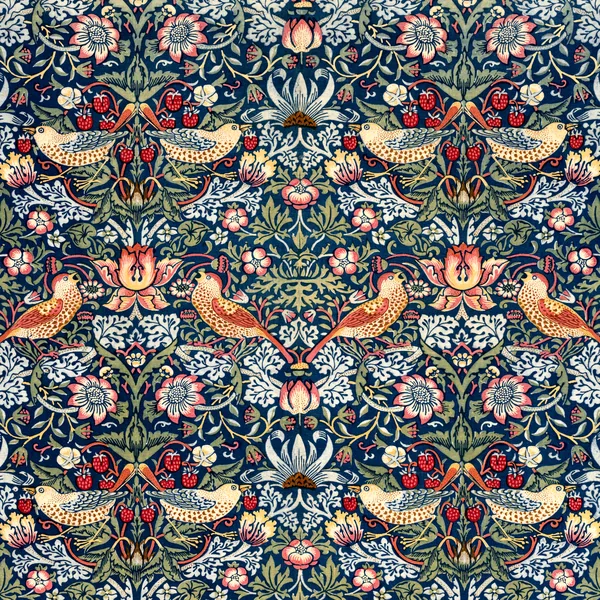
Morris intended Daisy for domestic interiors, giving Victorian rooms the feel of an open garden meadow. Later patterns in our collection of designs became much denser, such as the famous Strawberry Thief textile. Daisy, by contrast, relies on flat, stylized botanical forms and generous spacing between each clump of flowers.
Colourways
This site offers Daisy in two distinct colourways sourced from high-resolution museum scans. The first option is Green on Ivory, based on a block-printed panel in the Los Angeles County Museum of Art. It features crisp green foliage, pale petals, pink accents, and vivid blue floral heads against a light ivory ground marked by fine green flecks.
The second option is Dark Green on Stone, based on a sidewall in the Cooper Hewitt collection. This colourway presents slightly deeper green foliage and muted floral tones over a cool, grayish-stone background. Both colourways preserve the original hand-printed character of the archival paper rolls, including the subtle shading of the petals and leaves.
Daisy as a print
Daisy works well as framed wall art because its rhythmic, spaced clusters read clearly from across a room. ArtsyWall prints and ships Daisy in three formats: Archival Paper, Premium Canvas, and Framed Canvas. On Archival Paper, the fine grass flecks and crisp petal outlines stand out with sharp precision. When stretched on Premium Canvas or displayed as a Framed Canvas, the pattern feels substantial and painterly. If you prefer to cover an entire wall with this pattern, peel-and-stick versions are available as Daisy wallpaper.
Want Daisy on a whole wall? See Daisy wallpaper, sized to your wall.
Questions and answers
Who designed Daisy?
William Morris designed the Daisy pattern for his decorative firm. Although a museum record at the Cooper Hewitt lists an unknown artist for one sidewall specimen, historical archives and the Los Angeles County Museum of Art credit the original pattern directly to William Morris. It remains one of the earliest repeating surface patterns produced under his name.
When was Daisy designed?
William Morris designed Daisy in 1862, making it one of his earliest wallpaper creations. The design was first printed for commercial distribution in 1864 by Morris & Co. Surviving museum specimens from collections like the Cooper Hewitt and LACMA document these initial 1860s printings, which were executed by hand using carved pearwood printing blocks.
What does the Daisy pattern show?
The Daisy pattern shows formally arranged groups of flowering plants set over a pale ground flecked with fine grass marks. Across the repeat, you can identify clumps of daisies, columbines, and sweet Williams. Each cluster features spiky green foliage at the base, slender upright stems, open blossoms, and round buds rendered in clear botanical detail.
Was Daisy a wallpaper or a fabric?
Daisy was originally created as a hand block-printed wallpaper rather than a woven or printed fabric. Historical manufacturers produced the design on long rolls of paper by stamping carved wood blocks dipped in individual colors. The pattern decorated domestic walls with evenly spaced floral groupings, creating the quiet appearance of an English garden meadow indoors.