Corncockle by William Morris
Corncockle by William Morris is an 1883 floral textile pattern featuring bold cornflowers, artichoke-like heads, and sweeping foliage. Morris designed the dense botanical repeat for printed interior fabrics such as cotton and linen.
Colourways
| Designed | 1883 |
|---|---|
| Designer | William Morris |
| Type | textile |
| Motifs | flowers |
| Colourway | Red on Ivory |
| Repeat | not measured |
| Source | Cooper Hewitt, Smithsonian Design Museum, via Wikimedia Commons. Licence: Public domain (Wikimedia Commons). Museum record |
Order Corncockle as a print
Format
Size (inches)
$40
Made to order. Shipping included in the US.
Seamless pattern file
A repeat tile of this design, ready to fill any size in design software.
What Corncockle shows
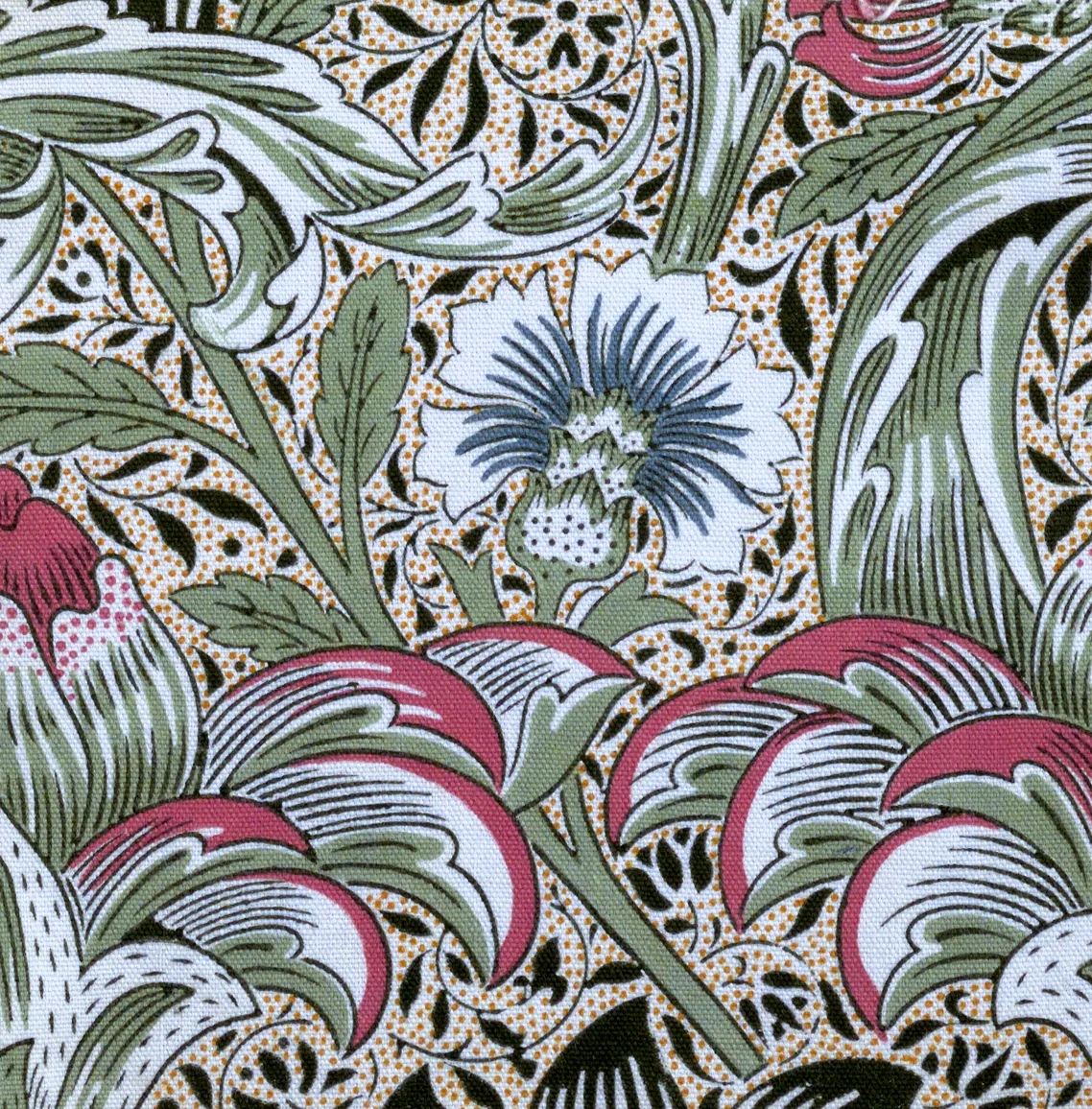
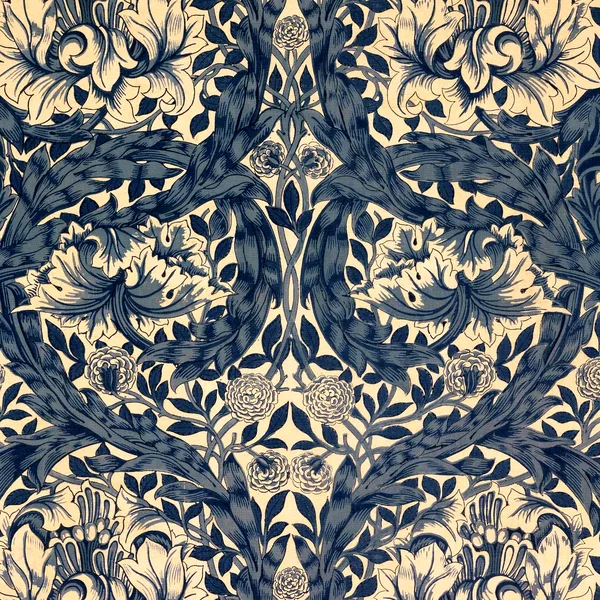
Corncockle by William Morris presents an intricate, layered field of English garden and meadow plants. Prominent cornflowers and large, artichoke-like flower heads rise along thick curving stems. Broad, serrated leaves arch across the composition, folding over one another to create rhythmic vertical movement. The foreground blooms open with jagged petals, while smaller buds and swelling calyxes peek through the foliage.
Behind the primary blossoms sits an all-over background of delicate scrolling stems and slender leaves. A fine pattern of yellow dots stipples the pale ground in the multi-colored version, adding subtle texture between the leaves. Dark outlines delineate every petal and curled leaf tip, giving the organic forms crisp graphic definition. The overall pattern feels dense and energetic, filling every square inch without losing the distinct silhouette of each botanical form.
Who designed it and when
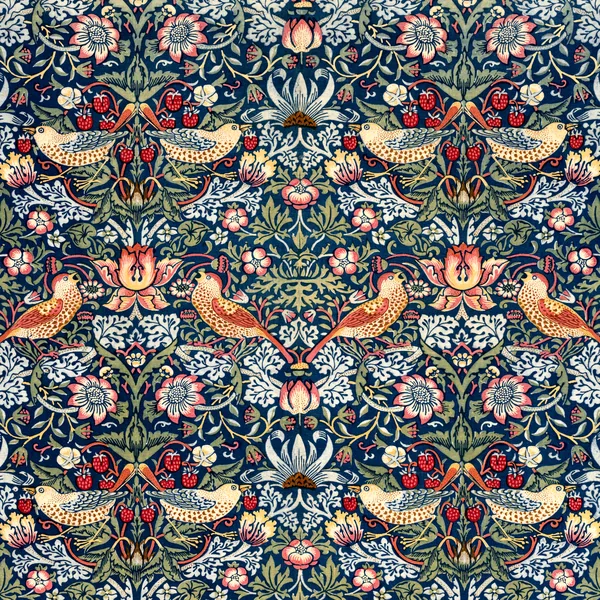
William Morris designed Corncockle in 1883. You can explore every William Morris design across our collection to see how his work evolved during this period. The early 1880s marked a prolific chapter in Morris’s career as a textile designer, coming immediately after he established production at Merton Abbey. That same year, he produced Strawberry Thief, another famous textile showcasing complex botanical repeats.
The historical attribution of Corncockle shows slight variation across museum records. While the Metropolitan Museum of Art and standard Morris catalogues attribute the pattern directly to Morris, a cotton sample in the Cooper Hewitt collection lists the designer as unknown. Where sources differ, historical evidence points to Morris designing the pattern for Morris & Co. at the height of his textile work. To understand his broader creative output, read our guide to William Morris and his decorative arts career.
How it was made and used
Morris created Corncockle as a printed furnishing textile. Unlike woven textiles or wallpapers, this pattern was intended specifically for printed cotton and linen fabrics. Surviving museum pieces show that Morris & Co. printed the design on substantial fabrics that could endure daily domestic use. Merton Abbey workshops handled the printing, applying traditional wood blocks and natural dyes to achieve rich, layered tones.
In Victorian homes, printed fabrics like Corncockle served multiple practical purposes. Householders hung them as window curtains and portières to block drafts, or draped them over tables and sideboards. The durable linen and cotton grounds also made the fabric suitable for upholstery on armchairs, daybeds, and loose furniture cushions. The lively repeating flowers brought garden imagery indoors, enlivening rooms with continuous botanical color.
Colourways
This site presents Corncockle in two distinct colourways taken from museum scans. The Brown on Ivory colourway reproduces a vibrant historical cotton sample from the Cooper Hewitt. In this version, the cornflowers bloom in clear blue with white highlights, while the artichoke-like flower heads feature warm pink and white petals. Olive and sage greens define the curving stems and foliage, set over a light ground dotted with yellow stippling and framed by dark green scrolling leaves.
The Ivory on Stone colourway comes from a large printed linen fragment in the Metropolitan Museum of Art. This monochromatic version strips away the multi-color palette to emphasize structure, value, and linework. Deep charcoal and stone tones trace the flower petals, leaves, and background scrolling across a clean, light ivory ground. It offers a restrained, graphic view of the 1883 repeat that highlights the precision of Morris’s original drawing.
Corncockle as a print
Prints of Corncockle are printed and shipped by ArtsyWall in three formats: Archival Paper, Premium Canvas, and Framed Canvas. On Archival Paper, the fine stippling and crisp dark outlines of the petals reproduce with sharp clarity, making it an excellent choice if you plan to use custom mats. The Premium Canvas format gives the pattern depth and rich surface texture, stretching the botanical forms across the edges of the room.
Framed Canvas presents Corncockle inside a wood floating frame, available in black, white, gold, silver, walnut, or oak. When framed, the dense repeat acts as an anchor on a wall, where the sweeping leaves and outward-facing cornflower heads draw the eye into the composition. The small gap of the floating frame separates the busy floral field from the surrounding wall, letting the rhythmic botanical curves stand out as structured wall art.
Want Corncockle on a whole wall? See Corncockle wallpaper, sized to your wall.
Questions and answers
Who designed Corncockle?
William Morris designed the Corncockle pattern in 1883 for his decorative arts firm. While the design record and the Metropolitan Museum of Art attribute the pattern to Morris, a textile sample in the Cooper Hewitt collection lists the artist as unknown. Most pattern scholars and museum archives recognize Corncockle as an original Morris design created during his fertile decade of printed cotton and linen production.
When was Corncockle designed?
Corncockle was designed in 1883. William Morris created the pattern during the same period he developed other famous printed textiles, producing it at the Merton Abbey print works in Surrey. Museum records at both the Metropolitan Museum of Art and the Cooper Hewitt date the initial design to 1883, when Morris focused heavily on large-scale botanical chintzes and printed furnishings for English interiors.
Was Corncockle a wallpaper or a fabric?
Corncockle was produced as a printed fabric rather than a wallpaper. Surviving historical museum examples show that Morris & Co. printed the floral pattern onto both cotton and linen textiles. The Metropolitan Museum of Art preserves a large printed linen fragment, while the Cooper Hewitt holds a cotton sample. Customers originally used these durable fabrics for curtains, furniture upholstery, and loose covers in nineteenth-century homes.
What colours does Corncockle come in?
This site offers Corncockle in two distinct colourways sourced from museum collection scans. The Brown on Ivory colourway reproduces a vibrant palette featuring cornflowers in blue and white, artichoke-like flower heads accented with pink, and green foliage against yellow stippling. The Ivory on Stone colourway offers a monochromatic presentation drawn from a printed linen fragment, highlighting dark outlines and crisp floral forms over a pale ground.
.jpg)