Campion: A Morris & Co. Pattern
Campion is a floral textile pattern issued by the historical firm Morris & Co. The design features winding stems, scrolling foliage, and small blossoms against a deep, dark ground.
| Designed | date unknown |
|---|---|
| Designer | Morris & Co. (designer not recorded) |
| Type | textile |
| Motifs | flowers |
| Colourway | Black |
| Repeat | not measured |
| Source | Cooper Hewitt, Smithsonian Design Museum. Licence: CC0. Museum record |
Order Campion as a print
Format
Size (inches)
$40
Made to order. Shipping included in the US.
Seamless pattern file
A repeat tile of this design, ready to fill any size in design software.
What Campion shows
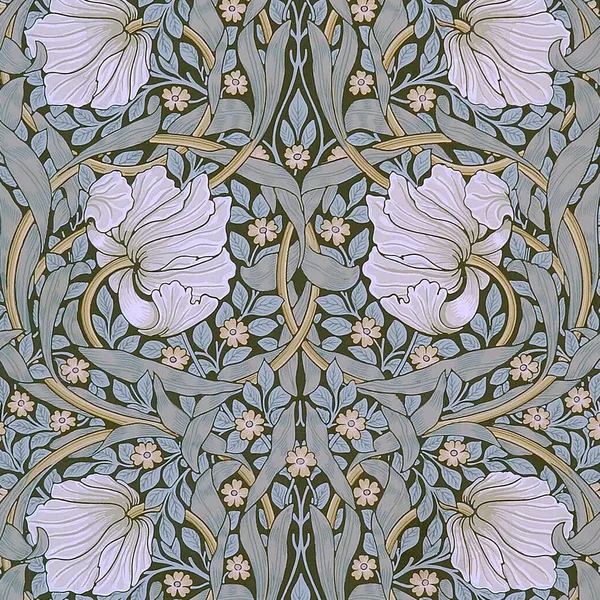
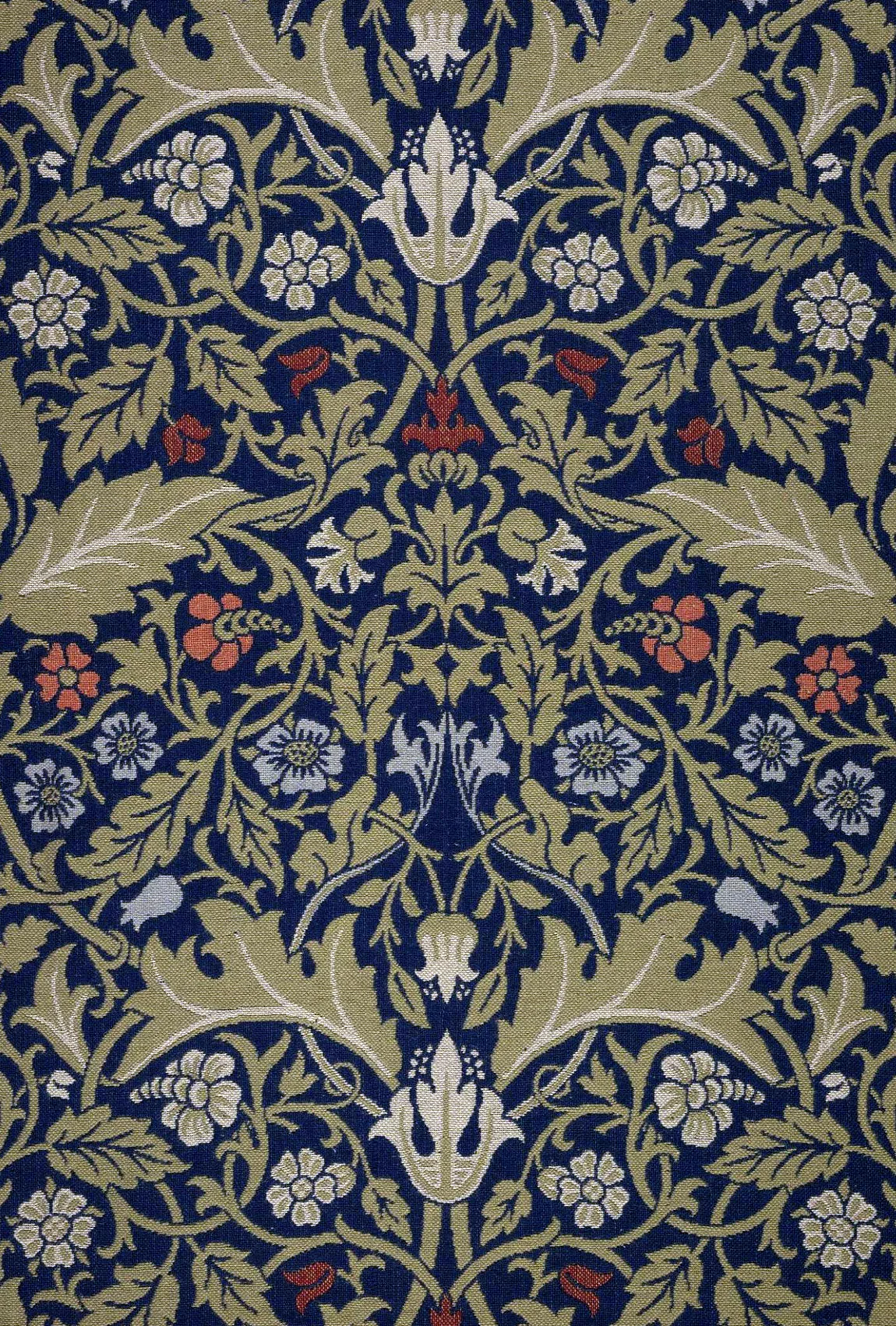
Campion presents a dense botanical layout built around winding stems and leafy foliage. The design displays an intertwining network of branching stems that carry jagged, lobed leaves and varied flower heads across the entire surface. A very deep, near-black dark ground sits behind the plants, providing strong contrast for the lighter plant details.
Several distinct flower varieties appear throughout the composition. You can see rounded, multi-petaled white and pale blue blossoms alongside smaller bell-shaped florets and drooping buds. Muted terracotta-red blossoms punctuate the field, adding warm accents among the cool tones. The leaves, shaded in olive-green and pale sage, feature directional ribbing that suggests the tactile quality of a woven textile. The elements mirror and interlock to form an upright, rhythmic pattern.
Who designed it and when
The specific designer of Campion is not recorded in museum records. The pattern was issued by the firm Morris & Co., which produced an extensive range of decorative textiles and furnishings throughout the late Victorian era. While many popular textiles from the firm were drawn by William Morris or his chief designer John Henry Dearle, museum collection records list this pattern as Morris & Co. with the designer not stated.
The original design year is also not recorded in company logs or museum entries. Surviving textile examples held in collections, including the Cooper Hewitt, Smithsonian Design Museum, date from the late 19th century. You can browse every William Morris design in our library to compare this pattern with well-documented works from the same era, such as Strawberry Thief. To learn more about the decorative Arts and Crafts movement founded by the firm’s leader, visit our guide on William Morris.
How it was made and used
Historical records classify Campion as a textile. Surviving examples from the late 19th century show that the pattern was produced as a decorative fabric rather than a printed wallpaper. The dense foliage, multi-colored floral accents, and interlocking repeat made it well suited for interior upholstery, portieres, and drapery in late Victorian interiors.
Morris & Co. placed great emphasis on traditional textile manufacturing techniques. The design was arranged to repeat cleanly across wide bolts of fabric, allowing rooms to be draped without distracting breaks in the motif. Today, the design survives through high-resolution public-domain scans made available by museums, allowing modern homes to display the historic pattern.
Colourways
This site presents Campion in one colourway, labeled Black, based on the surviving museum textile scan. The colourway features a deep, near-black dark ground that forms the backdrop for the foliage. Olive-green and pale celadon leaves dominate the center and sides, while pale blue and ivory flowers open along the curving stems. Muted terracotta and rusty-red blossoms provide subtle contrast throughout the composition. This palette reflects the subdued, naturalistic plant dyes favored by Morris & Co. during the late 19th century.
Campion as a print
Prints of Campion are printed and shipped by ArtsyWall in three formats: Archival Paper, Premium Canvas, and Framed Canvas. Archival Paper prints provide a textured, cotton-rag surface that highlights the intricate leaf outlines and delicate flower petals. Premium Canvas prints are hand-stretched over solid wood bars, bringing out the soft woven appearance of the original textile.
Framed Canvas prints arrive ready to hang in solid wood floating frames, available in black, white, gold, silver, walnut, and oak finishes. A black or walnut frame pairs naturally with the dark ground of Campion, anchoring the olive and terracotta tones. A gold frame offers a bright, traditional contrast that emphasizes the scrolling stems and pale blossoms.
Want Campion on a whole wall? See Campion wallpaper, sized to your wall.
Questions and answers
Who designed Campion?
The designer of Campion is not recorded in the museum records. The pattern was issued by the firm Morris & Co., but historical catalog entries do not state whether William Morris, John Henry Dearle, or another designer created the artwork. On this site, the pattern is attributed to the firm Morris & Co. directly.
When was Campion designed?
The exact year Campion was designed is not recorded in historical records. Surviving museum textile objects bearing this floral pattern date from the late 19th century. Because original documentation from Morris & Co. leaves the initial creation date unstated, we date the design by the surviving late 19th-century fabric specimens preserved in museum collections.
What does the Campion pattern show?
The Campion pattern shows an intricate botanical composition filled with flowering plants. Slender, curving stems intertwine across a dark ground, carrying lobed leaves, delicate buds, and multi-petaled blossoms. You can see flowers in shades of pale blue, white, and muted terracotta red, complemented by olive-green leaves arranged in a balanced repeat.
Was Campion a wallpaper or a fabric?
Campion was produced as a textile rather than a wallpaper. Surviving museum examples from the late 19th century show the pattern executed as a woven fabric. Today, the floral composition is preserved through museum scans and offered on this site as wall art prints and downloadable repeat pattern tiles.