Golden Lily: A Morris & Co. Pattern
Golden Lily is an 1899 Morris & Co. wallpaper design featuring entwined lily blossoms and leafy foliage arabesques. Discover the history of this classic pattern and browse it as fine art prints and seamless pattern files.
| Designed | 1899 |
|---|---|
| Designer | Morris & Co. (designer not recorded) |
| Type | wallpaper |
| Motifs | flowers, leaves |
| Colourway | Blue on Tan |
| Repeat | 9.6 × 15.8 in (estimated) |
| Source | Cooper Hewitt, Smithsonian Design Museum, via Wikimedia Commons. Licence: PD-Art, Commons template {{PD-Art}} (Wikimedia Commons). Museum record |
Order Golden Lily as a print
Format
Size (inches)
$40
Made to order. Shipping included in the US.
Seamless pattern file
One repeat tile, ready to fill any size in design software.
What Golden Lily shows
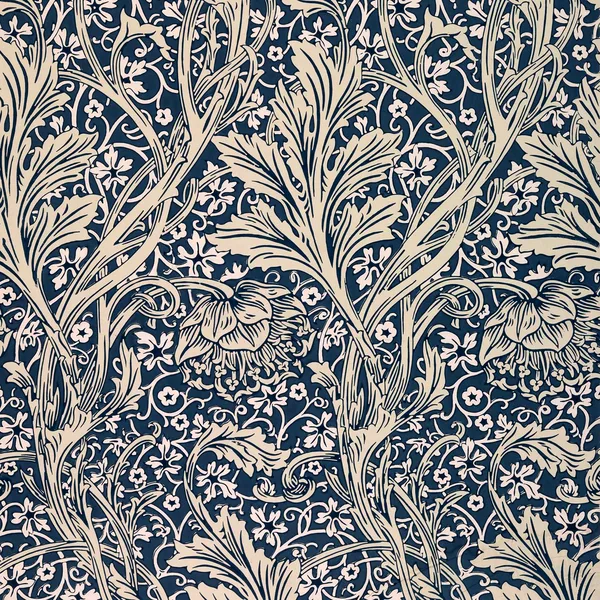
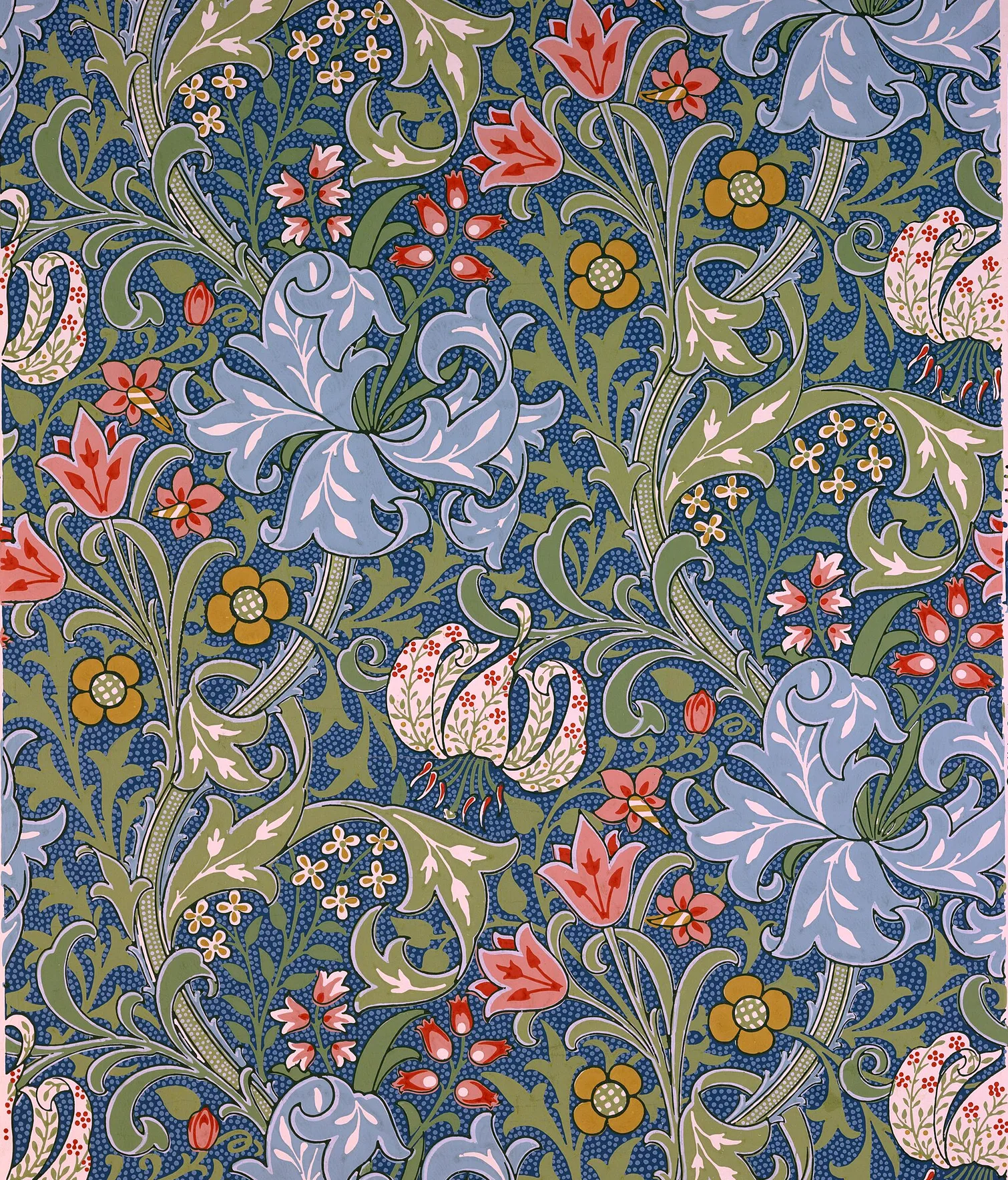
Golden Lily is an intricate Morris & Co. pattern dominated by twisting stems, large lily heads, and dense foliage arabesques. Diagonal stems curve across the surface, carrying stylized lily blossoms with curling, fleur-de-lis petals. Within the petals themselves, delicate secondary floral motifs provide texture. Sprouting alongside these prominent lilies are bell-shaped red blooms, open four-lobed yellow flowers, clusters of small cream buds, and pointed green leaves.
The entire composition rests on a background filled with delicate dots and leafy sprigs. Pale green stems wind past olive and sage foliage, guiding the eye in rhythmic curves across the vertical repeat. The dense layering produces a balanced surface where no background space remains empty.
Who designed it and when
The firm Morris & Co. issued Golden Lily in 1899. Museum records do not record a specific designer for the pattern, noting only that the firm produced it. Because the pattern debuted after William Morris died in 1896, it dates to the later phase of the company’s decorative output. You can explore the historical timeline of the firm in our guide to William Morris and his workshop.
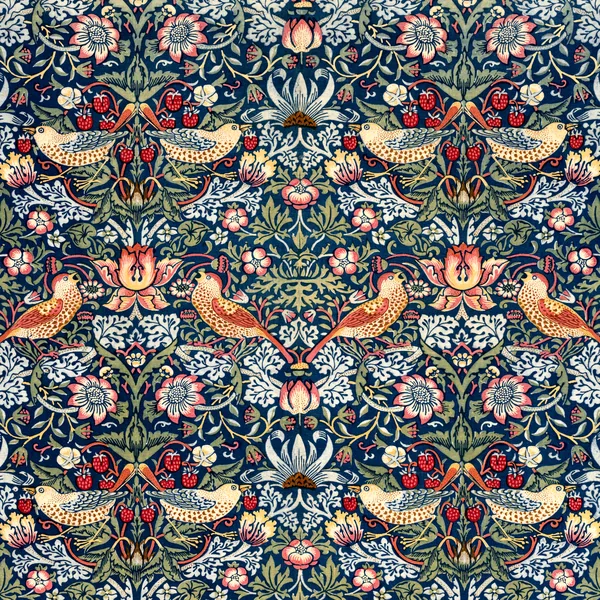
Today, museum archives attribute the manufacturing of the original wallpaper sidewall to Jeffrey & Company, the specialist London firm that printed wallpapers for Morris & Co. You can compare this late design with other firm classics across every William Morris design in our library, including earlier animal and floral favorites such as Strawberry Thief.
How it was made and used
Golden Lily was created as a sidewall wallpaper printed from hand-carved woodblocks. Jeffrey & Company printed the design using multiple woodblocks on paper, applying opaque distemper pigments layer by layer to build up its rich palette. A historic block-printed sample from 1899 is preserved in the Cooper Hewitt, Smithsonian Design Museum in New York.
The wallpaper was engineered on a half-drop repeat, estimated at roughly 9.6 by 15.8 inches. In this configuration, each adjacent vertical strip shifts down by half a repeat length. This alignment prevents visible horizontal bands and allows the winding lily stems to flow continuously across large wall expanses.
Colourways
On this site, the design is presented in the Blue on Tan colourway. This colourway comes directly from the 1899 Cooper Hewitt museum scan. The palette combines soft blue lily heads, olive-green foliage, red buds, and ochre-yellow blossoms set over a dark blue background with light cream under-leaf accents. The museum record describes the printing as green, red, blue, and yellow on a cream ground, showing the range of tones within the original block-printed document.
Golden Lily as a print
Golden Lily is available as fine art prints printed and shipped by ArtsyWall. You can choose from three formats: Archival Paper, Premium Canvas, and Framed Canvas. If you are looking for roll wallcoverings instead of individual art prints, you can find peel-and-stick wallpaper through our sister site.
As a framed print, Golden Lily works well as a focal point. Archival Paper highlights the fine dots and faint details inside the petals. Premium Canvas wraps the lush floral curves around solid wood bars, while Framed Canvas suspends the artwork inside an elegant floating frame. In any room, the sinuous lily vines and rhythmic curves create a structured, organic presence.
Want Golden Lily on a whole wall? See Golden Lily wallpaper, sized to your wall.
Questions and answers
Who designed Golden Lily?
The designer of Golden Lily is not recorded in the museum records. The pattern was issued by the firm Morris & Co. in 1899 and produced by wallpaper printer Jeffrey & Company. Although often associated with the work of William Morris, the individual artist remains unstated.
When was Golden Lily designed?
Golden Lily was issued in 1899. The firm Morris & Co. introduced the design as a block-printed wallpaper three years after the death of founder William Morris. A surviving 1899 specimen of the sidewall paper is preserved in the collection of the Cooper Hewitt, Smithsonian Design Museum.
What does the Golden Lily pattern show?
The Golden Lily pattern shows large lilies with curving petals alongside foliage arabesques. Stems loop across the field with red lily buds, four-petaled yellow blooms, small sprigs, and faint patterns within the lily petals. The elements interlock over a dotted background to produce a dense, flowing floral field.
Was Golden Lily a wallpaper or a fabric?
Golden Lily was produced as a wallpaper. The firm Morris & Co. issued it in 1899 as a block-printed sidewall paper on paper, manufactured by Jeffrey & Company. On this site, the design is offered as fine art prints and downloadable seamless digital pattern tiles.