Wreath by William Morris
Wreath by William Morris is an 1876 wallpaper pattern featuring curling foliage and ruffled floral blooms. Designed for Morris & Company, the pattern pairs bold botanical leaves with delicate pink, blue, and white flowers.
| Designed | 1876 |
|---|---|
| Designer | William Morris |
| Type | wallpaper |
| Motifs | flowers, leaves |
| Colourway | Black on Ivory |
| Repeat | not measured |
| Source | Other, via Wikimedia Commons. Licence: Public domain (Wikimedia Commons). Museum record |
Order Wreath as a print
Format
Size (inches)
$40
Made to order. Shipping included in the US.
Seamless pattern file
A repeat tile of this design, ready to fill any size in design software.
What Wreath shows
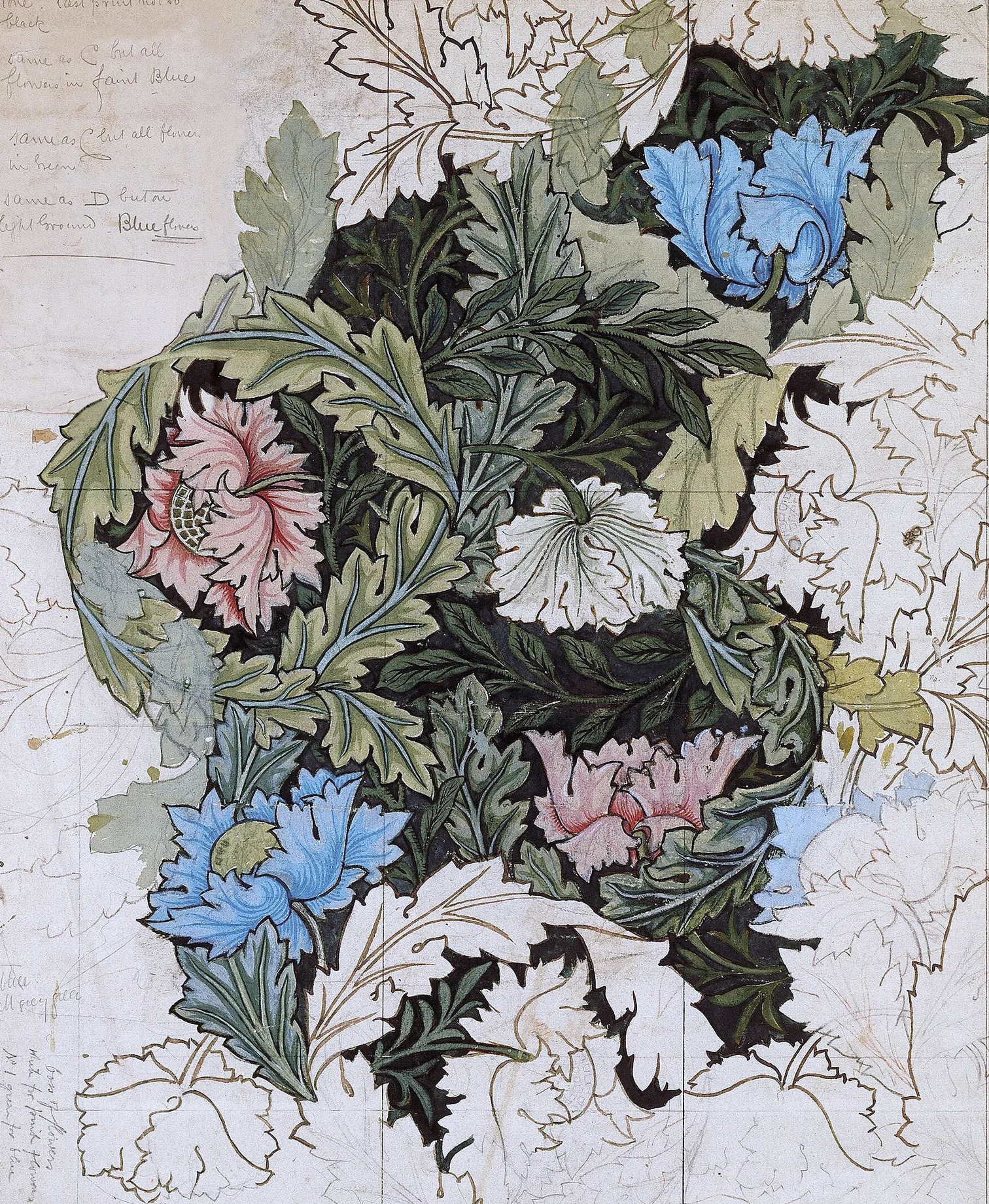
Wreath by William Morris is an 1876 wallpaper design centered on dense foliage and large, ruffled flowers. The pattern arranges curving leaves and layered blossoms into an interlocking botanical structure that Morris designed for interior walls.
The composition displays large flowers that resemble ruffled poppies or peonies. These blooms appear in three distinct color treatments: soft rose pink, bright sky blue, and white. The pink and blue flowers reveal pale yellow and green centers with fine petal striations. Thick stems connect the blooms, weaving them through clusters of jagged, acanthus-like leaves that turn and twist across the space.
In the center of the design, dark forest green leaves overlap on a solid black ground, creating strong contrast. Lighter sage green leaves curl around the outer edges, framing the darker focal points. Across the right side of the sheet, uncolored pencil outlines reveal the underlying drawing structure, showing how the leaves and flower petals continue into the adjoining repeat. Marginal handwritten pencil notes record instructions for variant color combinations.
Who designed it and when
William Morris designed Wreath in 1876. The design records attribute the pattern to Morris, while the museum page for the drawing at the Art Gallery of South Australia credits the artist line to Morris & Company, London. Where the museum record and the design record differ, the sources reflect the joint identity of Morris as an individual designer and the workshop he led.
Morris established his decorative firm in 1861 and directed its pattern output for decades. You can read about his life and artistic practice in our guide to William Morris and his work. While later patterns such as Strawberry Thief introduced birds and woodland creatures into the foliage, Wreath concentrates strictly on flowers and leaves. You can browse every William Morris design in our library, where patterns are cataloged by their original designer, including William Morris, John Henry Dearle, May Morris, and Kate Faulkner.
How it was made and used
Wreath was created as a wallpaper design. The primary surviving artifact of the pattern is a design drawing preserved in the collection of the Art Gallery of South Australia under accession number 20032D1. This original work was produced circa 1876 using gouache and pencil on paper, with dimensions of 75 millimeters high by 50.80 millimeters wide.
The drawing documents the working method of the Morris studio. Morris painted portions of the pattern in opaque gouache while leaving surrounding areas as pencil outlines on plain paper. This technique allowed the designer to test color harmonies and ensure that the repeating motifs would align smoothly when joined edge to edge. The finished wallpaper was used to decorate interior walls, giving living spaces an ordered botanical pattern of scrolling greenery and prominent blossoms.
Colourways
On this site, Wreath is available in one colourway: Black on Ivory. This label is our own descriptive name based on the museum scan rather than a historical Morris & Company trade title. The colourway captures the authentic appearance of the circa 1876 drawing in the Art Gallery of South Australia, which is reproduced from a public domain scan.
The Black on Ivory colourway pairs a light ivory ground with a dark, near-black core beneath the foliage. Ruffled flowers in rose pink, sky blue, and white stand out clearly against the deep center. Surrounding leaves range from soft sage green to rich forest green, accented by visible pencil lines and handwritten notes from the original drawing sheet.
Wreath as a print
Prints of Wreath are printed and shipped by ArtsyWall in three formats: Archival Paper, Premium Canvas, and Framed Canvas. The Archival Paper format uses 340gsm, 100% cotton rag paper with a textured watercolor surface that highlights the delicate gouache brushstrokes and graphite pencil notes. It ships unframed, rolled in a protective tube.
Premium Canvas uses acid-free canvas hand-stretched over solid wood bars with an attached sawtooth hanger. Framed Canvas places the canvas inside a wood floating frame, leaving a small perimeter gap so the artwork appears suspended. You can select from six wood frame finishes: black, white, gold, silver, walnut, and oak. When framed on your wall, Wreath presents an attractive contrast between dark botanical density and soft, colorful blossoms.
Want Wreath on a whole wall? See Wreath wallpaper, sized to your wall.
Questions and answers
Who designed Wreath?
William Morris designed Wreath for his firm, Morris & Company. While the original museum drawing from the Art Gallery of South Australia lists Morris & Company as the artist, the pattern is credited to Morris himself. You can view Wreath alongside patterns created by Morris, John Henry Dearle, May Morris, and Kate Faulkner in the catalog of historic patterns.
When was Wreath designed?
William Morris designed the Wreath pattern in 1876. The surviving gouache and pencil drawing preserved in the Art Gallery of South Australia carries a date of circa 1876. This places the design in a productive decade for Morris & Company, during which the workshop created many classic botanical wallpapers and textiles for Victorian home interiors across Britain.
What does the Wreath pattern show?
The Wreath pattern shows large ruffled blossoms intertwined with dense foliage, curling acanthus leaves, and slender stems. The flowers include pale pink, sky blue, and white petals arranged across layers of light sage and dark forest green leaves. Dark background areas set off the twisting botanical shapes, while fine pencil lines show where the design draft repeats.
Was Wreath a wallpaper or a fabric?
Wreath was created as a wallpaper pattern rather than a woven or printed textile. The surviving historical artwork in the Art Gallery of South Australia is an original design drawing executed in gouache and pencil on paper. The firm classified the finished repeat pattern as a wallpaper design intended for interior wall decoration in nineteenth-century residential rooms.