Windrush by William Morris
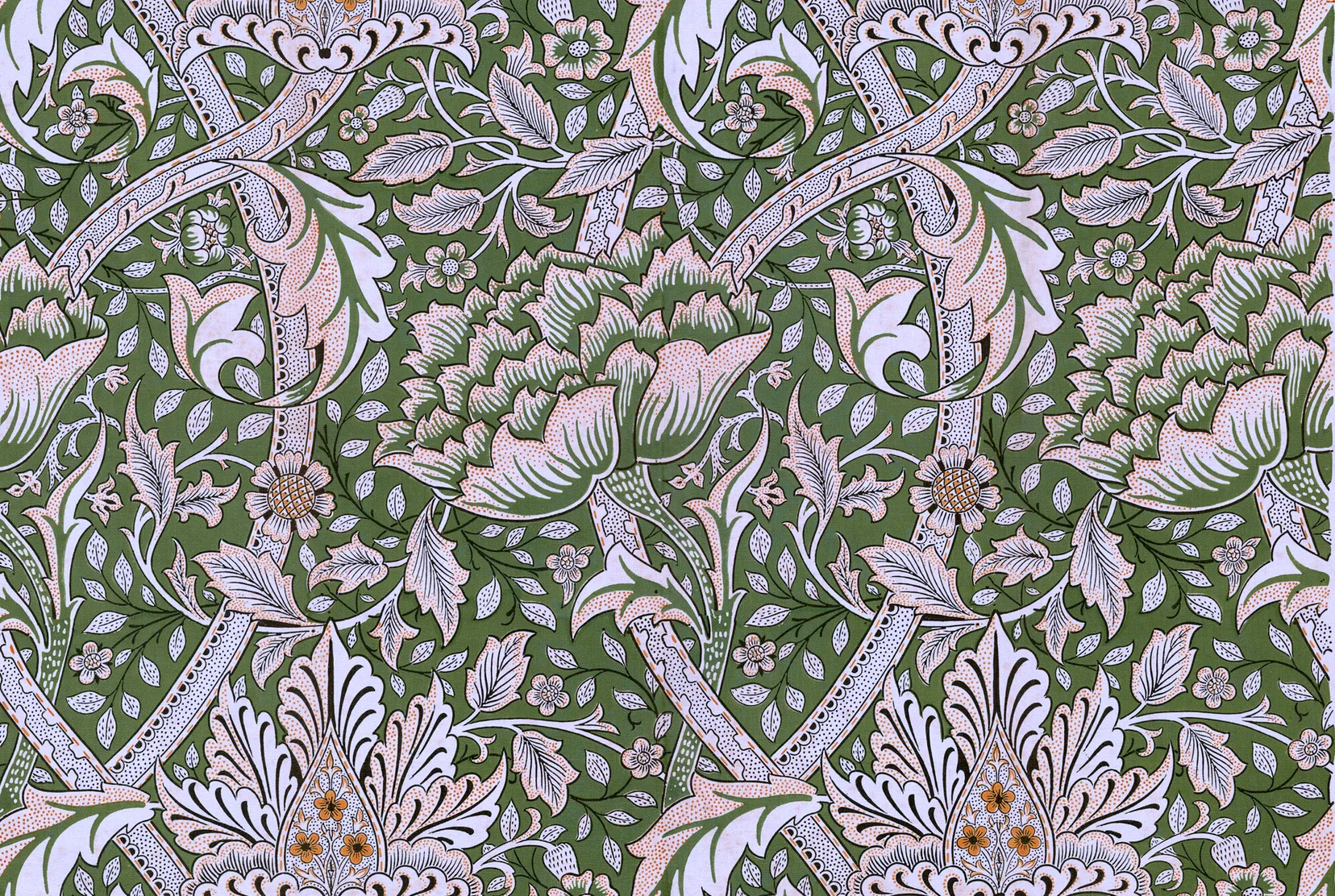
Windrush by William Morris is an 1883 textile pattern defined by large, cupped floral blooms, swirling foliage, and pale climbing diagonal ribbons on a rich dark green ground.
| Designed | 1883 |
|---|---|
| Designer | William Morris |
| Type | textile |
| Motifs | flowers, leaves |
| Colourway | Green |
| Repeat | not measured |
| Source | Art Institute Chicago. Licence: CC0. Museum record |
Order Windrush as a print
Format
Size (inches)
$40
Made to order. Shipping included in the US.
Seamless pattern file
A repeat tile of this design, ready to fill any size in design software.
What Windrush shows
Windrush by William Morris is a bold botanical textile pattern from 1883 dominated by large, scalloped blossoms and sweeping foliage. The composition centers on generous, cup-shaped flowers with layered petals that open upward across the surface. Pale stems and curved leafy ribbons weave diagonally through the design, creating a strong sense of diagonal motion.
Beneath the primary blooms, pointed acanthus leaves curl inward, showing serrated edges and fine vein markings. In the lower sections, palmette-like leaf clusters flare outward in symmetrical sprays, flanked by tiny rosettes. Dotted bands travel upward through the foliage, acting as structural ribbons that guide the eye between repeats.
The background of the design is a deep green, densely covered with miniature sprigs, small five-lobed flowers, and finely drawn leaflets. White and cream highlights give the petals crisp contours, while soft peach shading adds depth to the flower centers and dotted bands. Morris filled almost every square inch, balancing heavy central blooms with delicate secondary flora.
Who designed it and when
William Morris designed Windrush in 1883. It belongs to the prolific period of textile creation that defined his middle career, alongside famous patterns such as the Strawberry Thief printed chintz from that same year. Morris was deeply engaged in botanical drafting during the early 1880s, producing patterns based on native English plants as well as stylized historic ornament.
While many textiles issued by Morris & Co. were designed by his assistant John Henry Dearle, museum archives attribute Windrush directly to Morris. You can learn more about his background and philosophy in our guide to William Morris. The pattern represents his mature style, where botanical observation combined with geometric discipline to create a balanced repeat. You can explore the full range of textiles and wallpapers in our catalog of every William Morris design.
How it was made and used
Morris created Windrush as a textile. Unlike wallpapers that required block printing onto paper rolls, textiles at Morris & Co. were printed onto woven cloth such as cotton chintz or linen. The printing process required hand-carved woodblocks, with a separate block cut for each distinct color in the pattern. The blocks were pressed onto the fabric by hand to align the repeat seamlessly.
The design was intended for interior furnishings, including drapery panels, upholstery, and loose covers. The flowing diagonal rhythm and dense background made it practical for fabric, because folding or draping did not break the visual flow of the ornament. Museum records at the Art Institute of Chicago show that production of Windrush continued well into the twentieth century, with surviving examples printed between 1917 and 1925.
Colourways
On this site, Windrush is presented in its classic Green colourway. This colourway features a dark forest green ground that provides rich contrast for the lighter plant motifs. The leaves and stems are rendered in shades of olive green, off-white, and pale cream, while subtle terracotta stippling highlights the interiors of the ribbons and petal margins.
The dark ground allows the pale blossoms and ribbon structures to stand out clearly across the repeat. Because the design incorporates fine dots and delicate outline work, the contrasting tones ensure that small secondary flowers remain legible alongside the large foreground blooms.
Windrush as a print
Windrush is offered as an art print in three formats, printed and shipped by ArtsyWall: Archival Paper, Premium Canvas, and Framed Canvas. On textured Archival Paper, the fine stippling and delicate line work of the original block-printed textile read with crisp precision. On Premium Canvas or Framed Canvas, the rich green ground and sweeping floral forms give the impression of a classic decorative fabric panel.
Framed Canvas choices include floating wood frames in black, white, gold, silver, walnut, and oak. In a dark walnut or oak frame, the earthy green ground feels grounded and traditional. In a clean white or black floating frame, the crisp white contours of the petals and ribbons stand out, making Windrush a striking focal point on any wall.
Want Windrush on a whole wall? See Windrush wallpaper, sized to your wall.
Questions and answers
Who designed Windrush?
William Morris designed Windrush in 1883 as a textile pattern for his decorative arts firm. Although some Morris & Co. patterns from the late nineteenth century were drafted by colleagues like John Henry Dearle, museum records from the Art Institute of Chicago confirm that Windrush was designed directly by William Morris himself.
When was Windrush designed?
Windrush was designed in 1883 by William Morris. The original design dates to that year, although surviving fabric examples held in museum collections, such as the printed textile at the Art Institute of Chicago, include pieces printed between 1917 and 1925. The pattern remains in the public domain today.
What does the Windrush pattern show?
The Windrush pattern shows a dense arrangement of flowering stems, curling acanthus leaves, and prominent multi-petaled blossoms. Curved diagonal bands filled with delicate dot patterns run through the composition. Smaller five-petaled florets, pointed leaf sprays, and fine foliage fill every open space across the dark green ground.
Was Windrush a wallpaper or a fabric?
Windrush was produced as a textile rather than a wallpaper design. Historical records and museum collections classify it as a printed fabric featuring complex botanical repeats. The design was produced on fabric lengths for curtains, upholstery, and loose furnishings, rather than being printed on rolls of paper for walls.